



Recent legislation changes: Recent legislation will require Ontario medical schools to reserve 95% of seats for Ontario residents and 5% of seats for other Canadians. Starting in 2026, non-Canadian candidates have virtually a 0% chance of acceptance in Ontario med schools.
Recent accreditation changes: U.S. applicants are now considered international medical students in Canada. Before July 2025, the U.S. and Canada used the same accreditation process through the LCME, allowing for easier med school application across the border.
If you’re applying via OMSAS, keep reading for an in-depth look at which Ontario schools are the best, when you need to apply, and how you can better prepare yourself for success on the OMSAS.
Download Our Ontario Medical School Guidebook
- Requirements for Every School
- OMSAS Application System
- Autobiographical Sketch
The 8 Medical Schools in Ontario
Check out the 8 Ontario medical schools, which require applicants to fill out the OMSAS. Use the table before for a quick overview, or scroll down to learn even more about each institution.
| School Name | Average GPA | Average MCAT | Interview Format | Casper Required? | Acceptance Rate |
|---|---|---|---|---|---|
| McMaster University | 3.9 | 129.2 CARS, other sections not provided | vMMI | Yes | 3.7% |
| North Ontario University | 3.76 | Not provided | MMI and traditional panel | Yes | 5.3% |
| University of Ottawa | 3.93 | MCAT score not required for admission | Traditional panel | Yes | 3.5% |
| Queen's University | 3.78 | 514 | MMI and traditional panel | Yes | 2.8% |
| University of Toronto | 3.95 | Not provided | vMPI | Yes | 6.4% |
| Toronto Metropolitan University (first class FA2025) | N/A | MCAT score not required for admission | N/A | No | N/A |
| Western University | 3.89 | 28-129 per section (Psych/Soc scores not provided) | Virtual panel | No | 7.1% |
| York University (first class FA2026) | N/A | N/A | N/A | N/A | N/A |
1. McMaster University
The Michael G. DeGroote School of Medicine at McMaster University runs a 3-year MD program with training 11 months out of the year. 217 students are admitted each year, and the average undergrad GPA of incoming students is 3.95.
McMaster is home to a world-renowned research institute, which conducts cutting-edge research into new treatments and cures for diseases.
Admission criteria:
- Undergraduate coursework (15 full courses or 30 half courses)
- GPA (minimum 3.0 out of 4.0)
- MCAT (the only requirement is a minimum CARS score of 123)
- Casper (it was developed at McMaster after all)
- 3 confidential assessment forms (CAFs), also called references
- Autobiographical sketch (ABS)
- A virtual MMI-type interview
Special applicant streams include:
- Indigenous students
- Black students
- Canadian military
- MD/PhD
2. North Ontario University
North Ontario School of Medicine (NOSM) at North Ontario University is Canada’s first independent medical university. They run a 4-year MD program with 88 spots. The MCAT and Casper exams are not required for admissions.
NOSM prefers applicants already working or seeking to work with disadvantaged populations in Northern Ontario, including indigenous and francophone communities.
Admission criteria:
- 4-year degree
- English proficiency
- GPA (minimum is 3.0 out of 4.0)
- 3 CAFs
- ABS
- NOSM-specific supplementary questions
- Context score, referring to geographic and cultural aspects of your background
- MMI-type interviews
Special application streams include:
- Indigenous applicants
- Francophones
- Canadian military
- Those with exceptional circumstances
3. University of Ottawa
University of Ottawa’s Faculty of Medicine runs a 4-year MD program with 184 seats each year, roughly 128 English-speaking slots and 56 French-speaking slots. Located in Canada’s capital city, this was the first North American medical school to educate in both official languages.
University of Ottawa does not require completion of the MCAT to apply or to be admitted.
Learn more on their website.
Admission criteria:
- At least 3 years of full-time undergraduate study, including lab coursework
- Proficiency in either English or French
- GPA (minimum is 3.5 out of 4.0)
- Casper
- ABS
- 3 CAFs
- Traditional panel interview
Special application streams include:
- Black students
- Canadian military
- MD/PhD
- Indigenous students
- Non-Ontario/Quebec francophones
- Nunavut-specific applicants
- Low Socioeconomic Status (LSES) Initiative
4. Queen’s University
Queen’s University was founded in 1841 by royal charter from Queen Victoria, and the Queen’s School of Medicine was established only 13 years later. Located on the shores of Lake Ontario, this beautiful campus boasts a 4-year MD program with up to 140 spots each year.
120 of those spots are at their main Kingston campus, but up to 6 of those spots are reserved for Canadian Forces Members through the Military Medical Training Program (MMTP) Pathway. 20 spots are for their Queen’s-Lakeridge Health MD Family Medicine program.
Learn more on their website.
Admission criteria:
- At least 3 years of full-time study
- English proficiency
- GPA (minimum is 3.0 out of 4.0)
- MCAT (2024-2025 minimum was 500 total score)
- Casper
- 3 CAFs
- ABS
- Both MMI (primary) and panel (secondary) interviews
Special application streams include:
- Indigenous students
- Canadian military
- Social Accountability Admissions Pathway (SAAP)
- MD/PhD
- MD/MSc
5. University of Toronto
The Temerty Faculty of Medicine at University of Toronto is the oldest medical school in Ontario, founded in 1843. University of Toronto is home to Canada’s largest medical research hospital, the SickKids Centre for Learning Health.
Located in Canada’s largest city and Ontario’s provincial capital, U of T runs a 4-year MD program with 230 yearly spots at the St. George campus in downtown Toronto and 59 at the Mississauga campus.
Learn more on their website.
Admission criteria:
- Relatively few coursework requirements
- GPA (the minimum is 3.6 out of 4.0, competitive GPA is closer to 3.8)
- MCAT (minimum of 125 in each section, allowing one section score of 124)
- ABS (including an additional ABS statement)
- 3 CAFs
- 2 personal essays
- Interview, either virtual or in-person
Special application streams include:
- Black students
- Indigenous students
- MD/PhD
- Canadian military
6. Toronto Metropolitan University
This brand new school of medicine at Toronto Metropolitan University will welcome its first cohort of 94 medical students in September 2025. It offers a four-year MD program, and due to its accreditation process, its OMSAS application cycle will be slightly different in 2025.
Students will not require the MCAT to apply. They have intentionally refrained from requiring specific coursework so as to attract a diverse range of applicants from varied backgrounds.
Learn more on their website.
Admission criteria:
- 4-year degree
- English proficiency
- GPA (minimum is 3.3 out of 4.0)
- 4 supplementary questions (short essays)
- ABS
- 3 CAFs
- Brampton/Peel Region Connectedness
- Virtual interview, either MMI or traditional panel format
Special application streams include:
- Black students
- Indigenous students
- Equity-deserving students (for individuals who identify as 2SLGBTQ+, who are racialized people, who have a disability, and who have experienced socioeconomic, cultural, poverty-related, or familial barriers)
7. Western University
The Schulich School of Medicine & Dentistry at Western University runs a distributed 4-year program with 187 slots per year, mostly at the main London campus, with a few dozen at the Windsor campus (bordering Detroit).
Learn more on their website.
Admission criteria:
- In at least the third year of a 4-year-degree program
- GPA (Schulich does not publish minimum requirements)
- MCAT (Schulich does not publish minimum requirements)
- 3 CAFs
- Western Abbreviated Autobiographical Sketch (AABS)
- 3-person panel interview
Special application streams include:
- Black students
- Southwestern Ontario high school graduates
- Indigenous students
- Access Pathway (for those that have dealt with challenges of medical, socio-cultural, financial or underrepresented ethnicity)
- Military Medical Training Program (MMTP)
- MD/PhD
- MD + other postgraduate training options. Additionally, Schulich has a maximum of three (3) positions for International applicants.
8. York University
In light of recent legislation promoting homegrown medical education, York University announced plans to open a new school of medicine in Toronto.
They are on track for accreditation in early 2026, probably welcoming their first cohort of MD students in the fall of 2026 or 2027.
Learn more on their website.
Timeline and Key Dates
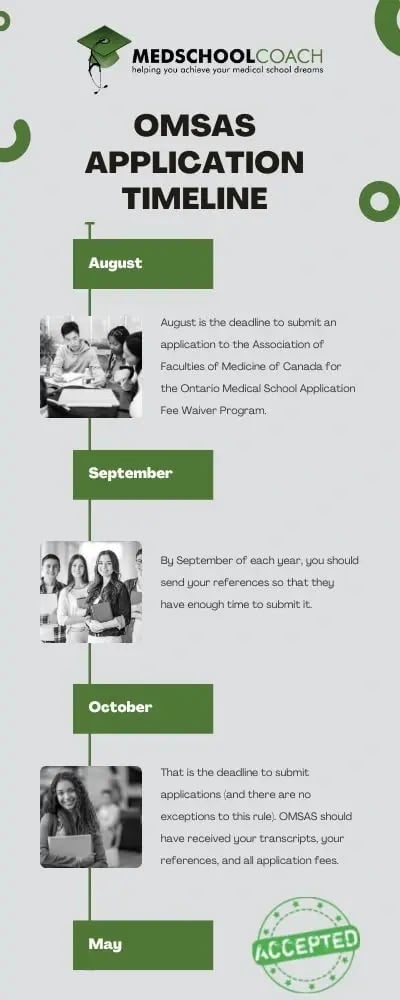
As a pre-medical student, showing that you have the organization skills to get your application ready on time is a must. The exact dates for OMSAS submission can be found on the OUAC website.
Check out this helpful OMSAS timeline:
- May: Start preparing your application. Write drafts of your Autobiographical Sketch and personal essays. Ask potential referees to write reference letters, even though the deadline is months away. Take the MCAT in May so you’re not wondering about your score or pushing up against the deadline in October. You can’t be too prepared.
- Mid-August: Apply for fee reduction to the Association of Faculties of Medicine of Canada for the Ontario Medical School Application Fee Waiver Program. They allow students with financial need to reduce or eliminate application costs.
- Mid-September: OMSAS suggests sending reference letters by the middle of September, but we recommend sending them earlier. The OMSAS includes a Document Tracking page to ensure that all documents are received by their respective deadlines.
- Early October: Submit applications by the OMSAS application deadline (academic document, references, payments). There are no exceptions to this rule. The exact submission deadline is different each year but almost always in early October.
- Late October: Send your MCAT scores into OMSAS. Remember, it can take a few days for OMSAS to receive your scores after the AAMC releases them, so make sure to plan ahead and request MCAT scores to be sent 4-5 days before the deadline.
- January: After applications are reviewed by medical schools, interview invites start to go out around this time.
- May: Ontario medical schools start to send out offers of admissions to accepted candidates.
OMSAS Application Guide
To apply to Ontario medical schools, fill out the Ontario Medical School Application Service (OMSAS). OMSAS application requirements are similar to the requirements of the U.S.-based primary applications (AMCAS, TMDSAS, and AACOMAS).
Need help with your OMSAS application?
Below is our guide on filling out the OMSAS, along with handy tips.
Autobiographical Sketch
The Autobiographical Sketch (ABS) allows applicants to share activities and experiences that contributed to their professional and personal growth, in the following areas:- Employment activities
- Volunteer experiences
- Extracurricular experiences
- Research experiences
- Awards and accomplishments
FREE Guide: Mastering Your Autobiographical Sketch
OMSAS ABS provides AdComs with a more holistic applicant picture than what is possible through transcripts alone. We recommend you take advantage of the allowed extracurricular activities and character count. Familiarize yourself with the CanMEDs framework when filling out ABS entries, as this is the standard by which doctors in Canada are determined to be proficient in patient care.
The major difference between the AMCAS Work and Activities section and the OMSAS Autobiographical Sketch is the amount of space given to describe each activity. While AMCAS allows 700 characters per activity, OMSAS permits just 150 characters.
Overall, you are allowed to include up to 32 items (more than double what the AMCAS allows) in the Autobiographical Sketch section of the application. You’ll also need to include a “verifier” of each of these items. (Note, these are people who can verify you’ve participated, not referees.)
References (Letters of Recommendation)
Medical school letters of recommendation are a vital part of the admissions process, both for med schools in the US and in Canada. OMSAS calls these reference letters Confidential Assessment Forms (CAFs), and your letter writers are called referees.
For OMSAS, you need to obtain and submit 3 letters of recommendation, specifically:
- 1 academic- or employment-related reference
- 1 non-academic reference
- 1 reference of your choosing
OMSAS recommends sending reference requests to your referees no later than September 15th in order to get your required documents in by the deadline in October. We recommend reaching out months in advance and getting the letters turned in by August.
Personal Essays
University of Toronto (Temerty Faculty of medicine) requires two personal essays (separate from the Autobiographical Sketch), each limited to 250 words or fewer. Here are the prompts:
- First, answer this: In what way(s) are you a product of the world around you? How has it, or how will it, impact your journey in medicine?
- Secondly, explore how the following Charlie Munger quote may affect your career in medicine: “We all are learning, modifying, or destroying ideas all the time. Rapid destruction of your ideas when the time is right is one of the most valuable qualities you can acquire. You must force yourself to consider arguments on the other side.”
Check out these successful personal statement examples.
Also, Toronto Metropolitan University requests four “supplementary essays” which are similar to personal essays but should be submitted through TMU’s applicant portal, not through OMSAS.
Excelling on Casper
Most OMSAS applicants must complete the Casper test, but Toronto Metropolitan University and Western University do not require the Casper.
Casper is a holistic virtual exam designed to test a medical school applicant’s communication and interpersonal skills. There is no scientific knowledge on the Casper test; it’s designed to instead test your “soft skills,” such as empathy, teamwork, etc.
While there’s no specific study guide for Casper, you can take practice tests and review the format and example questions to understand what to expect in advance.
Read More In-Depth: Complete Guide to the Casper Exam
Don’t Forget to Prepare for Interviews
After you apply to Ontario medical schools, admissions committees will start sending out interview invitations. If you’re fortunate enough to receive one or more, you will need to do plenty of interview prep to put your best foot forward.
Wear professional clothing, answer confidently but not arrogantly, come with questions for the interviewers, and be the best version of your honest self.
Learn More: Complete Guide to Med School Interviews
OMSAS Application Fee
Each applicant must pay an OMSAS application service fee of $220. Then, you’ll pay specific fees by institution:
- McMaster: $130
- NOSM: $125
- Ottawa: $130
- Queen’s: $130
- Toronto: $130
- TMU: $130
- Western: $125
OMSAS online transcript requests also require fees that must be paid at the time of the request.
If you need help with these costs, you can apply for the Ontario Medical School Application Fee Waiver Program to save an estimated $610.
Considerations for 2027 and Beyond
One piece of legislation and another move from a US accrediting body are majorly changing the application process for Ontario medical schools.
The LCME used to accredit both US and Canada medical schools. As of July 2025, the LCME only accredits U.S. med schools, and CACMS will accredit Canadian med schools. Unlike before this split, U.S. applicants will be considered “international” by Canada schools and vice-versa.
A recent legislation will go into effect in 2026, effectively banning international students (including U.S. applicants) from getting into Ontario medical schools. Ontario will require 95% of seats to go to Ontario residents, with the remaining 5% going to other Canadians.
Also, U.S. students will be considered international medical graduates (IMGs) when applying to Canadian residencies (and vice versa), making the residency application process across the U.S.-Canada border more difficult.
OMSAS Application Consulting & Pricing
Schedule a free consultation with our enrollment team to get help on the OMSAS application! Our physician advisors have admissions experience at Ontario Medical Schools and can help you put together the best possible application.
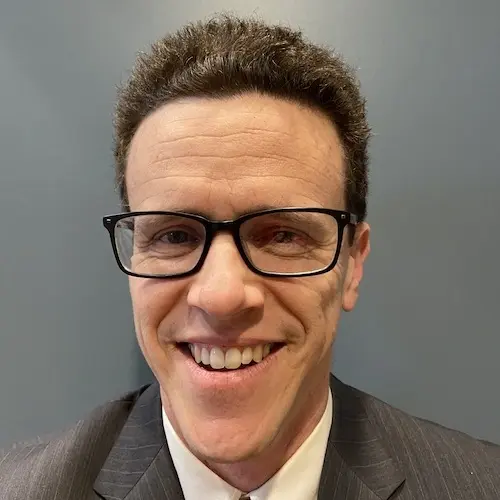 Luke Voytas, MD
Dr. Voytas, a dedicated pediatrician with an passion for nurturing future medical leaders, inspires every student and resident he mentors to reach their fullest potential. Leveraging his rich background in writing, he crafts narrative-driven application essays that uniquely capture each client’s journey and set them apart in the competitive world of medicine.