



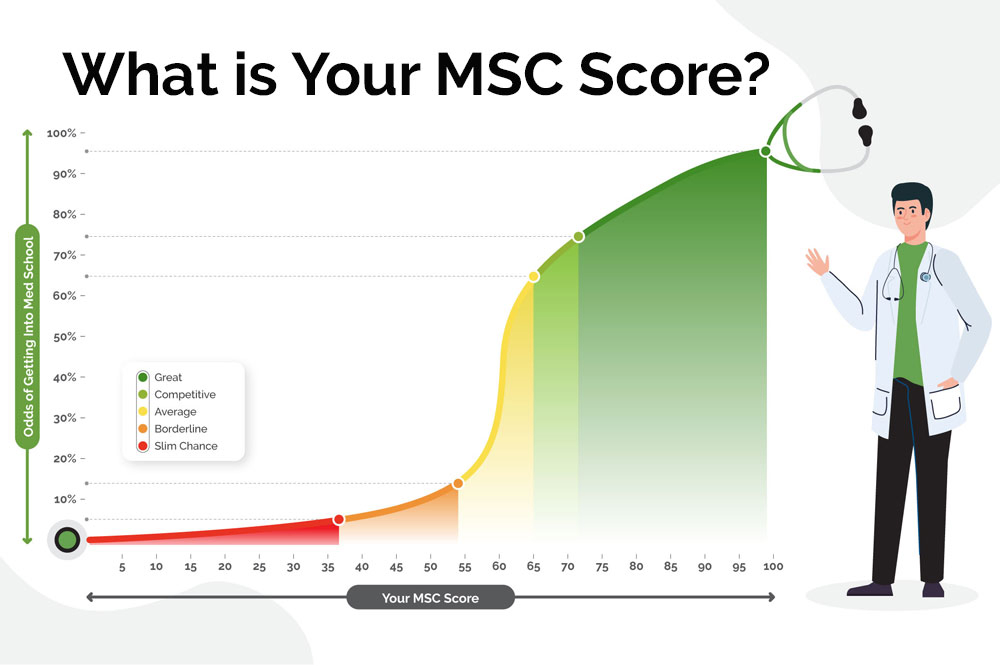
The Med School Competitiveness (MSC) Score is a tool developed by MedSchoolCoach to help pre-med students evaluate the strength of their medical school application. It is based on factors like GPA, MCAT score, clinical experience, shadowing, research, and more.
By comparing your application profile against data from thousands of real medical school applicants, the MSC tool provides a personalized rating from 0-100 to help you understand your competitiveness. It can also help you identify opportunities to strengthen your application.
You can calculate your own score using the free MedSchoolCoach MSC Score Calculator.
How Is My MSC Score Calculated?
Your MSC Score is calculated using a combination of factors that medical schools consider when evaluating applicants. These factors include, but aren’t limited to:
- GPA: Your cumulative and science GPA provide insight into your academic preparation for the rigors of medical school.
- MCAT Score: Your MCAT score is an important indicator of your readiness for a rigorous medical school curriculum, and a low score may mean retaking the exam.
- Clinical Experience: Hands-on clinical experiences in healthcare settings demonstrate your understanding of the medical profession.
- Shadowing Experience: Physician shadowing helps show your exposure to different areas of medicine.
- Research Experience: Research involvement can demonstrate curiosity, critical thinking skills, and engagement with scientific inquiry.
- Leadership Experience: Leadership roles highlight your ability to collaborate, take initiative, and contribute beyond academics.
Outside of these core categories, the algorithm also factors in elements that are harder to quantify. That includes personal life experiences, undergrad school, socioeconomic background, and whether an applicant identifies as part of an underrepresented minority. These holistic measures, paired with the other data, reflect the level of review that actual admissions committees use.
The MSC Score was created using an analysis of more than 50,000 applicant data points from over 15,000 real medical school applications. The algorithm is updated annually to reflect changes in medical school admissions trends and applicant data.
Interpreting Your Score
Your MSC Score provides insight into how your application compares with other medical school applicants. A higher score generally indicates a more competitive application profile. A lower score likely indicates areas of your application profile that need improvement.
Keep in mind that your MSC Score is one measure of competitiveness and does not guarantee acceptance to medical school. Admissions decisions consider your entire application, including your experiences, personal qualities, school list, and interview performance.
|
MSC Score |
What It Means |
|
0-36 |
Acceptance odds are low across the board. This range signals a need for significant improvement to raise your odds of acceptance. |
|
37-54 |
This is a borderline range. Applicants may need to strengthen key areas of their application, such as GPA, clinical experience, or extracurricular involvement, to become more competitive. |
|
55-64 |
This is the average range for successful applicants. Your application is generally competitive, though continued improvement can help you stand out at programs with a lower medical school acceptance rate. |
|
65-71 |
You're a competitive applicant with a strong overall profile. Your academic metrics are likely in line with those of successful applicants. Holistic factors such as your experiences, essays, and school list become increasingly important. |
|
72-100 |
Odds level off near the top. Holistic measures, such as interview performance and personal statement quality, become major differentiators, since many applicants at top medical schools share similar academic profiles. |
Your MSC Score Isn’t Everything
While your MSC Score is a helpful tool for evaluating your medical school competitiveness, it doesn't guarantee admission. Medical schools review med school applications holistically, considering many factors beyond the metrics included in the MSC Score.
Important components of a strong medical school application include:
- Personal Statement: Your personal statement gives admissions committees insight into your motivation for pursuing medicine, your values, and the experiences that shaped you and your career goals.
- Letters of Recommendation: Strong letters from mentors, professors, physicians, and supervisors can provide meaningful insight into your character, abilities, and potential as a future physician.
- Secondary Essays: Thoughtful secondary responses allow you to demonstrate your interest in individual schools and explain how your experiences align with their missions.
- Interview Performance: Interviews give admissions committees the opportunity to evaluate your communication skills, professionalism, and interpersonal abilities.
- Unique Experiences and Background: Meaningful service, extracurriculars, leadership roles, and personal challenges can all help you stand out from other applicants.
Your school list strategy matters, too. Look beyond just the top 10 med schools for your medical school journey. Applying to the right mix of schools based on your academic profile, experiences, mission fit, and goals is the best way to gain admission to a program that’s right for you.
Read Next: How to Choose Where to Apply to Medical School
FAQs
Improving your MSC Score starts with strengthening the factors it measures. Depending on your current profile, that may include raising your GPA, improving your MCAT score with MCAT tutoring, or gaining additional clinical experience.
Since medical school admissions are holistic, you should also focus on developing a well-rounded application beyond your med school competitiveness score.
The MSC Score is designed to estimate your competitiveness using data from thousands of real medical school applicants and current admissions trends. While it can provide valuable insight into your overall application strength, no calculator can accurately predict whether you’ll be accepted to a particular medical school.
Admissions decisions depend on many factors, including your personal statement, letters of recommendation, interview performance, school list, and institutional priorities.
Double Your Odds of Medical School Admission
Your MSC Score is just a starting point. No matter where you land, with personalized guidance from experienced admissions experts, you can create a plan to strengthen your application and improve your chances of acceptance.
Build your application alongside a doctor with admissions experience, and join the 95% of clients who get into medical school.
 Luke Voytas, MD
Dr. Voytas, a dedicated pediatrician with an passion for nurturing future medical leaders, inspires every student and resident he mentors to reach their fullest potential. Leveraging his rich background in writing, he crafts narrative-driven application essays that uniquely capture each client’s journey and set them apart in the competitive world of medicine.