



There isn’t one universally “least stressful” medical specialty. Burnout, work-life balance, call schedules, patient acuity, and control over your time vary considerably by specialty and often by practice setting within the same specialty.
When I talk with medical students preparing for the Match, I tell them not to judge a specialty by salary or one good rotation alone. The schedule you’ll keep as an attending, how often you’re on call, the kinds of patients you’ll treat, and how much control you have over your workday can have just as much impact on whether a specialty is sustainable for you.
For this guide, I considered several factors when comparing medical specialties:
- Burnout rates: How frequently do physicians in the specialty report burnout?
- Schedule and call: Can you count on a standard 9-5? What are the on-call expectations?
- Patient acuity and emotional load: How often are physicians managing emergencies, life-threatening illness, or emotionally difficult cases?
- Work-life balance: How many hours do physicians typically work, how predictable is the schedule, and how much control do they have over time off.
It’s also important to separate low burnout from good work-life balance. A specialty can have predictable hours and still come with significant administrative or emotional strain, while another may involve longer hours but higher physician satisfaction.
Below, I’ll compare the medical specialties that currently offer some of the strongest combinations of lower burnout and sustainable work-life balance, along with the tradeoffs to deciding which residency programs to apply to.
Our Physician Advisors match 99% of US clients and 88% of IMG clients into residency.
What Is the Least Stressful Medical Specialty?
Infectious diseases had the lowest physician burnout rate in the AMA’s 2025 physician data, at 23.3%, but there isn’t one objectively “least stressful” medical specialty. Six specialties had particularly low burnout rates, while five—nephrology, dermatology, infectious diseases, ophthalmology, and psychiatry—also appeared among the specialties with the lowest intent to leave.
| Specialty | Physicians Reporting Burnout | Intent to Leave Current Organization | Schedule & Work Style | Key Tradeoff |
| Infectious diseases | 23.3% | 24.5% | Mix of outpatient and inpatient practice | Overnight/weekend call may be required |
| Ophthalmology | 25.8% | 27.0% | Structured outpatient and procedural schedule | High-volume, precision-intensive work |
| Pathology | 28.3% | Not reported | Generally predictable schedule | Limited direct patient interaction |
| Nephrology | 29.3% | 17.6% | Mix of clinic, hospital consults, and dialysis care | Substantial call possible |
| Dermatology | 31.5% | 20.5% | Predictable outpatient schedule | Highly competitive Match |
| Psychiatry | 31.6% | 27.2% | Flexible practice models | High emotional load |
| Pulmonary disease | Not reported | 25.3% | Outpatient flexibility; schedule varies with inpatient/ICU work | Critical care can mean nights, weekends, and call |
| Pediatrics | 39.7% | 26.0% | Wide range of practice settings | Burnout remains notable |
| Orthopaedic surgery | Not reported | 27.8% | Mix of clinic and operating-room days | Demanding hours and call |
| Hospital medicine | 38.6% | 29.3% | Shift-based schedule with block s of time off | Long, intense workdays |
| All physicians | 41.9% | 31.1% | — | — |
Burnout isn’t the same as work-life balance. The AMA defines burnout as experiencing at least one symptom of burnout, while intent to leave reflects physicians who reported being moderately, likely, or definitely likely to leave their current organization within two years. Schedule, call responsibilities, patient acuity, and autonomy can still vary considerably within the same specialty.
WEBINAR: Exploring Medical Specialties – What to Think About and What it Takes
1. Infectious Diseases
Physician Burnout Rate: 23.3%
Intent to Leave Current Organization: 24.5%
Schedule Expectations: Varies by practice setting; may include outpatient clinic hours, hospital coverage, overnight call, and weekends.
Patient Needs: A mix of acute, complex, and chronic conditions in both inpatient and outpatient settings
Infectious diseases physicians reported the lowest burnout rate of any specialty in the AMA’s 2025 physician data. They also had one of the lowest rates of intent to leave their current organization.
That doesn’t necessarily mean infectious diseases offers an easy 9-to-5 schedule. Depending on where you practice, you might split your time between outpatient care and hospital consults and take overnight or weekend call. However, the specialty also offers considerable variety, with opportunities to work in clinical care, public health, research, education, and administration. That flexibility may make it easier to shape your career around the type of work and schedule you find sustainable.
2. Ophthalmology
Physician Burnout Rate: 25.8%
Intent to Leave Current Organization: 27%
Schedule Expectations: Often a mix of scheduled outpatient visits and procedures or surgery; call vary by practice setting
Patient Needs: Primarily scheduled eye care, with some urgent or sight-threatening conditions
Ophthalmologists reported the second lowest burnout rate in the AMA’s 2025 physician data. They also had one of the lowest rates of intent to leave their current organization.
Ophthalmology can offer a relatively structured schedule, particularly in outpatient practice. However, that doesn’t mean that the work itself is low-pressure. Ophthalmologists may see a high volume of patients, and eye surgery requires considerable precision because even a small error can have serious consequences for a patient's vision.
Practice setting also makes a difference. Some ophthalmologists have significant control over their clinic and surgery schedules, which can make it easier to protect time outside of work.
3. Pathology
Physician Burnout Rate: 28.3%
Intent to Leave Current Organization: Not reported in the AMA’s published list of specialties with the lowest intent to leave
Schedule Expectations: Often more predictable than acute-care specialties, though evening and weekend coverage may sometimes be required
Patient Needs: Primarily diagnostic work with limited direct patient interaction
Pathologists reported the third-lowest burnout rate in the AMA’s 2025 physician data. While pathology wasn’t included among the AMA’s 10 specialties with the lowest intent to leave, its relatively low burnout rate makes it worth considering if work-life balance is one of your priorities.
Pathology can offer more schedule flexibility than many acute-care specialties. One pathologist profiled by the AMA reported working about 40–50 hours per week, with occasional evening and weekend coverage for emergency surgical cases. However, fewer patient-facing responsibilities don’t mean lower stakes. Pathologists make diagnoses that can directly determine a patient’s treatment, including whether a tumor is cancerous and what therapies may be appropriate.
The main tradeoff is limited direct patient interaction in exchange for a generally more predictable schedule.
4. Nephrology
Physician Burnout Rate: 29.3%
Intent to Leave Current Organization: 17.6%
Schedule Expectations: Hours vary; private practice offers standard office hours while nephrologists in hospital settings may work evening/weekend hours and/or frequently be on call
Patient Needs: Primarily patients with chronic or complex kidney conditions, with some critically ill patients requiring inpatient care or dialysis
Nephrologists reported a 29.3% burnout rate in the AMA’s 2025 physician data, one of the lowest rates among the specialties surveyed. Even more notably, just 17.6% reported an intention to leave their current organization within two years, which is the lowest of any specialty highlighted by the AMA.
However, nephrology isn’t necessarily a low-hours specialty. Nephrologists may split their time between outpatient visits, hospital consults, and dialysis care, and some positions include substantial call responsibilities. Practice setting can make a major difference in what your schedule looks like.
The tradeoff is that nephrology’s low burnout and strong retention numbers can still come with substantial hospital and call responsibilities.
5. Dermatology
Physician Burnout Rate: 31.5%
Intent to Leave Current Organization: 20.5%
Schedule Expectations: Primarily outpatient, with generally predictable hours; inpatient consults and call may be part of some roles
Patient Needs: Mostly scheduled outpatient care, including chronic skin conditions, skin cancer, procedures, and cosmetic concerns
Dermatologists reported a 31.5% burnout rate in the AMA’s 2025 physician data, placing the specialty among those with the lowest rates of burnout. It also has the second-lowest percentage highlighted by the AMA for intent to leave.
Dermatology is largely outpatient-based, which can make schedules more predictable than in specialties built around emergency or inpatient care. However, a more controlled schedule doesn’t necessarily mean a relaxed workday. Dermatologists may see high patient volumes while balancing medical diagnoses, procedures, skin cancer detection, and other complex care.
Dermatology can offer a strong combination of lower burnout and schedule predictability, but the major tradeoff is getting there: dermatology remains a highly competitive specialty to match into.
6. Psychiatry
Physician Burnout: 31.6%
Intent to Leave Current Organization: 27.2%
Resident Burnout Rate: 26.9%
Schedule Expectations: Highly variable by practice setting; outpatient phyciatry mya offer more predictable hours, while inpatient, emergency, and addiction psychiatry can involve nights or longer shifts
Patient Needs: Primarily patients managing mental health, behavioral, or substance use conditions, including both ongoing care and acute crises
Psychiatrists reported a relatively low burnout rate in the AMA’s 2025 physician data, along with one of the lowest rates of intent to leave their current organization. Psychiatry also stood out for broader well-being: 83% of psychiatrists reported job satisfaction, while 30.5% reported significant job stress.
Resident data points in the same direction. In the AMA’s 2025 resident and fellow survey, 26.9% of psychiatry trainees reported burnout, while 91.8% reported being satisfied with their training programs.
Psychiatry can also offer considerable flexibility in how you practice, including outpatient, inpatient, academic, and subspecialty roles. However, a flexible schedule doesn’t make the work emotionally easy. Psychiatrists routinely care for patients experiencing serious mental illness, addiction, suicidality, and other crises, so maintaining strong emotional boundaries is an important part of making the career sustainable.
7. Pulmonary Disease
Physician Burnout Rate: Not reported in the AMA’s published list of specialties with the lowest burnout
Intent to Leave Current Organization: 25.3%
Schedule Expectations: Varies considerably by practice setting; outpatient pulmonary care may offer regular clinic hours, while inpatient and critical care roles can involve longer shifts, nights, weekends, and call
Patient Needs: A mix of chronic respiratory disease and more acute or complex conditions; physicians who also practice critical care may regularly treat critically ill patients
Pulmonary disease wasn’t among the specialties with the lowest burnout rates in the AMA’s published 2025 data. However, just 25.3% of pulmonary disease physicians reported an intention to leave their current organization within two years, one of the lowest rates of any specialty highlighted by the AMA.
Lifestyle can vary considerably depending on how you practice. Outpatient pulmonology may offer relatively predictable clinic hours, while pulmonary and critical care physicians may split their time between clinic, hospital consults, and intensive care. That can mean longer or less predictable hours during ICU coverage.
So pulmonary disease belongs on this list because of its strong retention data, not because the AMA identified it as a low-burnout specialty.
8. Pediatrics
Physician Burnout Rate: 39.7%
Intent to Leave Current Organization: 26%
Resident Burnout Rate: 33.4%
Schedule Expectations: Highly dependent on practice setting; outpatient pediatrics may offer regular clinic hours, while hospital-based and subspecialty roles can involve nights, weekends, and call
Patient Needs: Infants, children, and adolescents receiving preventive, acute, chronic, or specialized care
Pediatrics wasn’t among the specialties with the lowest physician burnout rates in the AMA’s published 2025 data. However, just 26% of pediatricians reported an intention to leave their current organization within two years.
Training data shows about one-third of pediatric residents and fellows reported burnout, while 88.8% said they were satisfied with their training programs. Lifestyle after residency can also vary substantially depending on how you practice.
Outpatient pediatrics may offer relatively predictable clinic hours, while pediatric hospital medicine and some subspecialties can require nights, weekends, or call. Pediatrics offers a wide range of practice settings, but the job you eventually choose may matter just as much as the specialty itself when it comes to work-life balance.
9. Orthopaedic Surgery
Physician Burnout Rate: Not reported in the AMA’s published list of specialties with the lowest burnout
Intent to Leave Current Organization: 27.8%
Schedule Expectations: Often divided between clinic and operating-room days; hours can increase considerably with call responsibilities
Patient Needs: Patients with acute injuries, chronic musculoskeletal conditions, and mobility or function problems that may require surgical treatment
Orthopaedic surgery isn’t typically considered a low-stress specialty, but its physician-retention data is notable. Just 27.8% of orthopaedic surgeons reported an intention to leave their current organization within two years, placing the specialty among the 10 lowest rates reported by the AMA.
That doesn’t necessarily translate to an easy schedule. One orthopaedic surgeon profiled by the AMA reported working 45–50 hours per week between clinic and the operating room, with longer weeks when on call. Surgery also comes with high-stakes decision-making and significant responsibility for patient outcomes.
That low intent-to-leave rate is a useful retention signal, but it isn’t evidence that orthopaedic surgery is low stress. That specialty still comes with demanding hours, call responsibilities, and a high-stakes surgical workload.
10. Hospital Medicine
Physician Burnout Rate: 38.6%
Intent to Leave Current Organization: 29.3%
Schedule Expectations: Often shift-based, with long workdays balanced by blocks of time off; nights, weekends, and holidays may be required
Patient Needs: Hospitalized patients with acute, complex, and sometimes life-threatening conditions
Hospital medicine isn’t necessarily a low-hours or low-stress specialty, but its physician-retention data still places it among the 10 lowest rates reported.
Hospitalists often work long shifts while they’re on service. One hospitalist profiled by the AMA described 12-hour shifts and about 15 shifts per month. The tradeoff is that shift-based work can create a clearer separation between work and personal time. When a shift or block of shifts ends, hospitalists may have several days completely free without an outpatient inbox or ongoing patient calls.
That structure can make hospital medicine sustainable despite the intensity of the work, but its relatively low intent-to-leave rate shouldn’t be interpreted to mean hospital medicine itself is low stress.
Learn what each specialty is like from the eyes of current residents. These free videos will introduce you to daily life in each specialty, along with the challenges and rewards of each.
What Contributes to Physician Burnout?
The burnout rates in the specialty comparison above can help you compare fields, but I wouldn’t use them to choose a career on their own. Where and how you practice can have just as much impact on your day-to-day experience as the specialty you choose.
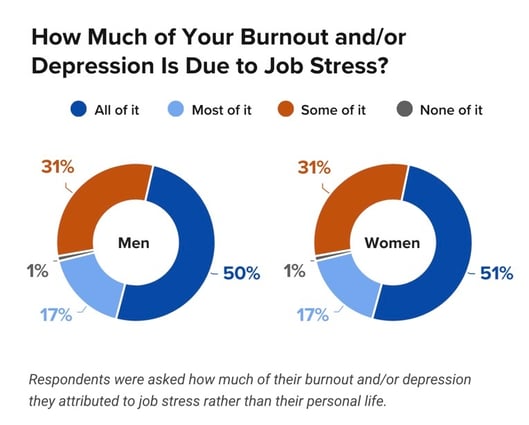
In Medscape’s latest report, roughly two-thirds of physicians who reported burnout and/or depression attributed all or most of it to job stress rather than their personal lives.
SOURCE: Medscape Physician Burnout & Depression Report 2026
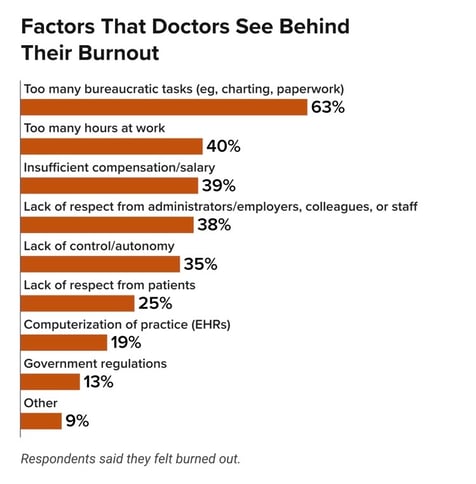
And much of that stress comes from factors that can exist in any specialty. Physicians experiencing burnout most often pointed to bureaucratic tasks such as charting and paperwork.
SOURCE: Medscape Physician Burnout & Depression Report 2026
When you compare specialties, keep in mind that low burnout doesn’t automatically mean high job satisfaction. These measures tell you different things about a specialty, which is why I wouldn’t choose a field based on burnout rate alone.
Look at the burnout rate data alongside the actual working conditions: hours, call, administrative burden, autonomy, and practice setting. Those factors will give you a more useful picture of what your day-to-day career may look like.
Let Us Help You Match with Your Dream Residency Program
Looking for a spot in a competitive residency program like dermatology or plastic surgery? We can help walk you through the process, from determining your ideal specialties to filling out the ERAS, selecting which programs to apply to, and interview prep.
We match 99% of US clients and 88% of IMG clients into residency. Build your application alongside a Physician Advisor with admissions committee experience.
 Jeanie Gribben, MD
Dr. Gribben is a graduate of the Icahn School of Medicine at Mount Sinai and a Merrill Presidential Scholar from Cornell University. She offers tutoring for Steps 1 and 2 and med school coursework, as well as advising support for medical students. She’s dedicated to personalized teaching strategies for student success.