



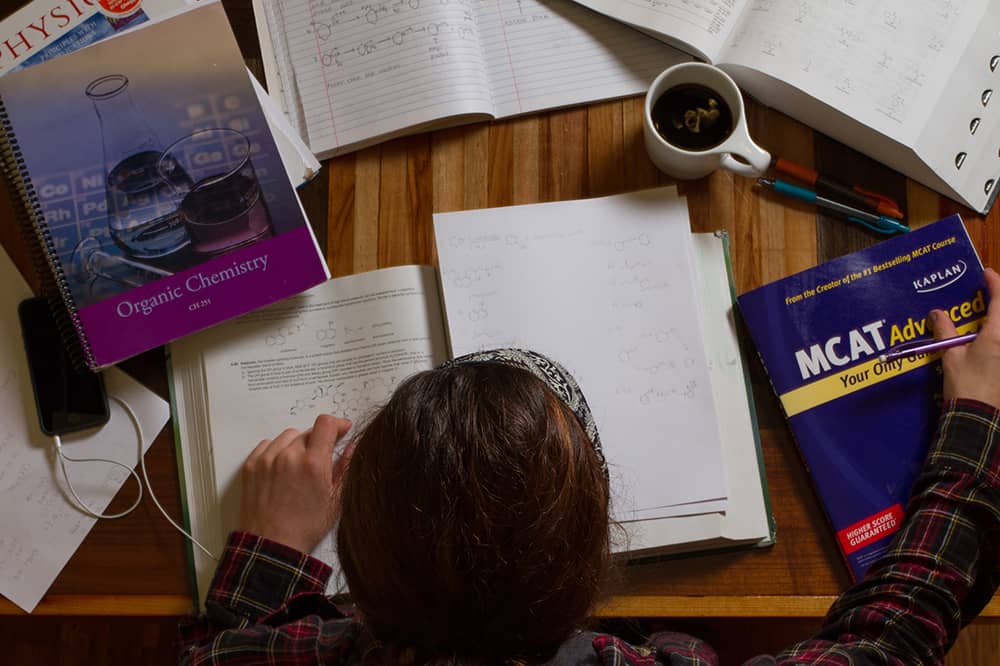
The Medical College Admission Test (MCAT) is a computer-based standardized exam used by most MD- and DO-granting medical schools in the U.S. as part of the admissions process. The MCAT assesses your knowledge of the natural and social sciences and critical thinking skills needed for the practice of medicine.
Most medical schools require an MCAT score to apply, and your score can play an important role in determining where you’re competitive. In 2025, the average MCAT score among applicants to U.S. MD programs was 506.3, while matriculants averaged 512.1.
The Association of American Medical Colleges (AAMC) administers the MCAT on multiple dates from January through September each year. The current version of the exam was introduced in 2015 and includes four sections covering chemical and physical sciences, critical analysis and reasoning, biological and biochemical sciences, and psychological and social sciences.
In this guide, I’ll walk you through what you need to know about the MCAT, including test dates and registration, scoring, how to build your study plan, useful MCAT resources, and what to expect on test day.
Get a Guaranteed Score Increase when you sign up for Silver, Gold, or Platinum MCAT tutoring.
Eligibility Requirements
You’re eligible to take the MCAT if you plan to apply to a health professions program that accepts MCAT scores. When you register, you’ll be asked to confirm that you intend to apply to an eligible program.
Most traditional med school applicants take the MCAT, although some students in BS/MD, BS/DO, or early assurance programs may not be required to take it, depending on the program.
If you’re an international examinee, you don’t have additional MCAT eligibility requirements. Also, if you’re currently enrolled in or have graduated from an MBBS program or equivalent, you can register without requesting special permission.
It’s important to complete the following classes before you take the MCAT so you are familiar with the material. If you haven’t completed the following classes before studying for the MCAT, your study period should be long enough to accommodate learning new material.
- 2 semesters of general biological sciences
- 2 semesters of general chemistry with lab
- 2 semester of organic chemistry with lab
- 2 semesters of physics with lab
- 1 semester of biochemistry
- 1 semester of introductory psychology
- 1 semester of introductory sociology
What Does the MCAT Actually Test?
The MCAT tests your knowledge of the sciences, as well as your critical thinking skills, through multiple-choice questions, the majority of which come after a passage you must read and comprehend. Each section of the MCAT covers different concepts, but there is significant overlap.
There are 4 sections of the MCAT:
- Section 1: Chemical and Physical Foundations of Biological Systems (Chem/Phys) — This 95-minute section covers general chemistry, physics, biochemistry, organic chemistry, and biology.
- Section 2: Critical Analysis and Reasoning Skills (CARS) — This 90-minute passage-based section of the MCAT does not test science concepts. Instead, the CARS section requires students to read passages covering various humanities and social studies topics and then answer questions that test pre-medical students’ critical thinking, problem-solving, and understanding of each passage.
- Section 3: Biological and Biochemical Foundations of Living Systems (Bio/Biochem) — This 95-minute section covers primarily biology and biochemistry, with a little general and organic chemistry thrown in.
- Section 4: Psychological, Social, and Biological Foundations of Behavior (Psych/Soc) – This 95-minute section covers psychology, sociology, and a bit of biology.
When to Take the Exam
You should take the MCAT as early as you feel prepared to take it during your application cycle. Take plenty of practice MCAT exams, and when you consistently get a score that would make you competitive to get into your top choice school, you’re ready.
If you plan to apply to medical school early in the application cycle, I generally recommend taking the MCAT by late May of the year you submit your primary application. MCAT scores are typically released 30–35 days after your test date, so testing by late May can help you have your score available early in the cycle. Individual medical schools set their own MCAT deadlines, however, so always check the requirements for the programs on your school list.
You may take this exam as early as the summer after sophomore year, assuming you’ve taken the recommended prerequisites, but many students wait to take it until the spring of junior year, senior year, or during gap years prior to applying.
The AAMC offers MCAT test dates from January through September each year. For the 2027 testing year, registration for all January through September test dates opens October 20–22, 2026, depending on testing-center region.
Seats fill up quickly, so choose your MCAT test date early. Registering 1-2 months in advance may not be early enough to get the MCAT test date and testing center location you initially hoped for.
Some students benefit from taking the MCAT during the summer when their study time is not divided by junior- or senior-year coursework.
Students who change to a premed major later in undergrad and aren’t able to complete MCAT prerequisites until senior year may benefit from a gap year. They can take the MCAT in the spring of their senior year and apply as soon as they graduate, or they can take it later that year and apply a year after graduation (which would mean two gap years).
How to Register for the MCAT
You can register for the MCAT through the AAMC’s MCAT Registration System. Before registering, create an AAMC account, review the current MCAT Essentials, and have an idea of your preferred test date and testing location.
Registration for all 2027 MCAT test dates opens October 20–22, 2026, depending on your testing-center region. You don’t have to register on opening day, but popular dates and locations can fill quickly.
You can only hold one MCAT appointment at a time. If your plans change later, you can reschedule or cancel your exam up to the AAMC’s 10-day scheduling deadline.
How to Study and Prepare for the MCAT
Many students spend about 3–6 months preparing for the MCAT, but your ideal timeline depends on your starting score, target score, familiarity with the tested material, and how many hours you can consistently study each week.
A strong MCAT study plan should combine content review, active learning, practice questions, full-length exams and MCAT tutoring. Below are some of my top recommendations for preparing effectively.
Download this free guide with 100 MCAT tips to help you study smarter and score higher.
Tip #1: Study Early, Study Smart
Start thinking about when you want to take the MCAT by the end of your sophomore year (when you’ve completed your prerequisites). Thinking about it this early will give you plenty of time to work on a study plan, take plenty of practice tests, prioritize high-yield topic study, and hire a tutor, if necessary.
Only you know your study habits, strengths, and weaknesses. So, create a personalized MCAT study plan for yourself. We make it easy for you — I wrote a guide on how to create an MCAT study plan regardless if you have 1, 3, or 6 months to study.
Start with a diagnostic or baseline exam, consider how much time you can realistically devote to studying each week, and work backward from your intended test date. Registering early can give you a concrete deadline to work toward, but make sure the date leaves you enough time to reach your target score.
Watch the Webinar: Where to Begin Studying the MCAT
Think you know your MCAT material? Put it to the test with our free MCAT Runner Game. Answer MCAT-style questions, clear obstacles, and see how far you can get.
Tip #2: Study With High-Quality Practice Tests
Content knowledge is important, but the MCAT also tests your ability to apply that knowledge to unfamiliar passages, data, and research scenarios. Incorporate high-quality practice questions throughout your study period rather than waiting until you’ve finished all of your content review.
As you work through practice questions, pay attention to why you miss each question. Use those mistakes to identify content gaps, reasoning errors, or timing issues, then return to those areas before practicing again.
Full-length practice exams should become increasingly important as your test date approaches. Take them under realistic testing conditions and thoroughly review both the questions you missed and the ones you were unsure about.
Tip #3: Reschedule If You're Not Ready
If your test date is approaching and your full-length practice scores are still consistently below your target range, consider whether postponing the MCAT would give you a better chance of reaching your goal.
For the 2027 testing year, the AAMC allows you to reschedule or cancel up to 10 days before your exam, although fees and cancellation refunds depend on how far in advance you make the change. No scheduling changes are permitted fewer than 10 days before your test date.
Rescheduling can be frustrating, but taking the MCAT before you’re ready may lead to a retake and additional preparation later.
Try our audio prep course to listen to MCAT content lessons anytime, anywhere.
Tip #4: Prioritize AAMC Practice Exams Over Third-Party Materials
Many third-party practice exams are not representative of the content you’ll see on the MCAT or indicative of your potential score. The reason for this is simple – companies have an incentive to make their MCAT practice materials harder than the real thing to scare you into buying more prep products.
To accurately gauge your MCAT performance, your best bet is to rely on the official AAMC practice exams and question banks.
Does this mean you should avoid third-party materials completely? No, not entirely – they can be a useful supplement, provided they are reasonably representative of the actual MCAT. You can use third-party exams early in the study process to get a feel for the exam without burning through valuable AAMC material.
We recruited experts from across the test prep industry to build our MCAT practice exams, and we can confidently say they are the most representative third-party tests available.
The MCAT practice exams by MedSchoolCoach are the most representative ones available. Try a free half-length exam today!
How the MCAT Is Scored
Each of the four MCAT sections is scored on a scale from 118 to 132. Your four section scores are then added together for a total MCAT score ranging from 472 to 528.
Your raw score is based on the number of questions you answer correctly. The AAMC then converts that raw score into a scaled score using a process called equating, which accounts for small differences in difficulty between different versions of the exam.
The average MCAT score of all test-takers is 501. The average score of allopathic medical school applicants is 506, and the average matriculant score is 512. (Note that these averages are slightly lower for osteopathic medical schools.)
Achieving a score of 520+ is demanding, and I’ve observed that it often necessitates an investment of well over 500 hours. Some of the top achievers I’ve collaborated with have reported dedicating over 1,000 hours to studying. However, depending on your goals, you may be able to achieve a decent score in a lot less time, provided you’re studying smart.
Read Next: How to Calculate Your MSC Score
What Is a Good MCAT Score?
A good MCAT score is one that makes you competitive for the medical schools on your list. There isn’t one score that guarantees admission, so I recommend comparing your results with the median or average scores reported by the programs you’re considering.
For DO programs, the average MCAT score among 2025 entering students was about 502.96. A score above that average may make you more competitive academically, but osteopathic medical schools also evaluate GPA, experiences, personal qualities, and overall fit.
For MD programs, the average MCAT score among 2025 matriculants was 512.1, so a score around 512 is a helpful benchmark to keep in mind. That said, the higher your score, the more schools you may be academically competitive for. A 515, for example, is currently around the 91st percentile, while a 520 is around the 97th percentile.
If you’re aiming for highly selective medical schools, it helps to look at the numbers for each program rather than rely on one national benchmark. For example, Yale School of Medicine reports a median MCAT score of 523 for its Class of 2029, while the Perelman School of Medicine at the University of Pennsylvania reports a median of 522 for its 2026 entering class.
You don’t necessarily need a 520+ to get into medical school, but if schools like these are on your list, you’ll likely want to aim well above the national MD matriculant average.
What to Expect on MCAT Test Day
Plan for the MCAT to take about 7.5 hours from start to finish. That includes just over 6 hours of testing, two optional 10-minute breaks, a 30-minute lunch break, and additional time for check-in, instructions, and end-of-exam procedures. If you need extra time or other testing accommodations, you’ll need to apply for them in advance.
Make sure you get to the testing center at least 30 minutes before the scheduled start time. You’ll need to certify before beginning the test that you have not and will not do anything to compromise the “integrity, validity, or security of the MCAT exam.”
During scheduled breaks, you may access food, water, and medication, but you cannot use your phone, review study materials, or leave the testing center.
You won’t be able to use a calculator, but the testing center will provide a noteboard booklet and marker for scratch work, including any math you need to do on the MCAT.
At the end of your exam, you will be prompted with 2 options: one to have the exam scored, and another to have it voided. If you void your MCAT exam, you won’t be refunded, you won’t get a score, and medical schools will not see it on your record. People generally void if they felt they were at a disadvantage on test day, such as being sick or taking the test in uncomfortable conditions.
As you prepare for test day, read our comprehensive guide on what to expect: MCAT Test Day Rules & Tips + What to Bring (And Not Bring)
MCAT Costs & Financial Assistance
For the 2027 testing year, the standard MCAT registration fee is $360.
If that price feels like a stretch, the AAMC offers a Fee Assistance Program for students who may not otherwise be able to afford the exam. If you qualify, your MCAT registration fee drops to $145, and you can also get access to other benefits, including free MCAT prep resources and reduced application-related costs. Just make sure you’re approved before you register, since the lower fee won’t apply retroactively.
If you test outside the United States, Canada, or U.S. territories, you’ll also pay a $130 international testing fee. That fee is nonrefundable if you later cancel your exam.
Need to change your test date? The earlier you make the change, the less it will cost:
| When you make the change | Reschedule fee | Cancellation refund |
| 60+ days before the exam | $55 | $180 |
| 30–59 days before the exam | $110 | $180 |
| 10–29 days before the exam | $210 | $0 |
| Fewer than 10 days before | Changes not allowed | Changes not allowed |
Do All Medical Schools Require the MCAT?
Most medical school applicants in the U.S. will need to take the MCAT. The AAMC states that all U.S. medical schools and many Canadian medical schools require MCAT scores for regular admission, although there are some exceptions.
In some cases, you can go to medical school without taking the MCAT. This is most common through combined or early-entry pathways such as BS/MD, BS/DO, and early assurance programs. Some of these programs waive the MCAT entirely, while others still require students to earn a minimum score before matriculating.
If you’re applying to medical schools outside the U.S. or Canada, MCAT requirements vary by country and institution. Some international schools accept or require the MCAT, while others use a different admissions exam or don’t require a standardized test at all. Always check the admissions requirements for the individual school before deciding whether you need to take the exam.
FAQs
How to Succeed on the Most Important Test You’ll Ever Take
The MCAT is hard to pass by design, but this comprehensive guide should make it much easier for you. Soon enough, you’ll be one step closer to completing a fulfilling medical education.
As someone who has been through the process and helped others along the way, I can assure you that with determination and a well-thought-out plan, you can conquer this challenge and shine. And tutors like me can help you succeed.
Find out why our clients raise their MCAT score by an average of 12 points. Schedule an MCAT tutoring consultation with our enrollment team today!
 Alex Starks
Alex scored in the 99th percentile on his MCAT and has over 13 years of teaching experience. He joined MedSchoolCoach to help lead our content division, focused on creating the most realistic practice questions and highest quality video content available anywhere.