




The MCAT tests more than your ability to recall science content. Across its four sections, you’ll need to apply foundational knowledge, interpret passages and data, and use critical thinking and reasoning skills.
Understanding what each section tests can help you identify where you need the most practice, prioritize high-yield topics, and build a more focused MCAT study plan. Below, I’ll break down each section and what you should know to prepare.
The MCAT is the most important test you’ll ever take; don’t leave your score to chance. Students who work with MedSchoolCoach score an average of 12 points higher than their previous test or practice test scores!
MCAT Sections Order and Timing
The four MCAT sections always appear in the same order:
- Chemical and Physical Foundations of Biological Systems (Chem/Phys)
- Critical Analysis and Reasoning Skills (CARS)
- Biological and Biochemical Foundations of Living Systems (Bio/Biochem)
- Psychological, Social, and Biological Foundations of Behavior (Psych/Soc)
Chem/Phys, Bio/Biochem, and Psych/Soc each contain 59 questions and give you 95 minutes to complete them. CARS contains 53 questions and lasts 90 minutes.
You’ll also have the option to take a 10-minute break after Chem/Phys, a 30-minute mid-exam break after CARS, and another 10-minute break after Bio/Biochem. Altogether, the MCAT includes 6 hours and 15 minutes of testing time and about 7 hours and 30 minutes of total seated time, not including check-in. Knowing what to expect on test day can help you plan for the exam’s pacing and breaks.
Each section is scored from 118–132 and contributes to your overall score which can range from 472-528. Performing consistently across all four is important when aiming for a good MCAT score.
This table gives you a snapshot of what to expect in each section. To view more details on how to prepare for a specific section, click on the section title or scroll down.
| Sections | Time | Questions | Format | Academic Disciplines |
| 1. Chemical and Physical Foundations of Biological Systems (Chem/Phys) | 95 minutes | 59 | Combination of passage-based and discrete |
30% general chemistry
25% first-semester biochemistry
25% introductory physics
15% organic chemistry
5% introductory biology
|
| 2. Critical Analysis and Reasoning Skills (CARS) | 90 minutes | 53 | All passage-based |
50% humanities
50% social sciences
|
| 95 minutes | 59 | Combination of passage-based and discrete |
65% introductory biology
25% first-semester biochemistry
5% general chemistry
5% organic chemistry
|
|
| 4. Psychological, Social, and Biological Foundations of Behavior (Psych/Soc) | 95 minutes | 59 | Combination of passage-based and discrete |
65% introductory psychology
30% introductory sociology
5% introductory biology
|
1. Chemical and Physical Foundations of Biological Systems (Chem/Phys)
Number of questions: 59 multiple-choice
Time to complete: 95 minutes
Question format: 10 passage-based sets of 4–6 questions and 15 discrete questions
Disciplines:
- 30% general chemistry
- 25% first-semester biochemistry
- 25% introductory physics
- 15% organic chemistry
- 5% introductory biology
Also known as Chem/Phys, this section tests your ability to apply chemistry, physics, biochemistry, and biology concepts to biological systems using scientific inquiry and reasoning skills.
You’ll see me refer to “passage-based” and “discrete questions” as we define the details of each of the MCAT sections. All questions on the MCAT are multiple-choice, but they’re not all structured exactly the same. Here’s the difference:
Passage-based questions require you to read a passage and critically apply your knowledge to answer. These passages describe scientific experiments, theories, or phenomena related to chemistry and physics.
Discrete questions are more direct MCAT questions that require you to recall information without interpreting a passage of information. They test your direct knowledge and comprehension of chemistry and physics principles, not so much your critical thinking.
On test day, you’ll need to consider how much time you have to answer each question as you review these MCAT sections. You have just over a minute and a half per question on the MCAT.
Preparation Strategies
Break out your physics and chemistry notes. You’ll need to use reasoning and problem-solving skills to connect the dots between different scientific concepts.
I suggest brushing up on these key concepts:
- Periodic table & trends
- Amino acids (structure & function)
- Lipids (structure & function)
- Carbohydrates (classification, nomenclature, & function)
- Protein (structure & function)
- Enzymes & enzyme kinetics
- Nucleotides & nucleic acids (structure & function)
- Thermodynamics (free energy & equilibrium constants)
- Kinetics (reaction rates)
- Temperature & phase changes
- Chromatography techniques
- Aldehydes, ketones, alcohols, carboxylic acids, & acid derivatives (nomenclature & reactions)
Download ourMCAT Equation Sheet to memorize every equation you need to know for Chem/Phys. From Coulomb’s Law to the Doppler Effect to the Arrhenius Equation, it’s all there!
Example Question
Check out this question from the Chem/Phys section of the Free MCAT Sample Test provided by the Association of American Medical Colleges (AAMC).
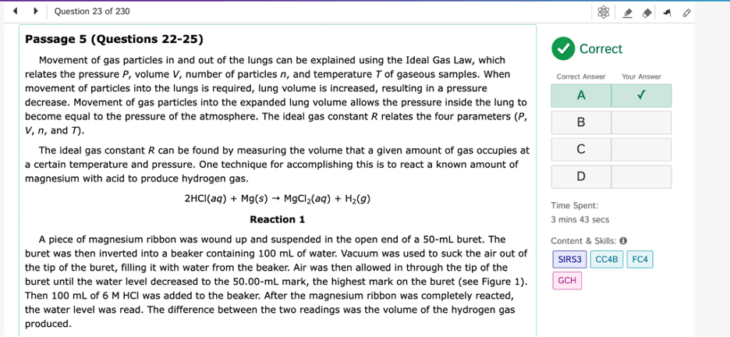
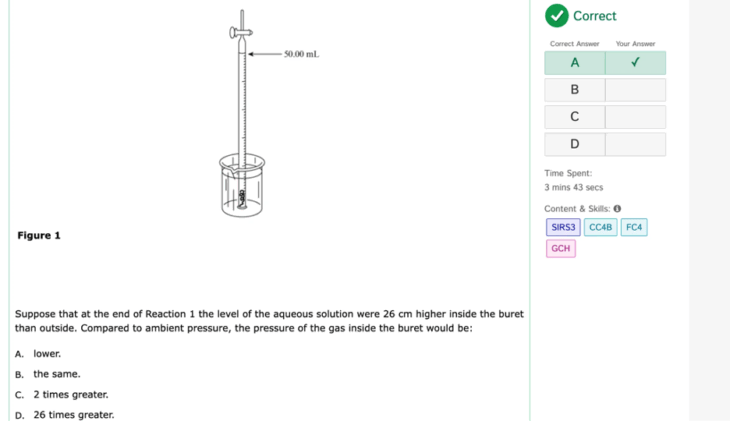
The solution is A. If the pressure of the gas inside the buret were the same or higher than atmospheric pressure, the level of the solution inside the buret would be the same or lower as outside, corresponding to answer choices B, C, or D. But the question states that the solution inside the buret is higher than it is outside. Therefore, neither B, C, or D can be correct, leaving answer choice A.
Read Next: How Long Does It Take to Get MCAT Results?
2. Critical Analysis and Reasoning Skills (CARS)
Number of questions: 53 multiple-choice
Time to complete: 90 minutes
Question format: 9 passage-based sets of 5–7 questions
Disciplines:
- 50% humanities
- 50% social sciences
The Critical Analysis and Reasoning Skills section of the MCAT differs from the other three sections because it doesn’t require specific science or other outside content knowledge. Instead, CARS tests your ability to comprehend, analyze, and reason through information presented in passages.
Passages come from a variety of humanities and social science disciplines, including ethics, philosophy, population health, cultural studies, anthropology, art, and history. Everything you need to answer the questions is provided in the passages and questions themselves.
Here is a breakdown of the types of CARS section questions:
- Foundations of Comprehension, 30%
- Reasoning Within the Text, 30%
- Reasoning Beyond the Text, 40%
Foundations of Comprehension questions test your understanding of the passage’s basic components, including its main ideas, themes, purpose, and the meaning or intent of words and statements in context.
Reasoning Within The Text questions require you to integrate information from different parts of the passage to infer the author’s overall meaning, intent, or beliefs, or they may require you to evaluate the validity of the author’s arguments.
Reasoning Beyond the Text questions require you to extrapolate passage ideas to new contexts or assess how new information affects passage ideas.
Half of CARS passage content will cover the humanities, while the other half will cover social sciences. The subject of CARS passages may involve ethics, philosophy, population health, diverse cultures, anthropology, art, history, and more.
Preparation Strategies
Because CARS requires speedy reading and covers often non-medical subjects, a majority of test-takers say that CARS is the hardest MCAT section. I recommend practicing with CARS-specific testing resources daily to get ready. There are plenty of practice tests and sample CARS questions available.
Hone your reading speed, comprehension, and retention skills. You don’t want to sacrifice comprehension for speed, but you do only have less than a minute and a half per question.
Also be sure to review your CARS practice questions. Reviewing the questions you get wrong in practice is the key to improving your score. Try to figure out why you got each question wrong and devise a strategy for preventing similar mistakes on Test Day.
How to Answer CARS Questions
For all passage-based questions, but especially for CARS questions, here’s my strategy. I first read the passage, mentally summarizing each paragraph, and use the highlighting tool to emphasize phrases that are important for the passage’s meaning. Then I answer each question, using process of elimination to get rid of options and speed things up.
If I get stuck on a question, I just make an educated guess and use the flag feature to make a note of it. After I’ve answered all the questions, I use the remaining time to revisit the flagged questions. Remember – easy MCAT questions are worth the same as difficult ones. So make sure you answer ALL the easy questions before spending too much time on the hard ones.
Skip the endless practice passages and stubborn low scores. This CARS video course will teach you the strategies our tutors used to score in the 95th percentile or above on CARS.
Example Question
In this sample question from the AAMC’s Free MCAT Sample Test, you can see how CARS differs from other MCAT questions. This question more closely resembles something you’d see in the Verbal section of the SAT than in any of your prerequisite courses for med school.
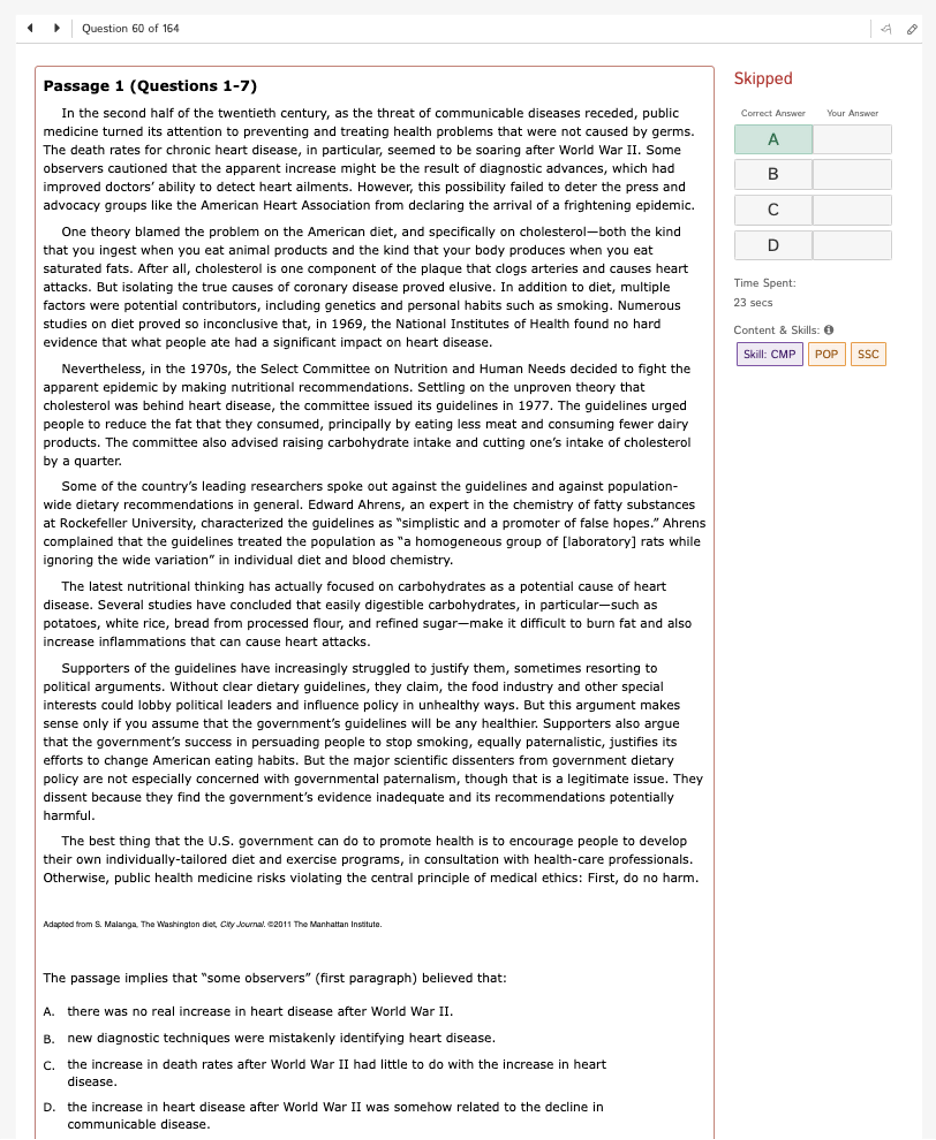
The correct answer is A. In paragraph 1, the author writes that “some observers” thought that the increase in heart disease deaths was merely “apparent” and that improved “ability to detect heart ailments” might be a better explanation. This suggests some felt like there was no increase in heart disease (as stated by Option A) and that the soaring numbers were the result of improved diagnostics.
3. Biological and Biochemical Foundations of Living Systems (Bio/Biochem)
Number of questions: 59 multiple-choice
Time to complete: 95 minutes
Question format: 10 passage-based sets of 4–6 questions and 15 discrete questions
Disciplines:
- 65% introductory biology
- 25% first-semester biochemistry
- 5% general chemistry
- 5% organic chemistry
Also referred to as Bio/Biochem, this section tests your ability to apply biology, biochemistry, organic chemistry, and general chemistry concepts to living systems using scientific inquiry and reasoning skills.
Read Next: MCAT Test Dates
Preparation Strategies
To prepare for Bio/Biochem, review the foundational concepts regularly and practice applying them to both passage-based and independent questions. I found that making my own flashcards was incredibly effective. Review practice questions to determine your scientific knowledge gaps, and tailor your study time to strengthen these areas.
On the other hand, a lot of what you think are “knowledge gaps” on the MCAT may be actually misinterpretations of the passages or confusion based on your own presuppositions. Consistently review your wrong answers to passage-based MCAT questions. That will help improve your ability to interpret passage content.
Here are some key concepts to focus on when studying for Bio/Biochem MCAT prep:
- Amino acids (structure & function)
- Carbohydrates (classification, nomenclature, & function)
- Gel electrophoresis & blotting techniques
- Protein (structure & function)
- Enzymes & enzyme kinetics
- Nucleotides & nucleic acids (structure & function)
- Glycolysis & gluconeogenesis
- Citric acid cycle
- Beta oxidation & fatty acid synthesis
- Electron transport chain & ATP synthase
- Transcription & translation
- Chromosomes
- Gene expression (in prokaryotes & eukaryotes)
- DNA replication & repair
- Thermodynamics (free energy & equilibrium constants)
- Nervous system (structure & function)
- Neurotransmitters
Study Tips: The Best Strategies for Doing Math on the MCAT
Example Question
Below is a sample question from the Bio/Biochem section of the AAMC’s Free MCAT Sample Test. I hope you remember Le Chatelier’s principle.
Notice how this is a discrete question — not a passage-based question. Discrete questions require you to know foundational concepts, like the dissociation of acid in blood. A passage-based question would have given you the full context of a situation and asked you to interpret the passage.
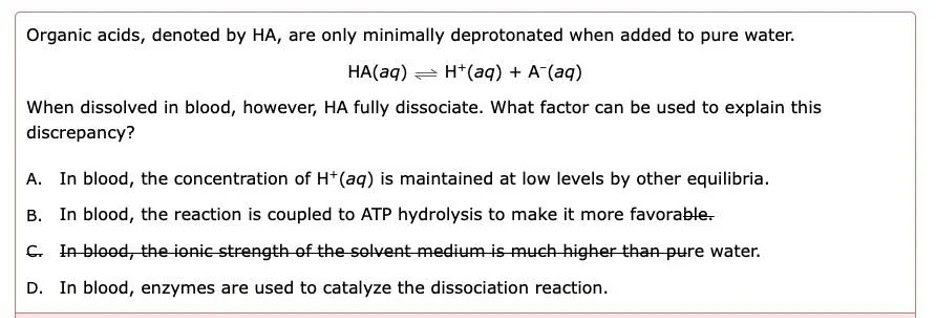
BTW, the answer here is A — here’s why. If HA is “fully dissociated” in blood, it means that the reaction favors the products. According to Le Chatlier’s principle, the reaction equilibrium will favor the products if the concentration of the products is kept low. Since, H+ is a product in the reaction above, A is the correct answer because it states that the concentration of H+ is kept low in the blood.
4. Psychological, Social, and Biological Foundations of Behavior (Psych/soc)
Number of questions: 59 multiple-choice
Time to complete: 95 minutes
Question format: 10-passage-based sets of 4–6 questions and 15 independent questions
Disciplines:
- 65% introductory psychology
- 30% introductory sociology
- 5% introductory biology
Also called Psych/Soc, the final MCAT section tests your ability to apply psychology, sociology, and biology concepts to human behavior and health. You’ll encounter topics such as psychological processes, social structures and inequalities, biological influences on behavior, and basic research methods and statistics.
Preparation Strategies
To prepare for Psych/Soc, combine content review with regular practice applying psychological and sociological concepts to passages, research scenarios, and data. Make sure you’re comfortable with the major theories and terms, but don’t just rely on memorization. This section also tests your ability to interpret studies, evaluate research methods, and distinguish between closely related concepts.
Key Psych/Soc concepts to review include:
- Nervous system structure & function
- Neurotransmitters
- Psychological disorders
- Sensation & perception
- Consciousness-altering drugs
- Sleep & sleep cycles
- Memory
- Cognition
- Language development
- Piaget’s stages of cognitive development
- Personality theories
- Motivation & emotion
- Attitudes & behavior
- Heuristics & biases
- Socialization, groups, & social norms
- Social structure & institutions
- Social stratification & inequality
- Research methods & study design
- Basic statistics & data interpretation
As you work through practice questions, review why you missed each one. Determine whether the issue was a content gap, confusion between similar terms, or difficulty applying a concept to a passage or research scenario. This can help you focus your study time on the areas that need the most improvement.
Example Question
Below is a sample question from the Psych/Soc section of the AAMC’s Free MCAT Sample Test.
Notice how the focus of this question is on psychological and neurological concepts, rather than biological, chemical, or physical concepts, as in Chem/Phys or Bio/Biochem.
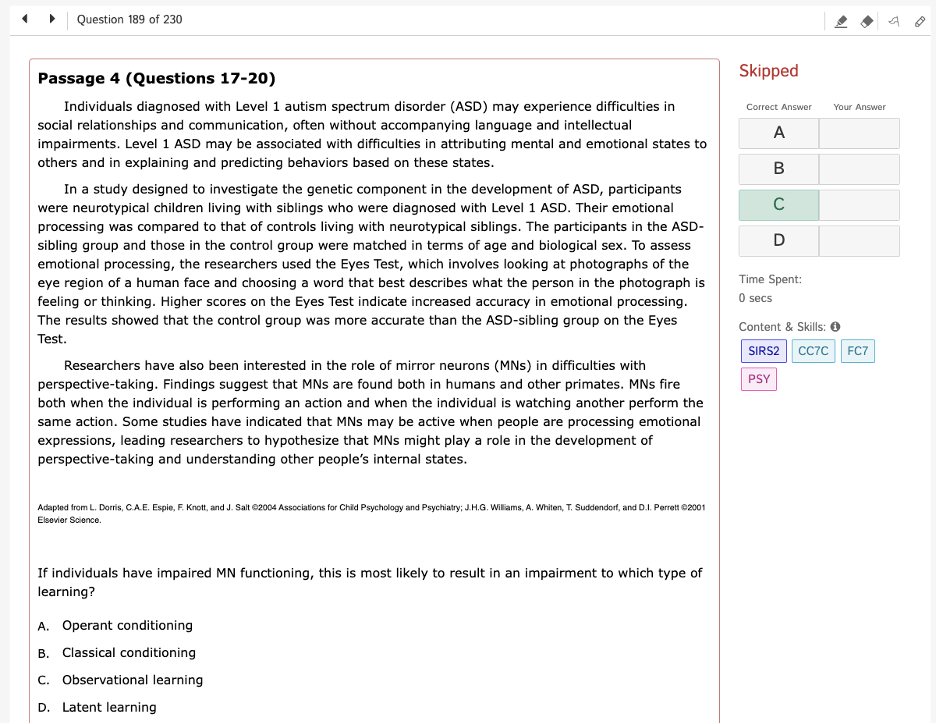
The correct answer is C. Observational learning can be summed up as learning through imitation. According to the passage, MNs are active when an “individual is watching another perform the same action.” This suggests that MN impairment might impair one’s ability to imitate, i.e. might impair observational learning.
Read Next: When Should You Take the MCAT?
Think you know your MCAT material? Put it to the test with our free MCAT Runner Game. Answer MCAT-style questions, clear obstacles, and see how far you can get.
Additional Resources
Your MCAT score is a major determinant of how you’ll do in the medical school admissions cycle. Don’t leave any doubt when you walk into the examination center that you’re as prepared as you can possibly be.
Here are some of the resources that will serve you best:
- MedSchoolCoach’s MCAT Practice Exams — The most representative practice exams on the market
- MCAT Go — An audio-only MCAT learning experience
- MCAT Prep App — Including videos, flashcards, and Q-banks at your fingertips
- MCAT CARS Mastery — A top-rated video course to get you ready for the CARS section
- MCAT Score Conversion Calculator — Get a scaled score from your AAMC practice exam
We offer several free MCAT study resources in addition to these.
However, the best way to prepare for the MCAT exam is to invest in tutoring. Our MCAT tutors all scored 99th percentile or higher on their respective sections, and they are well-versed in helping you devise a study strategy that fits your life, schedule, weak spots, and learning styles.
Our tutoring students improve their previous or practice exam scores by 12 points on average. Could you use 12 more points on the MCAT? If so, schedule a free consultation today to get started.
 Alex Starks
Alex scored in the 99th percentile on his MCAT and has over 13 years of teaching experience. He joined MedSchoolCoach to help lead our content division, focused on creating the most realistic practice questions and highest quality video content available anywhere.