



What makes a medical school application stand out is not necessarily a perfect GPA, a high MCAT score, or hundreds of hours of clinical experience. The strongest applications tell a cohesive story about who you are, what you’ve learned, and why you’re ready to become a physician.
Medical school admissions committees look at applicants holistically, but also within the context of their institutions. The Association of American Medical Colleges (AAMC) describes this approach as mission-aligned selection. Medical schools consider applicants’ experiences, academics, and attributes in relation to their mission and goals.
That means there’s no one way to create a standout medical school application. Strong grades and test scores matter, but so does everything else, including how you show the qualities and competencies needed to succeed as a medical student and future physician.
For years, I’ve worked with students as an admissions committee member and, now, as an advisor to pre-med students working to strengthen their applications. I’ve seen what sets successful medical school applications apart and how applicants can build a compelling, competitive application that fits with the schools they hope to attend.
This guide covers the elements of a competitive medical school application, from academics and extracurriculars to school selection, personal statements, and more. You’ll also learn about common mistakes that can weaken an otherwise strong application and how to avoid them.
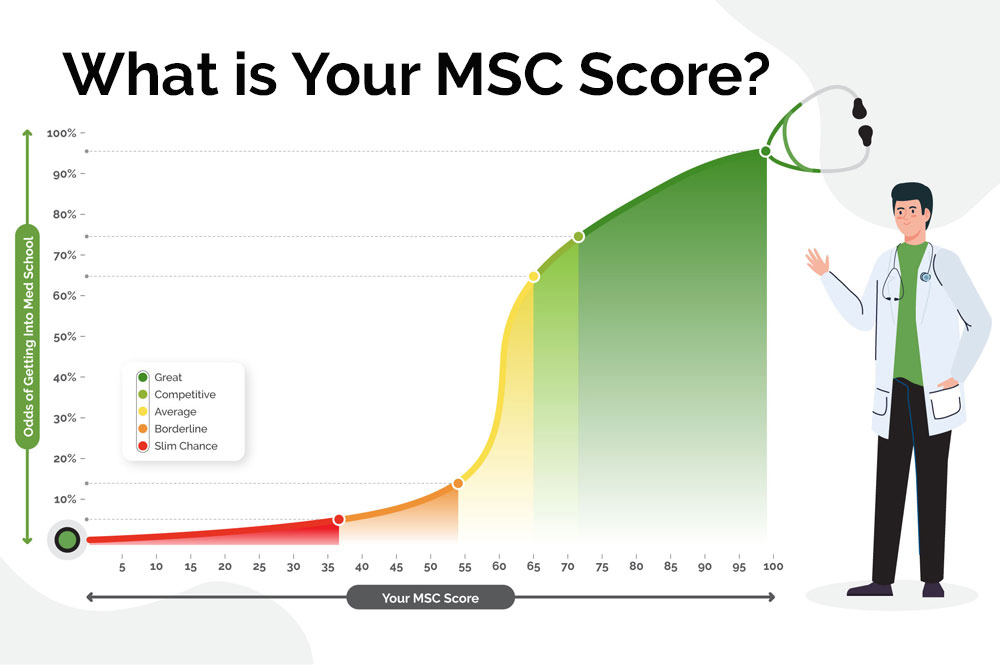
Use our free MSC Score tool to calculate your odds of med school acceptance. Enter metrics like GPA, MCAT, and extracurriculars, and get a score between 0 and 99 that ranks your odds of getting in.
Build a Strong Academic Foundation
While academic metrics are only one part of a holistic admissions process, they remain an important piece of a competitive medical school application. Your academic performance is one of the first things schools evaluate, and strong grades and a solid score on the MCAT can help show that you’re prepared for the demands of medical school.
Your goal should be to make your academic record as strong as possible while maintaining a balanced application. Taking on too many extracurricular activities at the expense of your studying can backfire if it leads to burnout or weak grades.
Competitive GPA and BCPM GPA
Medical schools consider both your overall undergraduate GPA and your BCPM GPA, which includes coursework in biology, chemistry, physics, and mathematics.
There is no single GPA that guarantees admission to medical school or makes you a competitive candidate. The average overall GPA for medical school matriculants was 3.81 in the 2025-26 application cycle, according to the AAMC. The average science GPA for that class was 3.75.
I always suggest aiming for an overall GPA of 3.7 or higher, but your course selection, the rigor of your coursework, trends in your grades, and the rest of your application all matter, too.
If your academic record is less than ideal, don’t assume that your pre-med journey ends there. Additional coursework, a post-baccalaureate program, or a well-planned gap year may allow you to demonstrate exactly what your top choices are looking for in their next round of applicants.
MCAT Score
The MCAT gives medical schools a common measure of applicants’ science knowledge, critical thinking, and reasoning skills, and is often used as a predictor for success on the USMLE.
The average MCAT score for matriculants in the 2025-26 application cycle was 512.1, compared with 506.3 for applicants overall. We always suggest that a score of 511-512 is a “good” MCAT score. A score between 518-520 is closer to the average for the top medical schools.
It’s important to note that these numbers can be useful benchmarks, but they aren’t universal minimums. Competitive scores vary by medical school and applicant pool, and the MCAT is only one data point in a holistic application process.
Rather than chasing an arbitrary score, aim to perform as well as you reasonably can while considering the schools on your list. If your score is lower than you hoped, look at it in the context of your entire academic record and the individual schools’ expectations before deciding whether to retake it or adjust your school list.
Read Next: Medical School Enrollment: Current Trends & Impacts
Prioritize Quality Extracurriculars, Research, and Clinical Work
Your extracurricular experiences give medical schools a fuller picture of who you are beyond your academic transcript and MCAT score. They can demonstrate your interests, values, leadership, cultural competence, teamwork, curiosity, and understanding of medicine.
But what med schools are looking for in applicants isn’t hundreds of activities. An experience becomes valuable when you’re genuinely engaged, contribute in a meaningful way, learn from the experience, and can explain how it has shaped you.
When evaluating an extracurricular, research, or clinical opportunity, consider:
- Sustained involvement: Have you committed enough time to develop a meaningful understanding of the experience?
- Meaningful contribution: Did you actively contribute, take initiative, or make a difference rather than simply show up?
- Personal growth: What did you learn about yourself, other people, or the world around you?
- Exposure to medicine and patients: If the experience is clinical, did it help you understand the realities of patient care and the physician's role?
- Teamwork and relationships: Did you learn to collaborate with people who have different perspectives, responsibilities, or areas of expertise?
- Reflection: Can you explain why the experience mattered and how it influenced your development?
Choose Your Extracurriculars Wisely
Whenever possible, choose extracurriculars that you can participate in long-term, interest you, and support your personal, professional, or academic growth and development.
You don’t need to limit yourself to healthcare-related experiences, either. Non-clinical activities can reflect your personality and demonstrate your ability to balance academics with personal interests. Research, community service, volunteer work, the arts, employment, and other pursuits can all contribute to a strong application when you’re meaningfully involved.
You might take a leadership role on a sports team or campus organization, teach or tutor other students, volunteer in your community, or pursue an activity you love. Your activities should help admissions committees understand who you are as a person and what you would bring to a medical school community.
Research Experience
A research-intensive path isn't essential for every aspiring doctor. If your career aspirations are more clinically oriented, it's perfectly acceptable to have an application with more clinical exposure than research experience.
However, demonstrating involvement in research settings can give you a significant advantage. Research opportunities can take many forms, including lab work, clinical research, internships, or other projects that allow you to work alongside researchers.
When discussing research on your application and during interviews, focus on more than the number of hours you spent in the lab. Think about answers to these questions:
- What questions were you trying to answer?
- What skills did you develop?
- What challenges did you encounter, and how did you respond?
- How did the experience deepen your understanding of science or medicine?
- What did you contribute to the project?
Even if your research work wasn’t groundbreaking, the skills you developed are worth highlighting, especially if you took on a leadership role. If the experience sparked a deeper interest in research, you may even find yourself considering an MD/PhD.
Clinical Experience
Clinical experience allows you to understand medicine from the perspective of patients, healthcare professionals, and the broader healthcare system. It can also help you determine whether a career in medicine is genuinely right for you.
Clinical exposure can take many forms, including shadowing a doctor, volunteer experiences in a hospital or clinic, or working as a medical scribe, EMT, or medical assistant. Beyond accumulating a certain number of clinical hours, admissions committees want to see evidence that you understand what it means to work with patients.
When reflecting on your clinical experiences, think beyond what you did. Consider what you observed, how you interacted with patients and healthcare professionals, what challenged you, and how those experiences influenced your understanding of medicine.
Shadowing, for example, can expose you to different specialties and help you understand the day-to-day responsibilities of physicians. Working directly with patients can teach you about communication, empathy, and professionalism.
Build your application alongside a physician with AdCom experience.
Write a Memorable Personal Statement
Your personal statement is your opportunity to show medical schools who you are beyond your grades, MCAT score, and list of experiences. Treat it as your best opportunity to connect with the admissions committee on a personal level before secondary applications or interviews.
Avoid the tendency to use your personal statement to recount your qualifications and achievements. There are other sections on the AACOMAS or AMCAS application for that.
Instead, your personal statement should be a compelling narrative that communicates your dedication and understanding of a career in medicine. Start with a meaningful experience or realization that gives the reader a sense of who you are. Then use specific examples and reflection to show how your experiences shaped your decision to become a physician.
Try this progression: Introduce a meaningful experience, explain what you learned from it, connect it to other experiences that shaped you, and show how those experiences led you to medicine. The experience itself matters, but your reflection on it is what makes the essay personal.
We have a detailed guide to writing your best medical school personal statement with more guidance on developing your story and avoiding common mistakes. You can also review our personal statement examples from accepted applicants.
Demonstrate You Have Something Unique to Offer
Medical schools are looking for applicants with different backgrounds, experiences, perspectives, and interests, not a homogeneous group of candidates. Your individuality is an asset when it comes to being a competitive med school applicant. Your undergraduate major, personal experiences, and the path you took to medicine can all help distinguish your application.
For nontraditional applicants, this can be especially important. Maybe your journey to medicine wasn’t a straight path but a more winding one shaped by varied experiences. Perhaps you have a background in the arts, business, education, or another field outside the traditional pre-med track.
These experiences can give you a diverse skill set and perspective that can enrich the medical profession. Emphasize these elements in your application rather than downplaying them.
Your academic choices can also showcase your individuality. There’s a common misconception that majoring in science is a prerequisite for medical school. It isn’t. Pursuing a major in the humanities, social sciences, English, or another field can demonstrate intellectual curiosity that can serve you well in medicine.
Ultimately, your background, experiences, and academic choices should help admissions committees understand what you would bring to their community and the medical profession.
Use the Work & Activities Section Strategically
The current AMCAS application allows you to include up to 15 entries in the Work and Activities section, with 700 characters to describe each experience. You can also designate up to three experiences as Most Meaningful, giving you an additional 1,325 characters for each to explain why they had a particularly significant impact on you.
Use this space strategically. You don’t need to fill all 15 entries to feel like you have a more complete application. Focus on experiences that demonstrate your interests, contributions, personal growth, and preparation for a career in medicine.
For each experience, briefly explain your role and contributions, then use the available space to highlight what you learned, how you grew, or how the experience influenced you. For your Most Meaningful experiences, take advantage of the additional space to provide deeper reflection on the experience and its impact.
Your Work and Activities section should complement, not repeat, the rest of your application. Your goal is to give admissions committees a fuller picture of who you are and what you would bring to a medical school community.
Obtain Strong Letters of Recommendation
Strong letters of recommendation can provide admissions committees with valuable insight into your character, abilities, work ethic, and potential as a physician. Choose letter writers who know you well and can provide specific, meaningful examples of your strengths and contributions.
Professors, research mentors, physicians, and other professionals who have worked closely with you may all be good choices. Whenever possible, choose people who can speak in detail about your academic abilities, character, leadership, or other qualities that will strengthen your application.
Give your recommenders plenty of time to write their letters and provide them with helpful context, such as your résumé, a draft of your personal statement, and information about your goals. This can help them write a more detailed and personalized recommendation.
Most importantly, don’t name-drop. Having a close relationship with a well-known physician or professor does not automatically make for a strong letter. A detailed recommendation from someone who knows you well is more valuable than a generic letter from someone with an impressive title or reputation.
If You’re Reapplying or Taking a Gap Year
A gap year or a reapplication cycle can allow you to strengthen your medical school application and demonstrate continued growth. The key is to use that time intentionally, addressing any weaknesses in your application while continuing to build meaningful experiences.
Reapplying
Reapplying to medical school after an initial rejection isn’t just about submitting a new application. You’ll need to show how you’ve evolved in areas where your previous application fell short. If you can’t demonstrate growth, you’re unlikely to be accepted.
If your MCAT score was a weakness, consider whether retaking the exam and improving your score would strengthen your application. If your GPA wasn’t competitive, a post-baccalaureate program or additional coursework can help demonstrate your academic readiness.
If you lacked sufficient clinical experience, consider gaining practical experience in healthcare. Opportunities can include working as an EMT, medical assistant, clinical lab technician, surgical technician, phlebotomist, medical scribe, or in another patient-facing or healthcare role.
If your extracurriculars need work, consider doing more volunteer work in a healthcare setting. When you reapply, your goal should be to show what has changed, what you have learned, and why you are now a stronger candidate.
Expert Tip: Pay attention to both the strength and timing of your application. Applying early can be particularly important at schools with rolling admissions, which review applications and make decisions throughout the admissions cycle.
Making the Most of a Gap Year
Embracing a gap year can allow you to develop personally, professionally, and/or academically in ways that directly benefit your medical career path. Here are some ways to make the most of your gap year:
- Complete a post-bacc program. If your academic record needs improvement, additional coursework through a post-bacc or special master’s program can demonstrate your ability to succeed in rigorous academic settings.
- Expand your extracurriculars. Take on meaningful volunteer, leadership, research, or community service opportunities that build on your existing interests.
- Work in healthcare. Working in a healthcare-related field can give you an inside look into patient care and teach you skills easily transferable later in your career.
- Teach or tutor. Teaching can strengthen your communication and leadership skills while allowing you to make a meaningful contribution to others.
- Travel. Travel can broaden your perspective and expose you to different cultures and communities, particularly when approached thoughtfully and with a genuine interest in learning.
Beyond strengthening your application, these experiences can give you unique stories to draw on when it’s time to craft medical school secondary essays or prep for med school interviews. The skills and insights you develop during a gap year can help you become a more thoughtful, engaging interview candidate when that stage of the process arrives.
Learn More: Your Guide to Multiple Mini Interviews (Plus Sample Questions & Prep)
FAQs
Medical schools have different policies regarding community college coursework. Some accept community college courses for prerequisites, while others prefer or require certain courses, like biochemistry, to be completed at a four-year institution.
Before applying, check the requirements for each school on its website or through the AAMC’s Medical School Admission Requirements (MSAR).
A single withdrawal isn’t necessarily a major concern, particularly if your overall academic record is strong. Withdrawals do not factor into your AMCAS GPA, but they do appear on your transcript. Multiple Ws, particularly in prerequisite or science courses, can raise concerns about your ability to manage a demanding academic workload.
If you have a withdrawal, focus on maintaining strong academic performance and demonstrating that you can handle the rigor of medical school.
Don’t Leave Your Med School Application to Chance
Whether you’re applying to medical school for the first time or reapplying, building a strong application takes time, strategy, and careful attention to every part of the process. You don’t have to navigate this process alone.
Expert guidance can help you identify opportunities to strengthen your application, avoid common mistakes, and present your strongest application.
Build your application alongside a doctor with admissions experience, and join the 95% of clients who get into medical school.
 Luke Voytas, MD
Dr. Voytas, a dedicated pediatrician with an passion for nurturing future medical leaders, inspires every student and resident he mentors to reach their fullest potential. Leveraging his rich background in writing, he crafts narrative-driven application essays that uniquely capture each client’s journey and set them apart in the competitive world of medicine.