




Whether you should take a gap year depends on your unique situation.
A gap year can enhance your medical school application and better prepare you to become a doctor by letting you seek relevant experiences, improve your GPA, and explore your interests more in depth.
However, the key is to use this time purposefully. Failing to do so may result in a more negative outcome.
Let’s talk about the pros and cons of taking a gap year before medical school, the most productive ways to spend one, and if it can improve your med school application and interview.
Build your application alongside a physician with AdCom experience.
How Many Undergraduates Are Taking Gap Years
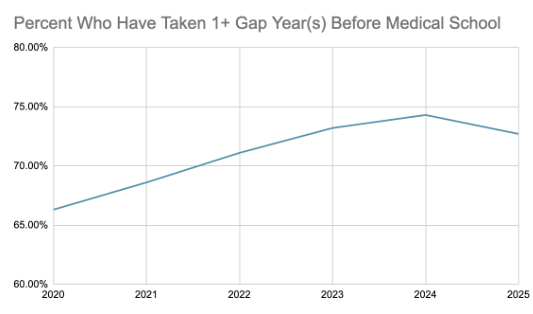
According to the Association of American Medical Colleges’ (AAMC) 2025 Matriculating Student Questionnaire, 72.7% of matriculants had at least one gap year between undergrad and medical school. This marks a slight decrease from last year, but it is part of an overall trend upward.
Benefits of Taking a Gap Year
Nowadays, AdComs (Admissions Committees) expect to see gap years on med school applications. Of course, they accept students straight from undergrad, but taking gap years is seen as normal and even beneficial if used properly.
Dedicate your gap year(s) to improving yourself, your application, and your future. Here are the top benefits of taking a gap year:
- Enhanced Extracurricular Experience: By taking a gap year, you can accumulate significant hours in clinical work, volunteering, research, and leadership — areas that are rigorously analyzed by AdComs. It’s possible to build your extracurricular activities portfolio while in undergrad without taking a gap year, but only if you’re exceptionally motivated and organized.
- Full-Time Work Opportunities: Many students nowadays don’t have enough clinical experience to submit a competitive application the summer after their junior year. It’s totally fine for you to wait until the end of your senior year — or the year after — and spend that extra time working full-time in a clinical setting or as a researcher to gain the additional work experience needed to be competitive.
- Alignment With Admissions Trends: More medical schools are expecting most applicants to have gap years, preferring more mature, well-rounded candidates. However, just make sure you don’t waste your time, as a wasted gap year will not bode well with AdComs.
- Flexibility for Career Exploration: Taking a gap year allows you to explore other careers or gain diverse life experiences. AdComs are always looking for diversity of life experiences, so seek those new experiences. Before applying to med school, you can shadow different physicians to learn what working in a specific medical career field would actually be like.
- Freedom to Explore Personal Interests: A gap year allows you to explore your interests outside the medical field, helping you become a more well-rounded individual — something med schools are looking for. Allow yourself to discover passions that could complement or enhance your medical career. Numerous medical professionals utilize diverse interests to drive breakthroughs and improve patient care.
- The Opportunity to Take Care of Yourself: Taking a gap year also means that you don’t have to cram as much in during undergrad, which could prevent burnout and improve your physical, social, and mental health.
Potential Downsides
While a gap year can offer valuable opportunities, it can also present drawbacks if not managed well. If not done productively (e.g., not enhancing your GPA, gaining relevant experience, or developing key skills), a gap year could negatively impact your med school application process.
Medical school admissions committees could view an unproductive gap year as a lack of commitment or focus. To avoid this, ensure that your gap year is purposeful and demonstrates growth, readiness, and a clear commitment to a career in medicine.
Read Next: Top AAMC Resources for Getting into Medical School
Here are the potential downsides to a gap year before medical school:
- Lack of Direction: If you took a year off between undergrad and med school, your CV during that gap should demonstrate direction. If your application shows odd jobs, a lack of commitment, and no attempt at personal or professional development, that gap year becomes a liability.
- Lack of Academic Improvement: If your GPA is low, taking a purposeful gap year allows you time to enroll in coursework through a post-bacc that can boost your GPA (overall or BCPM). If you didn’t improve your GPA, or if you needed more time to retake the MCAT and then didn’t retake, this can reflect poorly on you and your application.
- Lack of Anything: Your gap year should not leave an empty gap on your AMCAS application. Don’t waste the year relaxing at a beach house. Don’t spend an entire year sitting on your parents’ couch to save money. You should seek clinical opportunities, research jobs, volunteering experience, or other personal or professional development opportunities. Remember, you’re going to have to justify your gap year to an interviewer. It can be easy to talk about your gap year as long as you actually did something during that year.
The Most Effective Ways to Use a Gap Year
A gap year can significantly enhance your medical school application by providing an opportunity to boost your GPA, complete additional coursework, and gain experiences that reflect your commitment to medicine.
If you’re wondering what to do during your gap year before medical school, here are five ways to spend the extra year that can improve your med school application.
Gain Medical Field Experience
Use your gap year to gain more experience in the medical field, including:
- Clinical Experience: Getting more clinical hours can come from being a certified nurse’s assistant (CNA), an EMT, a medical scribe, or simply a volunteer in a clinic. Clinical experience can showcase practical skills, empathy, communication, and problem-solving — all coveted traits to show on an application or during an interview.
- Physician Shadowing: Shadowing a physician gives you a realistic understanding of different specialties and working environments. Shadowing can help you stand out as an applicant by demonstrating your dedication and readiness in interviews and your personal statement.
- Research Experience: AdComs value research experience on your AMCAS. Use your gap year to build up research hours. Consider volunteering in a research lab, working as a research assistant, or even conducting your own research project.
Pro tip: Working in clinical or research environments can introduce you to professionals who may become mentors and could write glowing letters of recommendation.
Need shadowing hours for medical school? Sign up for our free Virtual Shadowing course and start shadowing practicing physicians from your phone or laptop.
Take the MCAT and Improve Exam Performance
If your MCAT scores weren’t so hot the first time around and you need to retake it, then retake it! This isn’t an inside secret or anything, but it’s a great opportunity you need to take advantage of.
Try to improve your score by at least six points. If you’re only improving by 1-3 points (and you don’t already have a competitive score), AdComs may actually look unfavorably on your retake efforts.
Consider exploring new study techniques and habits that differ from those you used previously. Hiring a tutor or adopting innovative study methods can help refresh your approach and deepen your understanding.
If you’re not planning on taking a gap year, you should take the MCAT in the spring of your junior year (between January and May) so that you can submit your applications to medical school as soon as AMCAS opens in late May/June. (Remember: Med schools use rolling admissions. The earlier you apply in a given cycle, the better your odds of acceptance.)
That said, most medical schools accept MCAT scores within three years of planned matriculation, so if you are taking a gap year, you have a lot of flexibility about when to take your exam.
Ultimately, I recommend that gap year applicants take the MCAT when they’re ready and when it suits their schedule. That could mean taking it in the spring of junior year, or it could mean taking it later, in the summer between junior and senior year or in the spring of senior year.
Get a Guaranteed Score Increase when you sign up for Silver, Gold, or Platinum MCAT tutoring.
Volunteer Purposefully
Pre-meds should always be involved in at least one volunteering activity, even if they’re working at full-time clinical or research opportunities, especially during a gap year.
Below are some places where you can find great community service and volunteer opportunities that can fill out your med school application:
- Clinical setting
- Tutoring center
- Community garden
- Senior center
- Local healthcare nonprofits
- Sustainable international volunteering organizations
A note on international volunteering: Working with patients from different backgrounds and cultures can be invaluable. However, I encourage you to consider organizations that operate sustainably and do not perpetuate systems of white saviorism.
Strengthen GPA and Fulfill Prerequisites
Consider using your gap year to take additional coursework through a post-baccalaureate program or master’s degree. Focus on required or recommended classes you missed during undergrad, or use this time to enhance your GPA by excelling in upper-level science courses.
A post-bacc or master’s degree can be a big commitment, both time- and money-wise, so consider this option carefully. Only pursue these paths if you need additional coursework or a GPA boost.
You may want to consider a Special Master’s Program with a guaranteed linkage to medical school admittance. This is where you work towards a master’s degree (unlike a post-bacc), and if the SMP has linkage, then you’re guaranteed a spot or at least an interview at the linked med school.
Read Next: Best Med Schools for Non-Traditional Applicants
Explore Career Options
Medical schools value candidates who have spent time in another profession, due to the diverse life experiences and perspectives that they’ll bring into class discussion and real-life patient care.
Here are some great non-healthcare jobs that would enhance your med school application:
- Teaching or tutoring
- Any STEM profession, like engineering or software
- Military experience
- Business background
Remember: If you use your gap year(s) to pursue other career paths, you’ll still need volunteer experience, research hours, and clinical experience, just like any other applicant.
How to Talk About Your Gap Year Experiences
Whether you are filling out the Work and Activities section on the AMCAS or talking to an admissions committee during an interview, there are some key points to remember when it comes to talking about your gap year and your experiences during it.
Here are some expert tips on talking about your gap year on your application and in your med school interview:
- Be Honest but Strategic: Honesty is the best policy, but avoid arrogance. Don’t sell yourself short, but don’t exaggerate. On your application and in your interview, present your gap year experiences as positive because they were.
- Don’t Overshare: Instead, practice concise responses to commonly asked med school interview questions, and focus on demonstrating your soft skills like compassion and communication during your med school interview.
- Plan a Response to Weaknesses: If the interviewer asks about a weak point, like low clinical hours or an MCAT retake, you need to address it honestly and explain what you learned from it. But there’s no need to proactively point it out in your essays or in an interview. With one exception: a reapplication.
- Mention a Reapplication: If you are a reapplicant who didn’t get accepted the first time around, the best strategy is to proactively mention how you’ve overcome any weak points in your first application or interview as part of your personal journey. Show how you’ve grown!
- Communicate Growth With Confidence: Write down your gap year growth experiences before writing a personal statement or stepping into an interview. This can organize your thoughts and improve your chances of standing out as a med school candidate.
- Consider Non-Healthcare Strengths: Reflect on your skills and life experiences outside of academics or the medical realm and how they may translate to your role as a future physician. For example, if you raised a family during your gap year(s), you’ve learned the value of time management, determination, and organization. Highlight these non-medical experiences and skills during your interview and in your personal essays.
- Emphasize What Makes You Unique: Med school admissions may be looking for certain academic and application criteria, but they also want to know what makes you stand out from the crowd. Consider what makes you unique and a valuable addition to the school. Our quirks, non-traditional choices, and unique ways of thinking can often serve as some of our greatest strengths. Express your unique perspective and value in your personal statement, secondaries, and during interviews.
Learn More: How to Answer, “Why Do You Want to Be a Doctor?”
Embracing Your Unique Path to Medicine
Non-traditional paths to medical school are increasingly valued, especially gap years during which candidates gain unique life experiences and enhance their application with extracurriculars, clinical work, and volunteering hours.
In your application and interview, frame your gap year experiences as strengths because they did make you a better future physician. And don’t be afraid to ask for help demonstrating how your gap year makes you stand out!
You can partner with MedSchoolCoach to craft an unforgettable application that highlights your strengths and sets you apart from other applicants. We also offer MCAT tutoring and interview prep.
Build your application alongside a doctor with admissions experience, and join the 95% of clients who get into medical school.
FAQs
There is not a number of gap years that is “too high.” One single gap year is not considered abnormal, and two gap years are more popular than ever.
However, once you take three gap years, you would probably be considered a non-traditional student on a similar level to 40-year-olds who are switching their careers to medicine. Med school applicants who are 25 or older need to prepare interview answers for why they took longer to apply than normal, but 3+ gap years can easily be turned into a plus.
Some of the best gap year jobs include:
- Medical assistant (MA)
- Emergency medical technician (EMT)
- Emergency room (ER) tech
- Research assistant
- Clinical lab technician
- Home health aide
- EKG technician
- Medical scribe (though this job is being phased out by AI)
You can quit your gap year job at the beginning or middle of summer before starting medical school. I recommend giving yourself at least two weeks off in between the “gap year job” and med school, but you could conceivably take the whole summer off, depending on your situation.
If you’re planning to take a single gap year, you should take the MCAT before graduating college, either in the spring of your junior year, the summer before senior year, or during senior spring.
Remember that the application cycle takes around a year, and scores take about a month to come back, so build that into your timeline from when you submit primary applications in late spring/early summer to the following spring when admissions decisions are finalized.
So, if you want to take a single gap year, you’ll want to apply as soon as senior year is over in late spring/early summer. By taking the MCAT by early May of that year or sooner, you’ll have your score back in time to submit primary applications as soon as AMCAS opens in late May or early June.
Since we recommend submitting primary applications as soon as possible to maximize your chance of acceptance, you should target an MCAT test date of early May of your senior spring or sooner to be ready to apply. Taking the exam the year prior, either in the summer before senior year or in the spring of your junior year, can also work well.
Most med schools accept MCAT scores that are up to three years old at the time of matriculation, so taking a gap year gives you flexibility regarding your test date (and taking two or more gap years gives you even more flexibility).
When you finish your bachelor’s degree, your federal student loans will enter into a grace period, typically about six months, during which no payments are required. If you go to med school the next semester, you will get an in-school deferment, and no payments are required.
However, after the grace period runs out and you’re not in school (or another valid reason for deferment), you need to start repaying your federal loans. Loan servicers typically provide a payment schedule at least 30 days before your first payment is due.
Federal loans offer several reduced repayment options (including for $0 payments) based on your income and certain work situations. If you’ll be making a small income during your gap years, you may qualify for deferred payments or a reduced-cost repayment plan during this time.