Table of Contents
What to do the day before USMLE (United States Medical Licensing Examination) Step 1 is one of the most common questions I get from med school students as their exam date approaches. After months of intense preparation, it is completely normal to wonder how to handle those final hours and whether you should be reviewing notes or cramming last-minute facts.
First, congratulations. You have worked incredibly hard to get here. As the Director of Medical School Tutoring at MedSchoolCoach, I can confidently say that if you have followed your study schedule, you are ready.
In the final stretch before your test date, the focus should shift away from more studying and toward rest and recovery. That’s why my advice for the day before the exam is simple: relax. Get rest and good sleep, take care of yourself, and trust the work you’ve done.
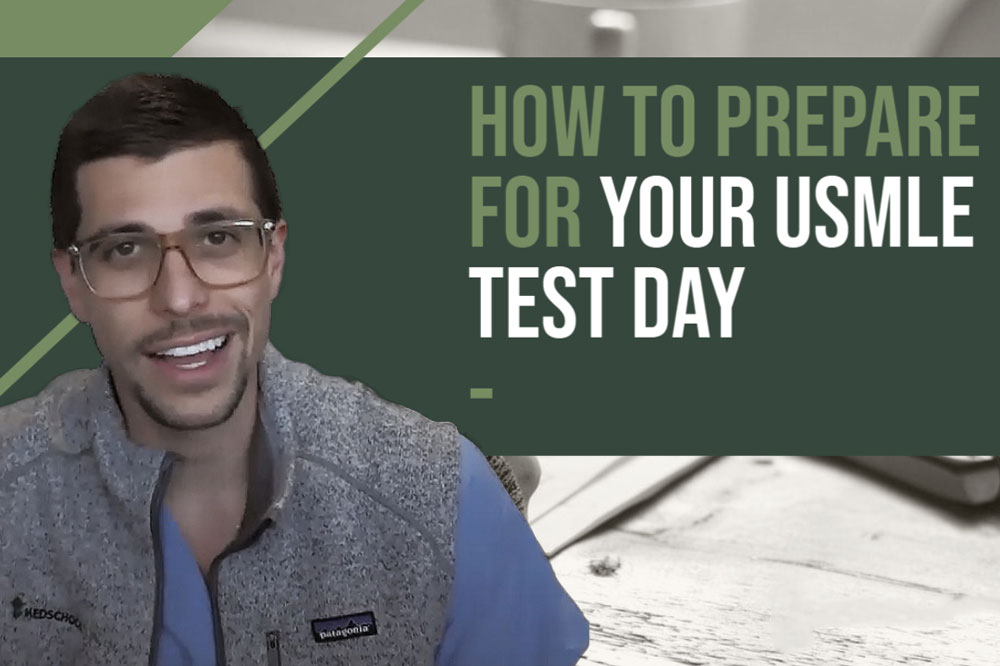
Below, I break down exactly what to expect before and on the USMLE Step 1 test day, including practical logistics and strategies for managing a long exam. For a full walk-through and added context, I recommend watching the video above.
Get a Step 1 Pass Guarantee when you sign up for 25+ USMLE or COMLEX tutoring hours.
Know Test Site Logistics
One of the simplest and most important things you can do to set yourself up for success is to know exactly where you are taking your exam and how you are going to get there. This is not something you want to figure out the day before or the morning of your exam.
Make sure you know the location of your testing center, how long it takes to get there, and build in extra time so you’re not rushing. Check the USMLE schedule ahead of time to avoid surprises. The last thing you want on exam day is to arrive late and stressed because of unexpected delays. Leaving early gives you a buffer in case something throws off your schedule.
It’s also important to carefully read the instructions sent to you in advance. These emails outline testing center rules, what you are allowed to bring, and what will be provided for you on test day. Reviewing this information in advance helps avoid unnecessary stress when you arrive.
Many students find it helpful to create a simple checklist beforehand. This can include the test center address, estimated drive time, parking details, and a quick review of the center’s policies.
The Day Before Your Exam
The day before your exam should be treated as a true day off, not a heavy study day. Instead of cramming, do something that helps you unwind and reset, and make sure you get 7-8 hours of sleep. Stick to familiar, balanced meals that are easy to digest.
Light exercise, spending time with friends or family, or doing something you enjoy can help you stay calm and grounded the day before. The purpose isn’t just comfort. Rest helps regulate stress, recharge your brain, and mentally prepare you for a long, demanding test day.
The work that matters most has already been done. By stepping back instead of studying more, you allow yourself to perform at your best.
What to Make Sure You Have
The night before your exam, gather everything you will need so you’re not scrambling the morning of test day. Essentials to make sure you have include:
- Testing permit (print a copy even if digital is accepted, just in case)
- Valid photo ID
- Snacks and water (or coffee, if it helps) for authorized breaks
- Any allowed personal items you plan to store in your locker (like your wallet and phone)
Review the testing center’s instructions to know exactly what must be stored in your locker and what is permitted in the exam room.
It’s Test Day: Here’s What to Expect
Knowing what to expect on test day can help reduce stress and keep you focused. From check-in to breaks, having a clear plan and understanding the logistics can help you feel more confident on testing day. Try to wake up at your usual time or slightly earlier to give yourself plenty of time to get ready, have breakfast, and arrive at the testing center without rushing.
Check-In
When you arrive at the testing center, the first step is to check in. I strongly recommend getting there early. Even though your exam may be scheduled to start at 8 a.m., most testing centers begin letting students in about 30 minutes beforehand. If you arrive later, you may end up starting your exam later. Getting there early helps you get through check-in and settle your nerves.
At the front desk, you’ll present your testing permit and a valid ID. You’ll likely be alongside other examinees taking a range of exams, such as the MCAT, GRE, or GMAT, so it’s a fairly mixed group.
After check-in, you’ll receive a locker key. Store personal items, such as your wallet, watch, jewelry, and phone, in the locker. I recommend turning your phone off completely and keeping it off for the entire exam, including breaks, so it doesn’t distract you between blocks. You can also store snacks in your locker for authorized breaks.
Materials Provided
The testing center provides a few essential items for the exam:
- Wired headphones: These are for audio components such as murmurs or videos during the exam. Make sure to test them when prompted.
- Noise-cancelling earmuffs: These are often old and uncomfortable, so I recommend bringing your own foam earplugs. (Read the USMLE rules on earplugs, as they only allow certain types.)
- Laminated scrap paper and marker: These are for notes, calculations, or jotting down thoughts.
Pro Tip: Many students wonder if they should write out complex pathways or quick formulas for biostatistics questions at the start of the exam. My advice is not to. You might never see questions on that topic. The laminated sheets are most useful for equations, math problems, or statistics questions. If a challenging pathway comes up, jot it down then.
Security and Entry Procedure
Before you ever sit down at your desk, you’ll go through a full security check. This happens when you first enter the testing area and every time you return from a break. The process typically includes:
- Fingerprint scanning and sign-in.
- Being asked to empty all pockets in your pants, shirts, and jackets.
- Glasses inspection, if you wear them.
- A brief visual check.
- A metal detector scan.
The first time you go through it, the process can feel a little uncomfortable or awkward, especially if you’re already nervous. That said, it’s routine for the testing center staff and usually doesn’t take very long.
What surprises many students is that you repeat this entire process every time you leave and re-enter the exam room. When you take a break, you’ll check out with fingerprints, and when you come back, you’ll check back in and go through security again. Depending on how busy the center is, this can take anywhere from a few minutes to longer if there’s a line.
Exam Length
USMLE Step 1 is a long and demanding exam administered in a single 8-hour testing session. It consists of 7 60-minute blocks of questions, with up to 40 items per block and a maximum of 280 total questions.
In addition to question time, Step 1 includes at least 45 minutes of break time and an optional 15‑minute tutorial at the beginning of the exam. You can take breaks between blocks, known as “authorized breaks,” by following the on-screen prompts. Breaks during a block are “unauthorized.”
Break Strategies, Timing, & Snack Planning
Everyone functions differently during a long exam like Step 1, so it’s important to develop a personalized fueling plan. For me, I knew that if I had anything too big or heavy on the day of, I’d put myself at risk for a food coma, so I just had snacks the whole day.
Some good snack options I suggest to students include:
- Granola or protein bars.
- Trail mix or nuts.
- Fruit, like apples, bananas, or dried fruit.
- Crackers or pretzels.
Choose small, easily digestible items that give steady energy, but that are already a part of your normal routine. Staying hydrated is just as important, so make sure to drink water consistently throughout the day. If you’re a coffee drinker, bring some with you to have during breaks.
Sample Test Day Schedule
You may want to structure your breaks differently depending on your needs, but here’s how I approached Step 1 and what worked for me:
- Blocks 1-2: I started the day with 2 60-minute blocks. I felt freshest at the beginning, so I could focus well.
- Break: I took a quick break to use the restroom, drink some water, and have a small snack.
- Blocks 3-4: I completed the next 2 blocks, with no breaks in between.
- Break: This is where I took a longer break of about 20-30 minutes to eat more, drink water, and have some coffee. By this point, I was mostly through the exam, so this longer break was psychologically helpful.
- Blocks 5-7: I finished the final 3 blocks, taking short breaks between each one as needed for hydration, snacks, or to use the bathroom.
This approach minimized the time spent checking out and back in at the testing center, which can take several minutes each time. If you need to use the restroom frequently or want snacks often, it’s reasonable to take a break after every block. Just keep them short so you don’t feel rushed.
Pro Tip: Practice your break and snack plan during UWorld questions and practice tests as part of your USMLE preparations. Simulate the timing and snacks you plan to bring on test day. This lets you see what works best for you and to make adjustments ahead of time.
Expert Mental Performance & Testing Tips
Test day is stressful by nature. You’ve been preparing for months, the environment is unfamiliar, and even the security process can feel uncomfortable. The first thing I tell students, and what I reminded myself on test day, is to relax.
Deep breathing, square breathing, grounding exercises, or brief mini-meditations can all help calm your nervous system the morning of the exam. Even something as simple as taking a few steady breaths before your first block can make a real difference. Practice these techniques ahead of time so they feel natural on exam day.
During the exam, focus on staying present and positive, and answer questions one at a time. I found it helpful to approach each question as if it were the most important question of the day. It’s easy to rush or disengage later in the exam, but staying locked in on one question at a time helps maintain your performance.
Your internal dialogue is important, too. You will see questions you’ve never seen before. You will feel unsure on some blocks. That’s normal. You do not need to get every question right to pass. When you feel stuck, choose your best answer and move on. Staying positive prevents you from spiraling or carrying frustration into the next question.
I treated every block as a fresh start. At the end of a block, I would pause, take a few deep breaths, and mentally reset before beginning the next one. You can have a rough block followed by a great one. Don’t let the previous block define the next.
The most effective way to build these skills is to practice them. When you’re doing UWorld blocks, practice focusing on one question at a time, resetting between blocks, and managing your mindset the same way you plan to on test day.
After the Exam: What Happens Next?
Once you finish Step 1, the waiting period begins. Scores are typically released about 4-6 weeks after test day. During that time, it’s completely normal to feel uncertain about how you did.
Almost everyone walks out of the exam feeling horrible. Even if you did really well and end up scoring really well, you’re probably going to feel like you just got hit by a truck. These are very tough exams. They’re very long days.
Don’t dwell too much on how you felt on the actual test day. The way you feel walking out is not a reliable indicator of your result. Try to move forward with your life, whether that means starting clerkships, preparing for your next rotation, or simply taking time to rest and recover. Obsessing over individual questions or replaying the exam in your head won’t help.
Once your score is released, you’ll have clarity and can plan next steps from there. When you’re ready, you can start planning for Step 2 and Step 3. Until then, give yourself permission to let the exam go. You’ve done the work, the exam is over, and the best thing you can do during the waiting period is focus on what comes next in your medical education.
FAQs
There’s no fixed number of hours that works for everyone. Many medical students study 2-4 hours per day during MS1 and MS2 alongside coursework, then increase to 6-10 hours per day during their dedicated study period.
What matters more than total hours is consistency, active learning, and regular practice questions rather than passive studying or long, unfocused days.
The exam format, length, and content have not changed since the transition to pass/fail. Step 1 is still the same one-day, 8-hour exam testing foundational medical sciences.
Something we have seen is that pass rates have declined slightly across all groups. International medical graduates have seen a slightly larger drop in pass rates, but there’s some good news for them, too. Learn more about Step 1 in the pass/fail era for IMG students.
At the same time, emphasis has shifted toward Step 2 CK, clerkship performance, and extracurriculars in residency applications.
While Step 1 may feel lower-stakes numerically, a failure is still reported and can significantly impact opportunities for residency programs. DO students may benefit from taking the USMLE Step 1 exam in addition to the COMLEX Level 1 to boost residency competitiveness.
Note that the USMLE Step 2 Clinical Skills (CS) test for med students was permanently canceled in 2021.
The best resources focus on high-yield content and active learning. We like the options on this list:
- First Aid for the USMLE Step 1: This one covers all high-yield topics in a structured way.
- SketchyMedical: If you’re a visual learner, this one offers mnemonics for microbiology, pharmacology, and pathology.
- Anki: This flashcard program, along with decks from Zanki or Brosencephalon decks, can help you memorize facts and concepts more efficiently.
- BRS Physiology: This one gives you a deep dive into physiology concepts.
- MedSchoolCoach Step 1 Tutoring: We offer personalized guidance to optimize your study plan. Schedule a free consultation with our enrollment team.
The tools that most closely reflect real Step 1 questions are:
- UWorld Question Bank: This is the gold standard for realistic practice questions and explanations.
- NBME Practice Exams: These are the official self-assessments for testing readiness and content familiarity.
- USMLE Official Step 1 Materials: These offer insight into exam structure and emphasis.
Get a Step 1 Pass Guarantee
Preparing for USMLE Step 1 can feel overwhelming, but you don’t have to do it alone. With expert guidance and a proven strategy, you can approach test day with confidence and focus.
Work with a 90th-percentile tutor, and get a Step 1 Pass Guarantee when you sign up for a Silver, Gold, or Platinum USMLE/COMLEX tutoring package.

Joel Ramirez MD
Dr. Ramirez is an integrated vascular surgery resident at UCSF who is passionate about teaching and tutoring for several board exams. He has served on the University of California, San Francisco School of Medicine admissions committee and is committed to being a leader in medical education.
See How We Can Help
Search for:
RECENT POSTS
How AI Is Being Implemented in Medical Education
medschoolcoach
Medical Schools in Kansas
medschoolcoach
Ivy League Medical School Acceptance Rates (2025)