Table of Contents
The medical school admissions process takes close to a full year. From completing prerequisites and taking the MCAT to writing essays, interviewing, and waiting for decisions, every step requires careful planning and strong execution.
Ongoing changes to the admissions process can make applying to medical school feel even more overwhelming. This applicant guide breaks the process down using a clear timeline and a step-by-step action plan based on nearly two decades of experience helping students succeed.
I include timelines and detailed breakdowns of each stage so you know exactly what to do, when to do it, and how to position yourself as a competitive applicant at every step.
Browse our free Med School Explorer tool to view key stats for each medical school, including GPA/MCAT, tuition, class size, secondary essays, interview format, and more. Filter and compare schools to build a personalized school list in minutes.
Medical School Application Timeline
Many U.S. medical schools use rolling admissions, meaning they review applications and offer interview invitations as materials are received. Some highly competitive programs, however, review applications on a fixed schedule and release decisions later in the cycle.
Either way, applying early can significantly improve your chances of acceptance, even if your stats are similar to those of other applicants.
In the past, students commonly applied during the spring or summer of their junior year. Today, gap years are extremely common and often expected, with many applicants applying during the spring of their senior year or one or more years after graduation.
Below is a visual timeline showing how the application cycle unfolds from start to finish.
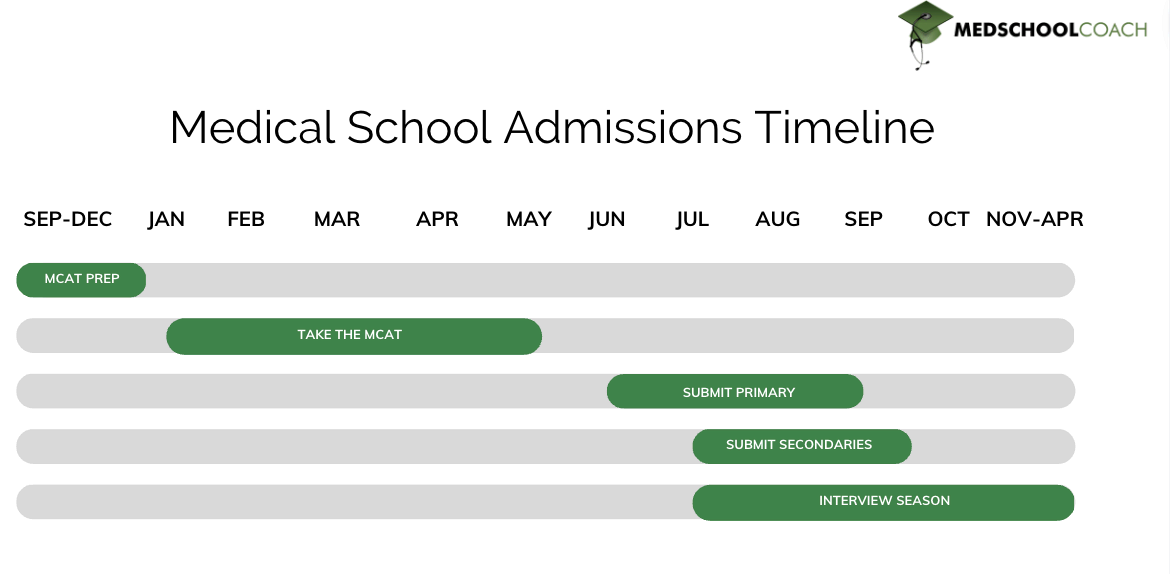
Acceptance decisions may arrive anywhere from a few weeks after your interview to the end of the interview cycle. Want a more detailed breakdown of med school timelines? Watch the video below.
Complete Prerequisites, Extracurriculars & Research
Preparation for medical school begins long before you submit your application. Admissions committees evaluate not only your grades and test scores, but also how you’ve spent your time outside the classroom and how consistently you’ve demonstrated your commitment to medicine.
Prerequisites
Medical schools require specific prerequisite courses and competencies for enrollment, and these requirements can vary slightly by school of medicine. Working closely with a pre-med or pre-health advisor as early as possible helps ensure you stay on track.
Here are a few things to consider:
- Plan your coursework early to complete all required prerequisites on time.
- Check individual school admissions requirements, as some programs differ.
- If you decide to pursue medicine later in undergrad or after graduation, consider a post-baccalaureate program to complete missing prerequisites.
Failing to meet even one required course can delay or derail your med school application and medical education, so careful planning is important.
Extracurriculars
Extracurricular experiences are one of the most essential parts of your medical school application. These activities demonstrate your exposure to medicine, your service mindset, and your ability to balance responsibilities.
I generally group extracurriculars into five core categories, each with recommended minimum hours:
- Shadowing: 30 hours
- Clinical experience: 150 hours
- Volunteering (non-clinical): 150 hours
- Leadership: 100 hours
- Research: Not required for all applicants or programs
These numbers represent minimums, not targets. Competitive applicants typically exceed them and show long-term commitment rather than short-term box-checking.
Research Opportunities
Research expectations vary widely depending on your career goals and your target programs. Some students can be competitive with little or no research, while others need extensive experience.
Here are some general guidelines:
- Primary care-focused programs: Research may not be necessary.
- Research-heavy or top-tier medical schools: Aim for 400 or more research hours.
- MD/PhD programs: Expect to need at least 1,500 hours of research experience.
Read Next: The Best Majors for Pre-Meds & How to Choose
Take the MCAT
The MCAT, or Medical College Admission Test, is a standardized exam that allows students to demonstrate the scientific knowledge necessary to excel in medical school. It is a full-day exam consisting of four sections covering biological sciences, physical sciences, psychology and sociology, and critical analysis.
Most students should plan to prepare for the MCAT for at least two to three months, focusing on high-yield content and full-length practice exams. To stay on track for an early application, schedule your test date so that your scores are released by early June. This generally means taking the MCAT by mid-to-late May at the latest.
You need a competitive score to get accepted to most U.S. medical schools. In the 2025/26 application cycle:
- The average MCAT score for MD matriculants was 512.1.
- The average MCAT score for DO matriculants was 502.97.
In general:
- 511-512 is competitive for most MD programs.
- 504+ is competitive for many DO programs.
- 515+ puts you in range for top-tier or Ivy League medical schools.
If your score is significantly below the averages for your target schools, it may be wise to retake the MCAT and delay your application by a year. Retaking for a one-point increase is rarely worth it, but a substantial improvement can meaningfully strengthen your candidacy.
Read Next: The Ultimate MCAT Guide with Study Tips & Resources
Write a Compelling Personal Statement
Your personal statement, sometimes called the personal comments essay, should be a story-driven snippet of your journey to becoming a doctor. This is where admissions committees learn who you are beyond grades and test scores, and why you want to become a physician.
Admissions committees are not looking for a list of accomplishments. A compelling personal statement should be centered on up to two meaningful experiences and reflect your motivations for pursuing medicine. Show insight into how your experiences shape those motivations.
Give yourself at least three to four weeks between your first draft and the final version you submit. You can review examples of real personal statements from students who were successfully accepted to medical school to better understand what works and why.
Craft your personal statement with 1-on-1 help from a Physician Advisor and a professional writer. No limits on messaging, hours, or edits.
Secure Letters of Recommendation
Letters of recommendation, also known as letters of evaluation, provide admissions committees with insight into how you perform in academic and professional settings. These letters help schools assess qualities like work ethic, professionalism, and readiness for medical training.
Most medical schools require two letters from science faculty and one letter from a non-science or non-STEM professor, but each program has slightly different requirements. Review the requirements for MD schools and DO schools.
Best practices for letters of recommendation include:
- Asking writers who know you well and can speak to your strengths in detail.
- Requesting letters well in advance, ideally several months before applications open.
- Providing your recommenders with your CV, personal statement draft, and relevant medical school application deadlines.
While some schools allow more, it’s generally best to submit no more than four letters per program, unless additional letters are specifically requested. Applicants may submit:
- Individual letters.
- Committee letters with multiple evaluator quotes.
- Committee letter packets that include a summary letter and supporting letters.
If you are applying to DO programs, it is strongly recommended to include a letter from a DO physician when possible.
Choose Where to Apply
Deciding where to apply to medical school is one of the most strategic parts of the admissions process. As a general rule, plan to apply to between 15-30 schools, although there is no formal limit.
Your goal should be to apply to schools that both align with your personal preferences and experiences and where you are likely to be accepted. Here are some things to consider:
- Program mission and fit: Look for schools whose values align with your interests, experiences, and career goals.
- Competitiveness: Compare your GPA and MCAT scores to the average metrics of accepted students.
- MD vs. DO programs: MD and DO graduates receive comparable medical training, but DO programs include osteopathic manipulative medicine and tend to emphasize primary care.
- Military medicine options: If you are interested in serving in the military, several pathways allow you to attend medical school at a reduced cost or tuition-free.
- Location and cost: Consider geography, tuition, and cost of living. If you live in Canada, you may be interested in Canadian schools closer to home.
- Program length and structure: Some schools offer accelerated three-year programs with more intense workloads.
- Special opportunities: MD-PhD and other dual-degree programs require additional essays and significant research experience.
- Residency considerations: Texas schools use TMDSAS and heavily favor in-state medical students for acceptance and financial aid.
- Early decision programs: I almost never recommend this, but if you have an incredibly strong application and are interested in only a single medical program, it is an option.
Tools like MSAR, MedSchoolExplorer, and MedSchoolCoach’s Med School Competitiveness (MSC) score can help you compare programs and refine your list.
Curated Medical School Lists
I’ve curated several medical school lists to help you build your own:
- 12 of the Best Medical Schools in the U.S.
- The 4 HBCU Medical Programs In the US (and 2 Coming Soon)
- The Easiest 30 U.S. Med Schools to Get Into
- The Best Medical Schools for Non-Traditional Applicants
- Accelerated Medical Schools in the U.S.
- Medical Schools that Accept International Students
- The 6 Best Caribbean Medical Schools
- Medical Schools That Don’t Require the MCAT
Submit Your Primary Application
There are three main primary application systems in the U.S. that you’ll use to apply to medical school. Each opens in May before your intended matriculation year and includes your academic history, activities, personal statement, and transcripts.
- AMCAS (American Medical College Application Service): This is used by most MD-granting allopathic medical schools. You can start submitting your AMCAS application in late May. Check the AAMC Fee Assistance Program page to see if you’re eligible for an application fee waiver.
- AACOMAS (American Association of Colleges of Osteopathic Medicine Application Service): The AACOM manages this application system for DO programs (osteopathic medicine). You can start submitting your AACOMAS application in late May.
- TMDSAS (Texas Medical & Dental Schools Application Service): Most Texas medical schools use this application system. You can start submitting your TMDSAS application in mid-May, with deadlines extending into October.
Each of these primary applications will require you to upload:
- Your coursework and grades
- Activities and experience descriptions
- Your personal statement
- Official transcripts
- Letters of evaluation (submitted either through the system or separately, depending on school rules)
You can submit your application before your MCAT scores are released. Schools will hold your application and automatically match it with your official scores once they arrive. Submitting early is important because admissions officers begin reviewing application materials and sending secondaries soon after applications are verified.
A Note on Canada: Ontario medical schools use the Ontario Medical School Application Service (OMSAS) application system. Starting with Fall 2026, most seats are reserved for Ontario residents and Canadian citizens, leaving very few spots for international students. Other provinces may still accept international applicants, but rules vary by school.
Verification Process
Medical school application verification takes up to six weeks to complete after submission. Your primary application goes through this verification process to compare your submitted information to your undergraduate transcripts before submitting it to your chosen schools.
The longer you wait to submit during the cycle, the longer verification will take. That’s one reason why submitting your primary application as soon as possible is key. The earlier you submit, the earlier your application will be reviewed, while the most interview spots are still available.
Submit Secondaries
Submit all secondaries by the end of July. Each school will include essay prompts, and you should also ensure any situational judgment test (SJT) results are submitted to the AAMC or AACOM if required. (Casper and AAMC PREview are the most common.)
DO and MD programs typically don’t review applications immediately after verification. Instead, they send secondary applications to students who meet minimum requirements. You can start drafting your responses right after submitting your primary application. Check out this essay prompts database for guidance.
During this evaluation, schools generally categorize applications into three outcomes:
- Interview: You’ll receive an interview invitation to meet with the medical school admissions committee, typically between September and March.
- On hold: In some cases, a school may not be immediately ready to move forward, but is not ready to reject your application. “On hold” is different from “waitlisted.”
- Rejection: When a school decides you aren’t the right fit for their program, you’ll get a message telling you you’ve been rejected.
Interviews
Medical school interviews usually take place between September and March. Depending on the school, interviews may be:
- MMI (Multiple Mini Interview): There are several short, structured interactions with different interviewers or stations.
- Traditional panel: You’ll sit in one longer session with a few admissions committee members.
- Virtual or in-person: Most schools still conduct interviews virtually, though some offer hybrid or in-person formats.
When getting ready, review common interview questions, including what you’re more likely to be asked during an MMI. Practice with friends, a mentor, or a mock interview service to become comfortable. Familiarize yourself with each school’s mission, programs, and culture, and prepare a few questions to ask the interviewers.
Admissions Decisions
Acceptance timelines can vary depending on the school. Some operate on a rolling basis, reviewing applications and sending out acceptances as materials are received. Others follow a fixed schedule, evaluating applications in batches and releasing decisions by spring.
Based on my experience as an admissions advisor, most accepted students get two to three acceptance letters, offering them a few options to consider. Even if you receive one acceptance, it’s a major accomplishment in the highly competitive medical school admissions process.
Read Next: How to Write a Letter of Intent for Medical School
Cost & Fees to Consider
For most students, applying to medical school costs between $2,000 and $3,000. This includes primary application fees (the initial fee and fees for additional school designations), secondary application fees per school, and interview travel costs.
Some students may also pay for test prep courses for the MCAT, tutoring or admissions consulting, and application services. The number goes up the more applications you send out, as well.
Reapplicants & Non-Traditional Applicants
Some applicants don’t follow the traditional straight-from-undergrad path. Whether you’re reapplying after a previous cycle or coming from a different career or life path, you’ll face unique challenges, but also opportunities to stand out.
Reapplicants
If you’re reapplying after a rejection, you must show meaningful improvement since your last cycle. Consider the following:
- Improve your MCAT score. (Tutoring can help increase by 10-12 points on average.)
- Boost your GPA through a post-baccalaureate program or Special Master’s Program.
- Gain additional clinical experience or volunteering hours.
- Strengthen your personal statement and highlight growth or new experiences.
- Expand or improve your research experience if relevant.
Non-Traditional Applicants
Non-traditional applicants may face unique challenges, but differences can also be strengths. Typically, non-traditional applicants:
- Are over 26 years old.
- Pursued another career before medicine.
- Majored in something other than science.
- Have a spouse and/or children.
- Have taken several gap years, and not just to prepare for medical school.
These applicants can stand out by emphasizing transferable skills, unique experiences, and a strong commitment to medicine.
FAQs
Medical school is highly competitive. In the 2023-2024 U.S. application cycle, only about 45% of applicants were accepted into MD schools. About 42% were accepted into DO schools.
The process requires strong academics, meaningful clinical and research experience, impactful extracurriculars, and a compelling personal statement. With careful planning and preparation, applicants can maximize their chances of acceptance, even in this competitive environment.
Admissions committees review applications holistically, considering multiple aspects of your record. The most important factors typically include:
- GPA and BCPM GPA
- MCAT score
- Clinical experience and patient exposure
- Research experience (if applying to research-focused programs)
- Extracurricular activities and leadership
- Personal statement and essays
- Letters of recommendation
Other factors can also play a role, such as specialty interests, fit with the program’s mission, and unique personal experiences. Strong performance across multiple areas will make you a more competitive applicant.
Competitive averages vary depending on the type of program:
- MD programs: Overall GPA 3.6, Science/BCPM GPA 3.7, MCAT 511-512
- DO programs: Overall GPA 3.5-3.6, MCAT 504-506
GPA and MCAT averages tend to be higher at Ivy League or top-tier MD programs, with MCAT scores often at 515+.
Falling below the competitive averages for overall GPA, BCPM GPA, or MCAT does not automatically disqualify you from medical school. To succeed, you’ll need to strengthen other parts of your application, like your personal statement, clinical experience, or research work.
If you’re concerned about not being competitive enough to get accepted, consider waiting for the next application cycle and improving your application by:
- Retaking the MCAT exam if you think you can increase your score by more than six points. (MCAT tutoring can help you here. Our students improve their scores by about 12 points on average.)
- Completing a post-baccalaureate program to improve your GPA and retake important classes for which you got a poor grade.
- Logging more clinical work experience hours in your full-time day job.
- Investing in medical school application consulting can more than double your chances of acceptance.
Be a Standout Medical School Applicant
Applying to medical school is a long, detailed process, and starting early can make all the difference. Every component of your application, from your personal statement to your clinical experience, plays a role in showing admissions committees that you’re ready for med school.
Build your application alongside a doctor with admissions experience, and join the 95% of clients who get into medical school.

Sahil Mehta MD
Dr. Mehta is the founder of MedSchoolCoach and has guided thousands of successful medical school applicants. He is also a practicing physician in Boston where he specializes in vascular and interventional radiology.
See How We Can Help
Search for:
RECENT POSTS
How to Create Your Residency Match Rank Order List (ROL)
medschoolcoach
The Med School Journey – Definitions to Become a Doctor
medschoolcoach
USMLE Step 3 Scoring
Joel Ramirez MD
MCAT Math Tips from the Nation’s Leading Tutor
Dr. Ken Tao
Medical School Acceptance Results