




In July 2025, the Step 2 passing score increased from 214 to 218. Since the USMLE Step 1 score system is now pass/fail, Step 2 CK is among the most influential factors in residency admissions, and the bar just got set higher.
Not to worry, though! We’re here to tell you all about what to expect from the USMLE Step 2 CK exam, the most up-to-date passing standards, and how to get the USMLE scores that will get you into the residency of your dreams.
Get a Guaranteed Score Increase when you sign up for Silver, Gold, or Platinum USMLE/COMLEX tutoring.
An In-Depth Breakdown
Below is a breakdown of what is on the USMLE Step 2 CK exam.
First, let’s look at the content on which you’ll be tested on the Step 2 exam:
| System (subject) | Estimated percentage of this section |
|---|---|
| Human Development, Normal Age-Related Findings, and Care of the Well Patient | 2-4% |
| Immune System | 3-5% |
| Blood & Lymphoreticular System | 3-6% |
| Behavioral Health | 5-10% |
| Nervous System & Special Senses | 5-10% |
| Musculoskeletal System/Skin & Subcutaneous Tissue | 6-12% |
| Cardiovascular System | 6-12% |
| Respiratory System | 5-10% |
| Gastrointestinal System | 5-10% |
| Renal & Urinary System & Reproductive Systems | 7-13% |
| Pregnancy, Childbirth & the Puerperium | 3-7% |
| Endocrine System | 3-7% |
| Multisystem Processes & Disorders | 4-8% |
| Biostatistics & Epidemiology/Population Health/Interpretation of Medical Literature | 3-5% |
| Social Sciences: Legal/Ethical Issues & Professionalism/Systems-based Practice & Patient Safety | 10-15% |
Next, let’s look at the physician tasks and competencies that are tested on Step 2:
| Competency | Estimated percentage of this section |
|---|---|
| Patient Care: Laboratory/Diagnostic Studies | 13-17% |
| Patient Care: Diagnosis | 16-20% |
| Patient Care: Prognosis/Outcome | 5-9% |
| Patient Care: Health Maintenance/Disease Prevention | 5-10% |
| Patient Care: Pharmacotherapy | 8-12% |
| Patient Care: Clinical Interventions | 6-10% |
| Patient Care: Mixed Management | 12-16% |
| Practice-based Learning & Improvement | 3-5% |
| Professionalism | 5-7% |
| Systems-based Practice & Patient Safety | 5-7% |
Finally, the Step 2 CK exam covers content related to these traditionally defined physician disciplines:
| Competency | Estimated percentage of this section |
|---|---|
| Medicine | 55-65% |
| Surgery | 20-30% |
| Pediatrics | 17-27% |
| Obstetrics & Gynecology | 10-20% |
| Psychiatry | 10-15% |
Step 2 is not scored linearly. If you get 90% of the questions right, you’re not going to get a 270. It’s a little more complicated than that due to a few factors:
- Experimental questions: There are unscored questions on Step 2. You won’t know which ones are experimental and unscored, so treat every question like it’s important.
- Difficulty: Part of the USMLE’s algorithm for weighting/curving your score is the difficulty of the test or certain questions, as determined by how other test takers did.
There is no hard and fast rule about how many questions you need to get right to pass, but USMLE.org states, “examinees typically must answer approximately 60% of questions correctly to achieve a passing score.”
Is there a penalty for wrong or unanswered questions? No, there is no penalty for guessing. Wrong and unanswered questions are both scored as incorrect. So, it’s essential not to leave any questions unanswered. Additionally, there’s no partial credit for partially correct answers.
Note: There used to be a Step 2 CS (Clinical Skills), but it was suspended in March 2020 due to the pandemic. It was fully discontinued in January 2021 due to internal evaluation of its effectiveness, high cost to students, and the evolving medical landscape.
New “Passing” Standards
In July 2025, the USMLE (United States Medical Licensing Examination) Management Committee announced new passing standards for Step 2. The former passing score has been raised from 214 to 218.
This was done after thoroughly consulting multiple sources:
- Independent groups of physicians and medical education professionals unaffiliated with the USMLE participated in content-based standard-setting panels in March-April 2025.
- Surveys of various stakeholders (residency program directors, medical school faculty, state licensing representatives, examinees) found the current passing standards for the Step 2 CK examination inappropriate.
- USMLE looked at data trends in examinee performance and score precision.
If you’re worried about a decreasing pass rate, it’s important to know that the new passing standard isn’t a very strict metric. About 2% of Canadian and US test takers failed to pass Step 2 last year. With the same test scores but the new passing standard, about 3%-4% of test takers will now fail the same test.
That said, because a 218 is roughly 3rd percentile for first-time US and Canadian examinees, it’s not a very competitive score for residency applications. Even in the least competitive specialties, like Family Medicine and Psychiatry, matched U.S. MD applicants have a median Step 2 score of greater than 240.
Learn More: A Comprehensive Guide to the NRMP Match
All of this compounds on top of the COVID-era decision to change Step 1 to a pass/fail grading system, which was designed to alleviate stress for medical students. However, it really only shifted it forward and added to the stress of Step 2, taken in the third year or fourth year of med school.
What Score You Need
The USMLE Step 2 CK test is scored on a scale of 1 to 300. But no one really gets a 1 or a 300. The most recent average Step 2 score is 250. Among US IMGs (International Medical Graduates), the average Step 2 score was around 235.
Here are the important score thresholds you need to know:
- Former minimum passing score: 214
- New minimum passing score: 218 (bottom 3%)
- Good score: 245 (34th percentile)
- High score: 255 (60th percentile)
A high USMLE Step 2 score of 255 puts you in a great place to apply for competitive residencies. Although programs look at your application holistically, a 255+ Step 2 score greatly increases your likelihood of getting a residency interview invite.
It’s important to know which specialty you’re looking to pursue. Different average scores are expected for different specialty applications.
- If you’re looking at less competitive specialties like Family Medicine or Psychiatry, a Step 2 score of 245 puts you around the average of matched U.S. MD residents in those types of residency. For Internal Medicine, the average is a bit higher—in the low 250s.
- If you’re aiming for a more sought-after residency specialty like Neurosurgery, Dermatology, Plastic Surgery, or Orthopedic Surgery, the average Step 2 score for U.S. MD matched residents is higher, above 255, to be a competitive applicant.
Download our free Autonomic Pharmacology Anki deck to start learning the mechanism of action, main effects, and indications of each autonomic drug. Get access to 150 Anki cards plus a 55-page high-yield PDF, packed with the only info you need on autonomic drugs.
How Programs View Your Score
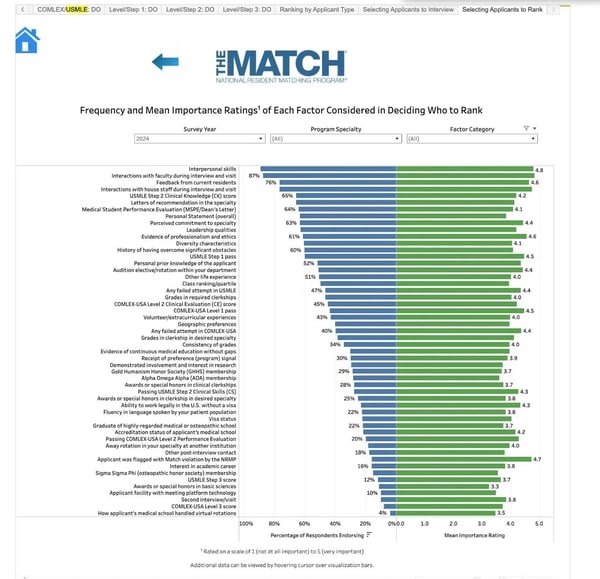
Residency programs view your Step 2 CK score as critical to your residency application, especially since Step 2 CS was discontinued in 2021, and Step 1 was converted to a pass/fail format in 2022.
Residency program directors consistently list Step 2 scores as among the most crucial variables when deciding who to invite for residency interviews.
Of course, you can match it into residency with a low Step 2 score, and matching isn’t a sure thing if you score high. The residency application process is multifaceted, and Step 2 is just one of several factors.
A 260 on the USMLE Step 2 CK exam puts you in the 74th percentile, which is a very good score. With a 260, you can apply to competitive residencies.
Get a Guaranteed Score Increase
At MedSchoolCoach, we have worked with hundreds and hundreds of students looking to improve their USMLE scores and residency applications. You can take the USMLE Step 2 with confidence! We offer a guaranteed score increase on your Step 2 CK test. If you don’t improve your score versus a previous attempt or an NBME self-assessment, we’ll add more hours to your tutoring package at no extra cost!
Work with a 90th-percentile tutor, and get a Guaranteed Score Increase when you sign up for a Silver, Gold, or Platinum USMLE/COMLEX tutoring package.
FAQs
Prepare for your Step 2 CK exam by using a high-quality question bank. You’ll also want to follow a structured, realistic study plan that reflects the official USMLE Step 2 CK content outline. Build your study schedule around your clerkships, making QBank questions your primary resource and carefully reviewing every mistake to spot patterns in your weaknesses.
Additionally, review the test format and official sample questions from the exam. This will help you know exactly what’s being tested and how test questions will be formatted.
To improve your Step 2 CK score, establish a baseline by using an NBME Comprehensive Clinical Science Self-Assessment and use that score report to identify weak systems and topics. Then, focus your studying on targeted practice blocks in those areas rather than just completing random questions.
Here are some of our tips so you can improve your score:
- Pay attention to why you miss questions. Figure out if it’s because of knowledge gaps, misreading stems, or strategy errors. Then, address each reason for a missed question specifically.
- Look for sample exams from trusted sources. Flashcards are also an effective tool for studying.
- Work with a MedSchoolCoach Step 2 CK tutor who can help you refine your test-taking approach and close the specific gaps that are limiting your score.
- Get plenty of rest before your test day. I’ve seen Reddit users say that a cup of coffee before the exam improved their score by 5 points.
- Go with your gut and don’t second-guess yourself. I’ve heard people describe their test-taking experience as one of constantly second-guessing themselves. When they stopped overthinking and went with their first choice, their score improved.
A 260 on the USMLE Step 2 CK exam puts you in the 74th percentile, which is a very good score. With a 260, you can apply to competitive residencies.