Table of Contents
The AMCAS (American Medical College Application Service) is the centralized application system used by all allopathic medical schools (MD schools) in the United States. AMCAS is managed by the AAMC (Association of American Medical Colleges) in Washington, D.C.
Important AMCAS dates and deadlines:
- May 1, 2026 — AMCAS opens for the 2026/27 application cycle
- May 24, 2026 — Last recommended date to take the MCAT for this cycle
- June 15, 2026 — Latest recommended date to submit AMCAS
- June 19, 2026 — Last recommended date to take the Casper or AAMC PREview exam, if required by your institution (see the latest Casper schedule here and the PREview schedule here)
- August 15, 2026 — Latest recommended date for secondary submissions
- September 12, 2026 — Latest date to take the MCAT exam in 2026 (but we recommend a test date in May or earlier, if possible)
- January-March 1, 2027 — Application deadlines for most MD schools fall here (but we recommend applying much, much sooner)
I’ll walk you through what to expect when submitting your primary application through AMCAS, including a step-by-step guide with screenshots.
Are you also applying to DO schools or any medical programs in Texas? Check out our guides to AACOMAS (osteopathic schools) or TMDSAS (Texas medical programs).
Browse our free Med School Explorer tool to view key stats for each medical school, including GPA/MCAT, tuition, class size, secondary essays, interview format, and more. Filter and compare schools to build a personalized school list in minutes.
AMCAS Application Timeline
The AMCAS application window opens the first week of May each year. However, there are actions you should take in preparation for the AMCAS application even before it officially opens.
Medical schools typically use a rolling admissions process, which means applications are reviewed as admissions officers receive them, which naturally benefits early applications. We recommend submitting your application as early as possible — the first week of June is ideal.
Below is the best AMCAS timeline to follow, broken up into three helpful time periods.
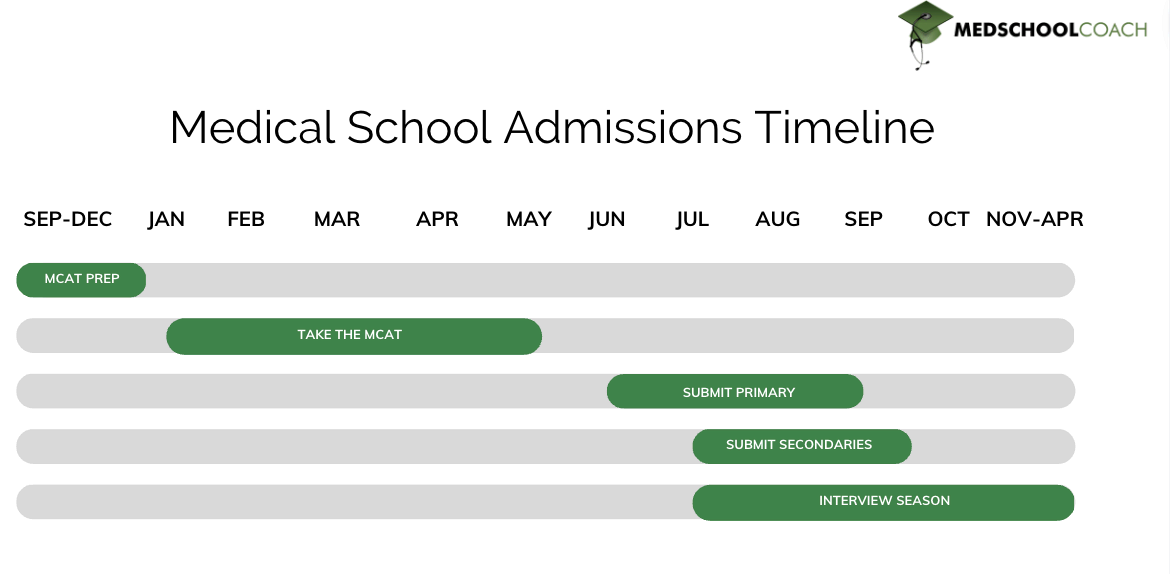
September – December
Don’t wait till May to start preparing your application. Before the AMCAS officially opens, there are several actions in September through December that you can take to reduce your stress later and strengthen your application:
- Plan a comprehensive MCAT study schedule and prepare for the exam.
- Check in with your pre-med advisor to ensure you’re on track to meet all the prerequisites.
- Begin contacting evaluators you hope will provide you with letters of recommendation.
- Research the specific MD programs you want to apply to. Use our free MedSchoolExplorer to discover which programs are perfect for you!
- Consider any extracurriculars (including clinical work) you plan to complete before graduation to strengthen your application.
- Request your official transcripts from all undergraduate schools you’ve attended.
January – April
The AMCAS officially opens in May, but there’s still a lot you can do to make your life easier down the line. Here are the steps you can take in January through April, leading up to the AMCAS opening in May:
- Start drafting your personal statement. Do not use AI to write it. (You may use AI to suggest edits, though.) Get a mentor to review your personal statement and give feedback.
- Start drafting your work and activities descriptions. The Work/Activities section is where you can demonstrate what kind of leader, student, and future physician you are.
- Take the MCAT early enough to get your scores back by the end of June or earlier. Your MCAT scores are automatically released to AMCAS, so you don’t have to do anything extra to have the scores included with your application. (Keep in mind that this means you also cannot prevent previous MCAT scores from being included.)
- Schedule your Casper or AAMC PREview exam if required by your chosen school(s).
- Create an account on the AMCAS website. Log in or create your account here.
May
At the beginning of May, the AMCAS system opens up, but you cannot submit any applications for a couple of weeks. As soon as AMCAS opens up, here’s what you can do:
- Complete the Identifying Information, Schools Attended, and Biographic Information sections of the application.
- Fill out the Course Work and Official Transcript(s) section. These can get tedious, but check out our simple guide below.
- In the Letters of Evaluation section, list your letter writers who will send in confidential letters about your character and competency. Check in with your evaluators to ensure they received the request via email. Schedule follow-up times with them after a period of time has passed if their evaluation hasn’t been submitted.
- Request that your schools send your official transcripts directly to AMCAS. Resolve any holds due to financial or other issues as quickly as possible.
- Paste in your Personal Statement and Work/Activities descriptions. The AMCAS uses simple text processing without any formatting, so be careful about formatting errors.
June – August
We recommend submitting your application by the beginning of June. Here’s what the summer looks like:
- Submit your application after filling out the remaining AMCAS sections and reviewing the essay portions.
- Download a completed copy of your primary application.
- Keep an eye on your application’s verification status. Verification should take around 10 days to complete. If your application has a significant number of errors, it may be “undelivered” and returned to you for correction.
- If you need to make changes after submission, check out our list on what can be edited.
- When requested, submit secondary applications no later than the end of July or the beginning of August.
From September 2026 through February 2027, you may receive requests to interview at one or more programs. Most schools operate on a rolling admissions process, meaning they accept students right away who successfully complete interviews. Others may wait until all interviews are complete before sending acceptance letters as late as March 2027.
How to Fill Out Your AMCAS Application
Filling out your AMCAS will take many hours, but you can spread it across several weeks.
Pre-draft your personal statement and work/activities descriptions months in advance, and print out all your transcripts. That way, filling everything out will take 2-6 hours, and you can apply early in the cycle to increase your odds of an interview invite.
There are 9 AMCAS application sections:
- Identifying Information
- Schools Attended
- Biographic Information
- Course Work
- Work/Activities
- Letters of Evaluation
- Medical Schools
- Essays (including Personal Statement)
- Standardized Tests
Some of these sections are simply informational, while others are used to assess you as a candidate on a personal, academic, and professional level.
You must fill out the Identifying Information and Schools Attended sections before you can proceed to other sections. The Medical Schools section can only be opened after you’ve completed the Biographic Information section.
Pro Tip: The AAMC defines core competencies that pre-medical candidates should demonstrate on their primary application. It’s a good idea to understand these competencies, so you have the best shot at crafting an application that stands out from the rest.
Keep reading to learn more details about completing each section. (Plus, we grabbed screenshots to help you better understand the AMCAS.)
Set Up Your Account
Set up your account with AMCAS so you can fill out their online med school application:
- Visit the Applying to Medical School with AMCAS® page on AAMC’s website.
- Click the blue “AMCAS Sign In” button in the upper right corner.
- On the sign-in page, click “Create Account” on the right.
- Enter your personal information, initial questions, and account information as indicated.
- Check your email for a verification link.
- Once you’ve clicked the link in your email, you’ll receive a notification that your account has been verified, and you will be directed to sign in.
Select from available application cycles.

Pro Tip: Start early and go slowly, carefully checking every field of the application as you go. You can save and edit the application as many times as you want before hitting submit. Even the tiniest errors in grammar, capitalization, and punctuation will reflect poorly on you with admissions committees.
Follow the prompts to enter your identifying information, including:
- Legal name
- Gender
- Birth country, state, and county
- Birth date
- Citizenship
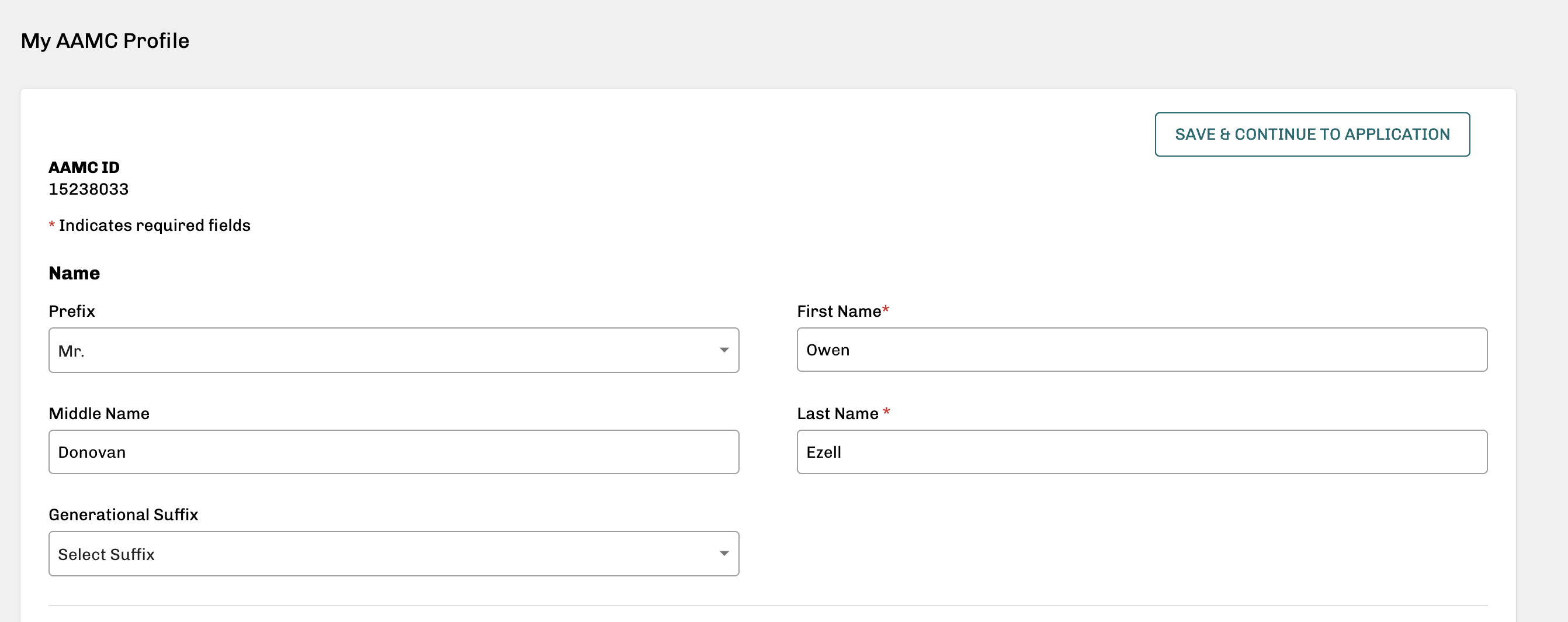
After filling out your name, click “Save & Continue to Application.”
You’ll be taken to an application main menu that shows your personal information, the 9 sections of the application (and whether they’re complete or not), quick links for help with your application, and your document statuses.
You won’t see an area to view your letters of evaluation/recommendation or transcripts since these are submitted directly to AMCAS.
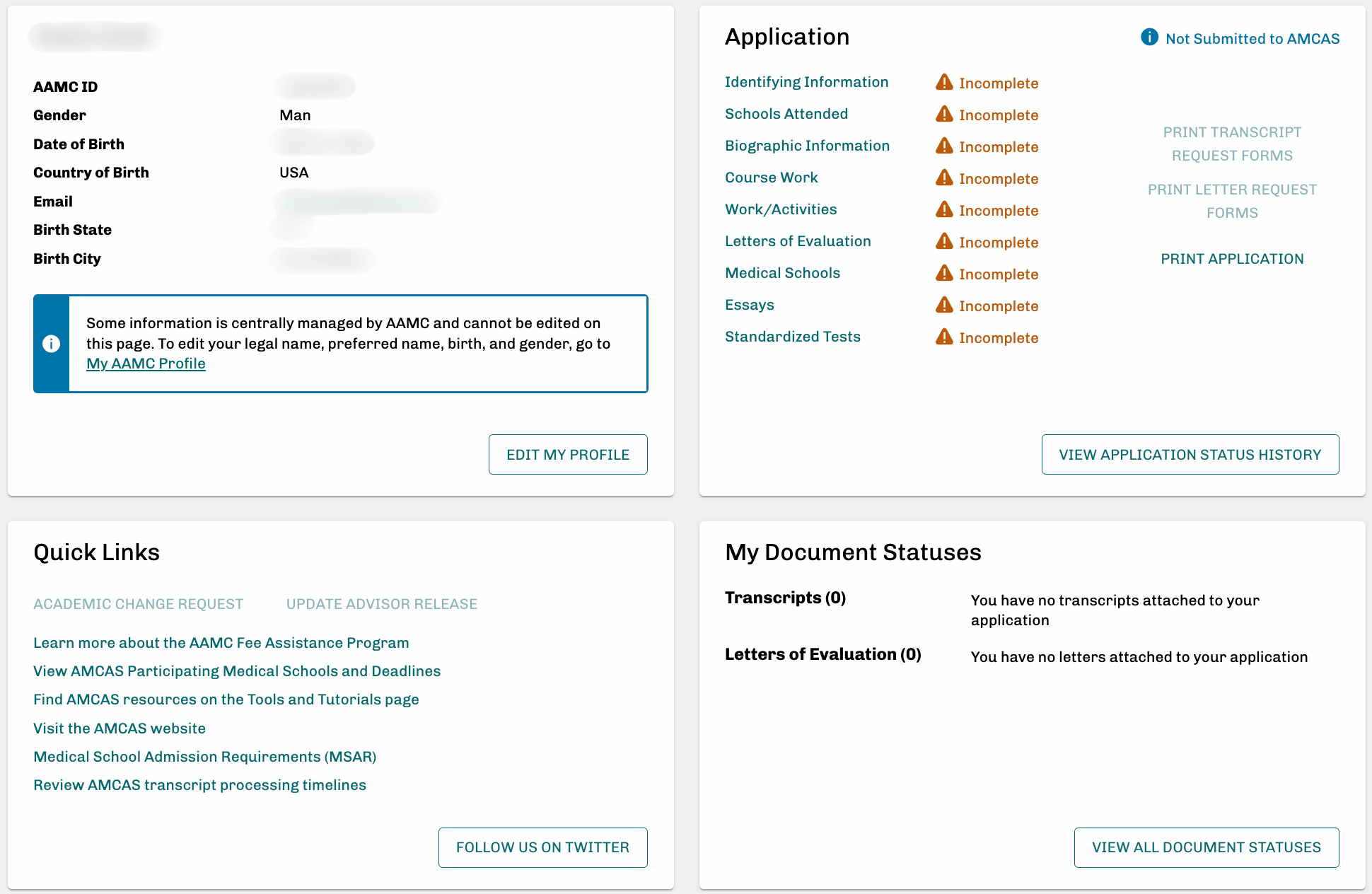
Section 1: Identifying Information
Most of the Identifying Information data is pulled over from your profile creation. Complete any missing or inaccurate information in this section until a checkmark shows the section is completed.
Section 2: Schools Attended
In the Schools Attended section, you’ll enter the information for your high school and colleges, including any attempted postsecondary, foreign/study abroad, or military education.
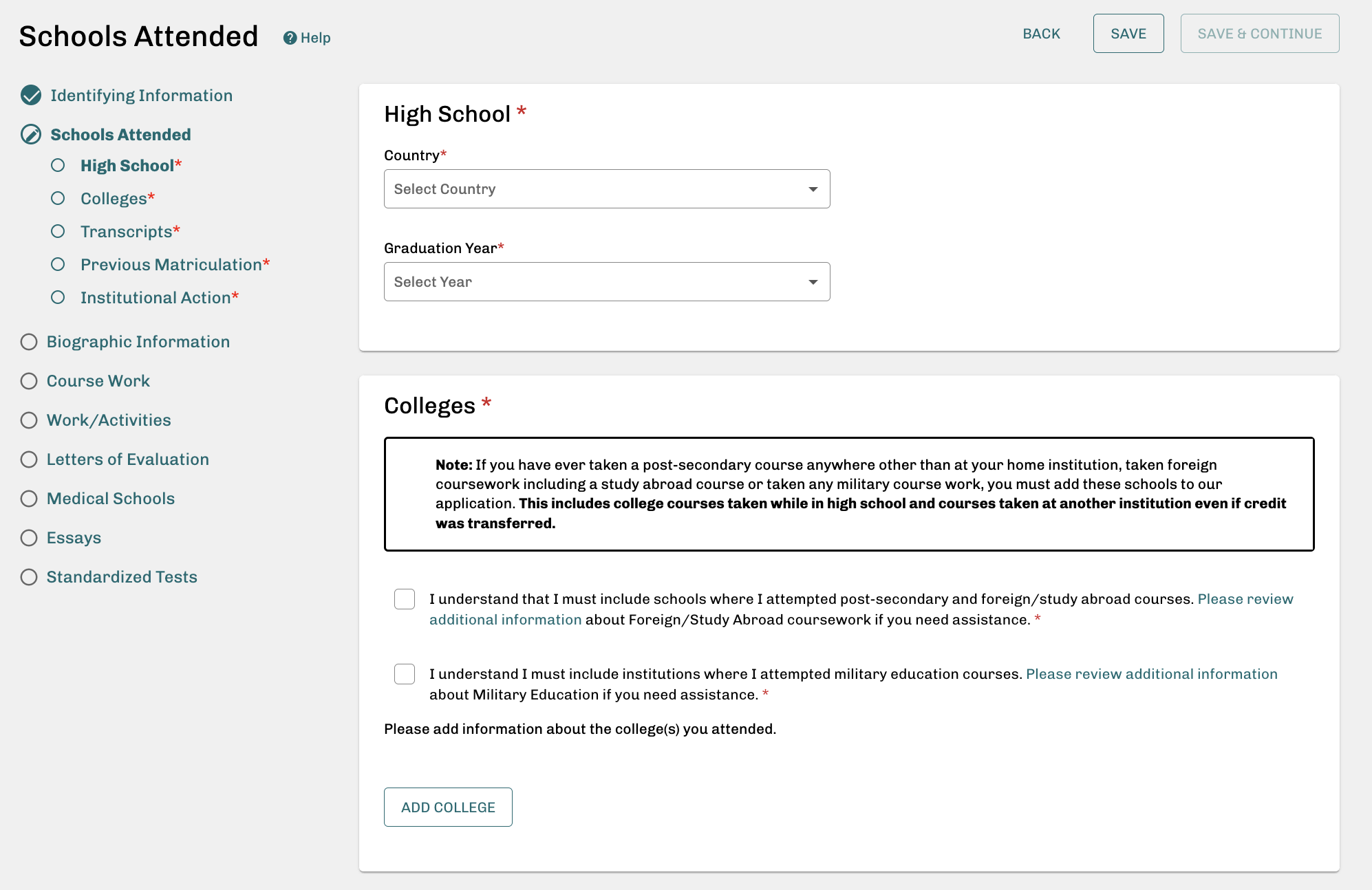
You will also have to state whether you have matriculated as a medical school student previously and whether you were ever the recipient of any institutional action by any college or medical school for unacceptable academic performance or conduct.
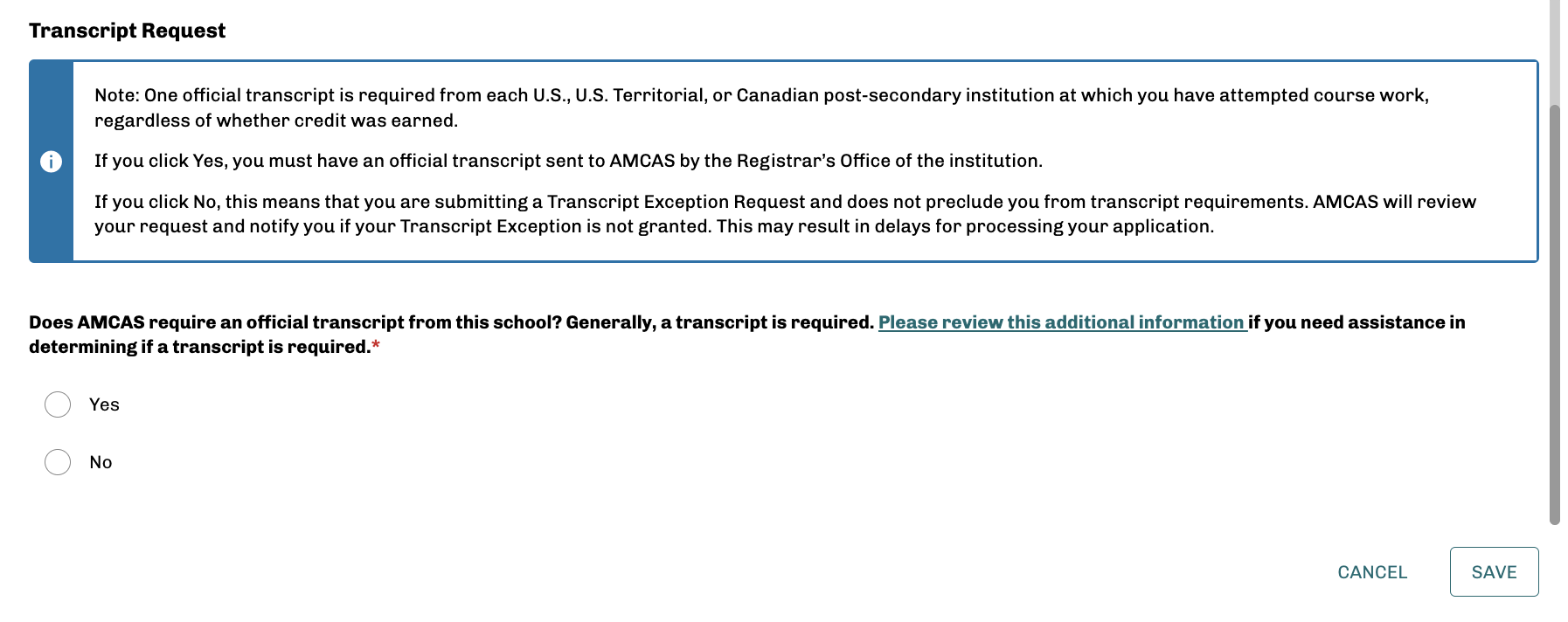
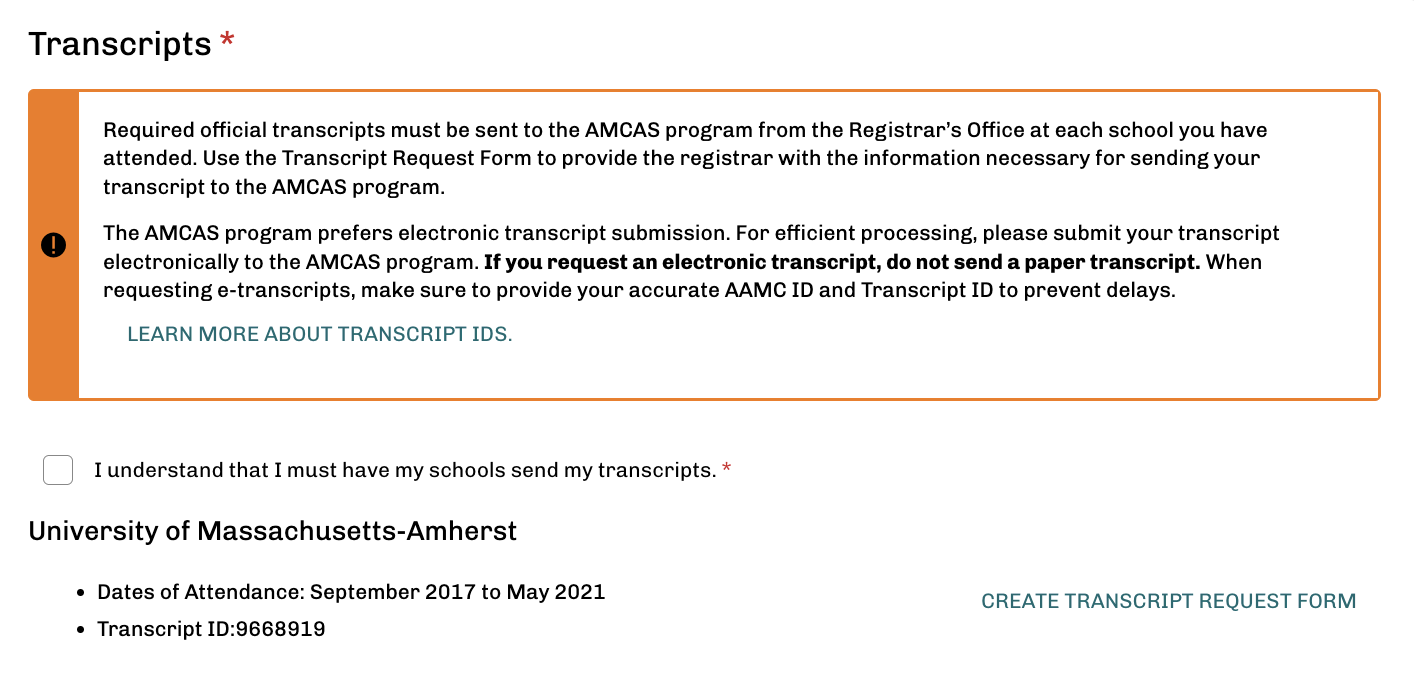
This is also where you’ll first see the notice that official transcripts are submitted directly to AMCAS from your school’s registrar. Once you enter a college’s information, you’ll have an opportunity to create a transcript request form.
Section 3: Biographic Information
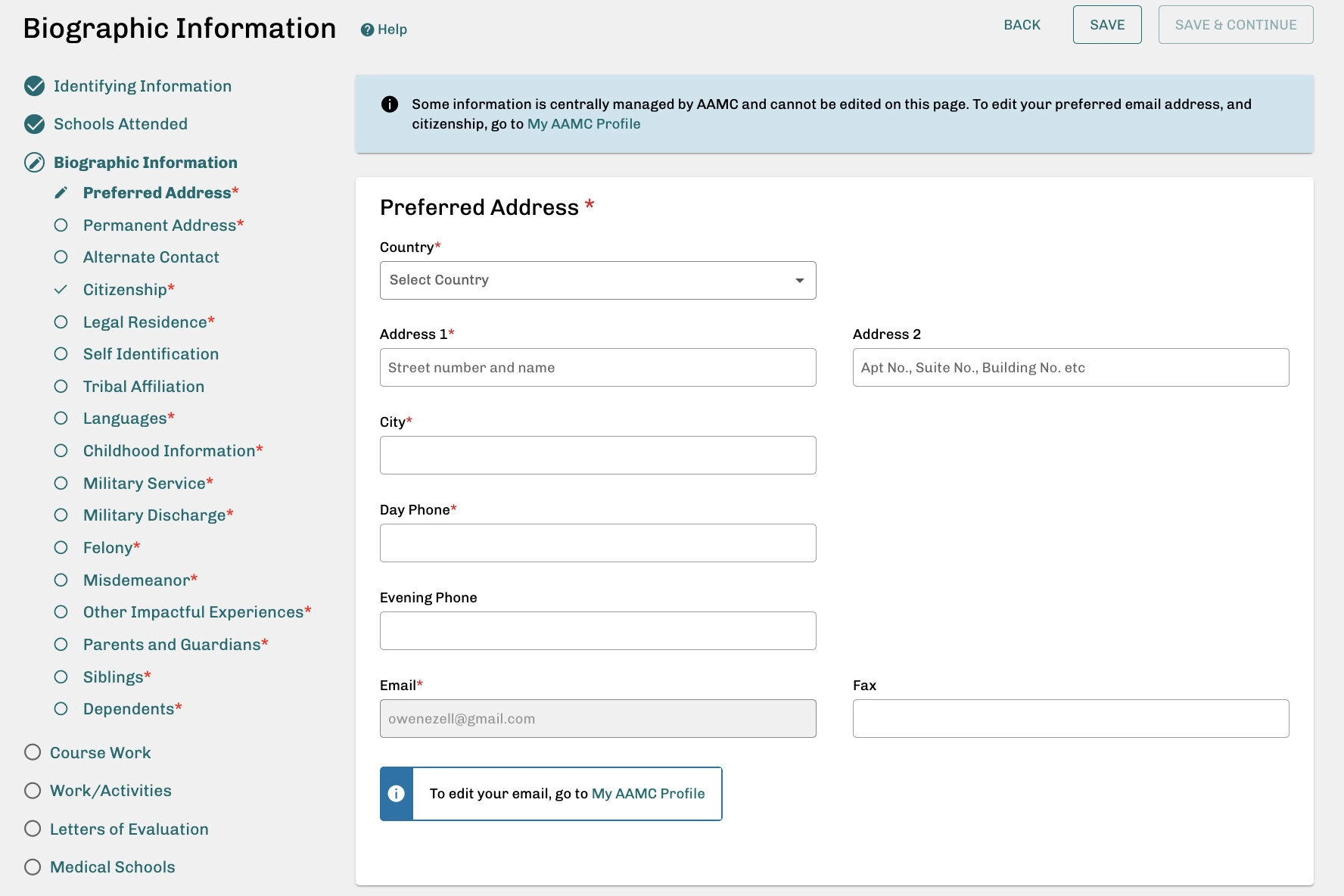
Biographic Information is a hefty section with a ton of personal information and background. Go step by step and fill in the blanks as indicated. These prompts include:
- Preferred address
- Permanent address
- Alternate contact
- CItizenship
- Legal residence
- Self-identification
- Tribal affiliation
- Languages
- Childhood information
- Military service
- Military discharge
- Felony
- Misdemeanor
- Other impactful experiences
- Parents and guardians
- Siblings
- Dependants
The “Other Impactful Experiences” question was added to the section in 2024. It replaces the “Disadvantaged Status” question seen in previous application cycles.
If you answer “Yes” to the “Other Impactful Experiences” question, you’ll be expected to submit a narrative essay of 1,325 characters or fewer describing your experience and sharing how it directly impacted your life opportunities. Learn more about this question here.
Section 4: Course Work
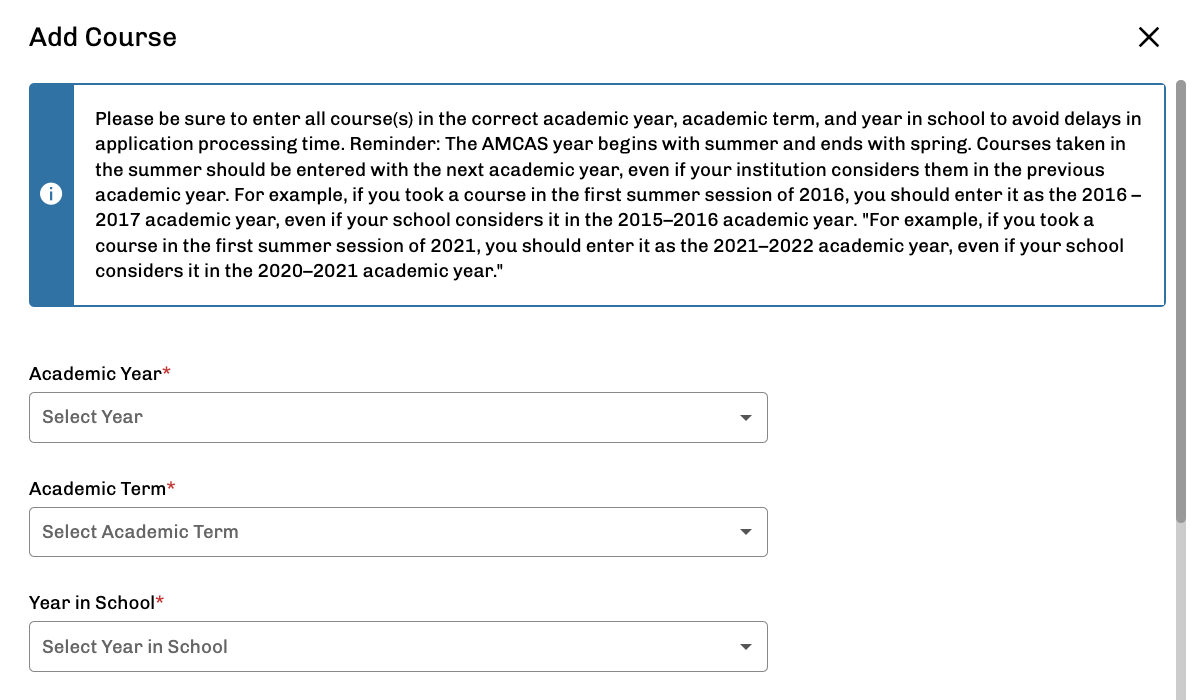
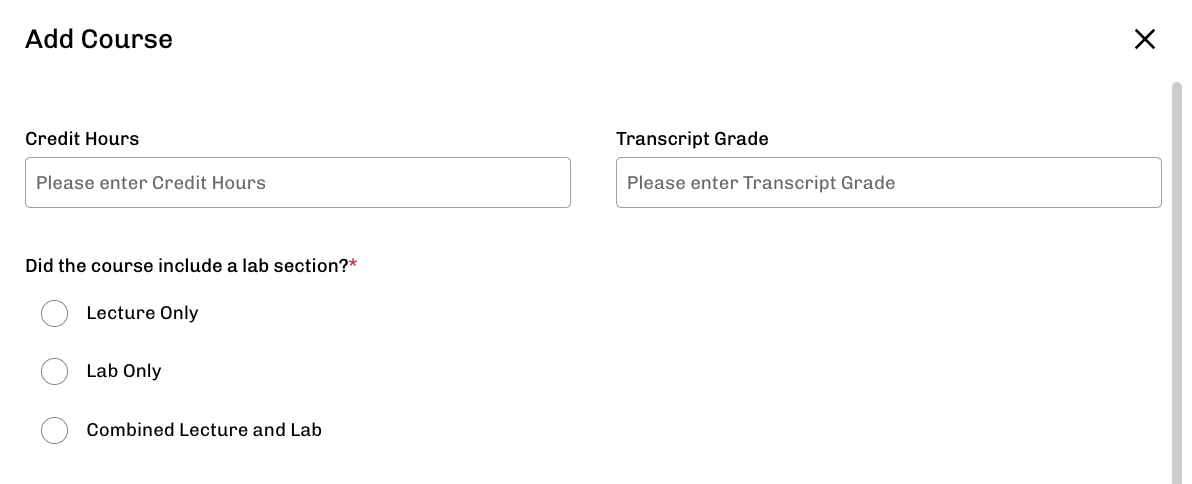
In Section Four, you must enter every course you took at each school — it’s tedious, so have your printed transcripts in hand and settle in for this section.
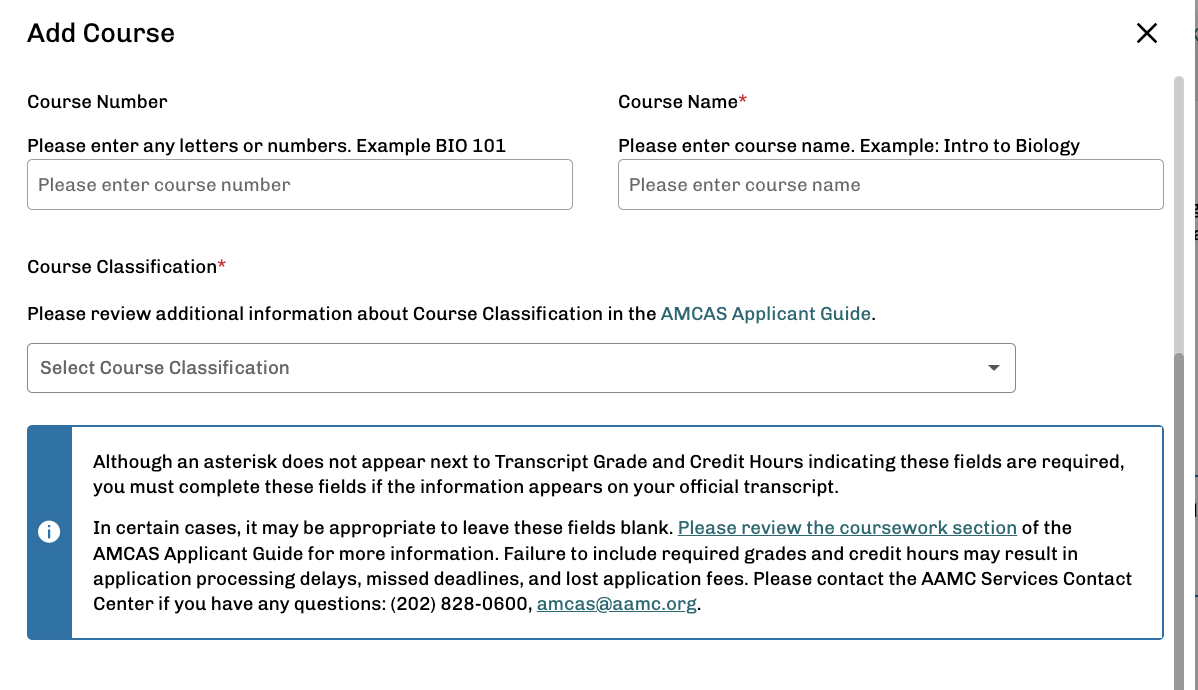
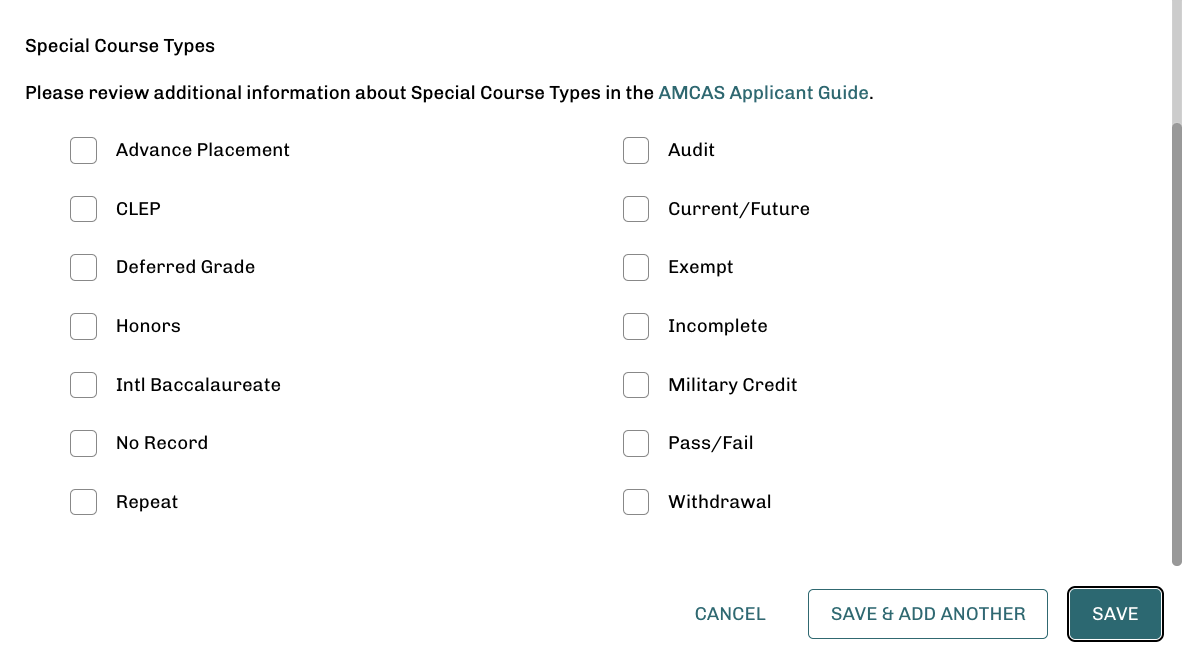
For each course, you’ll fill in institutional information, course classification, your grade, and more. See screenshots below for details.
Pro Tip: Course classification can be tricky. All courses are classified as BCPM science courses (biology, chemistry, physics, math) or AO courses (all others). AMCAS offers a Course Classification Guide that provides examples of how courses are often categorized.
Ultimately, you are responsible for selecting the correct course classification, but AMCAS reserves the right to change classifications if the assigned classification clearly does not apply. Misclassified courses may delay the verification of your application. Working with an admissions advisor can ensure you classify courses correctly the first time.
Section 5: Work/Activities
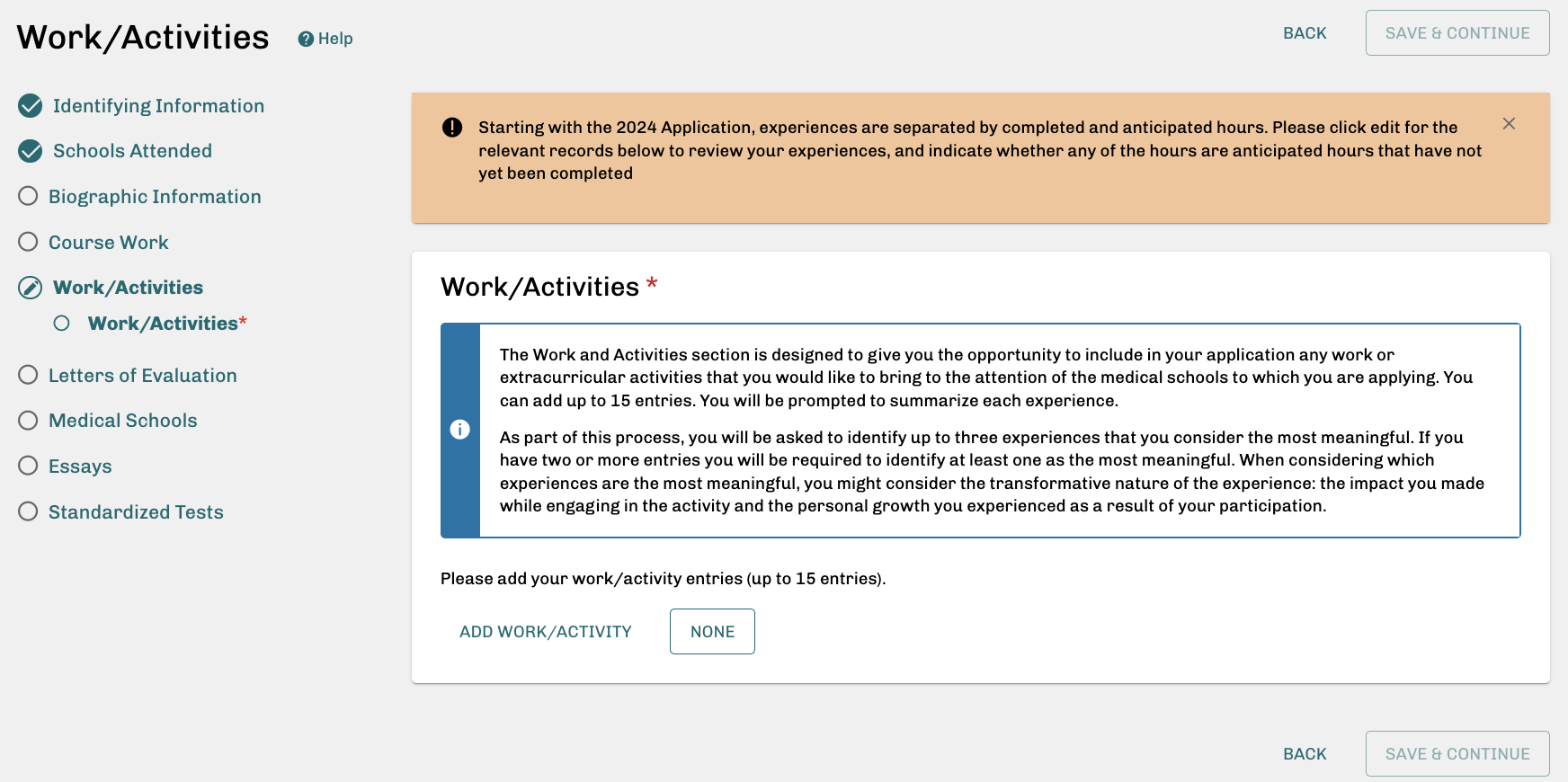
The Work and Activities section is another hefty section where you can show what makes you a strong applicant beyond your schoolwork.
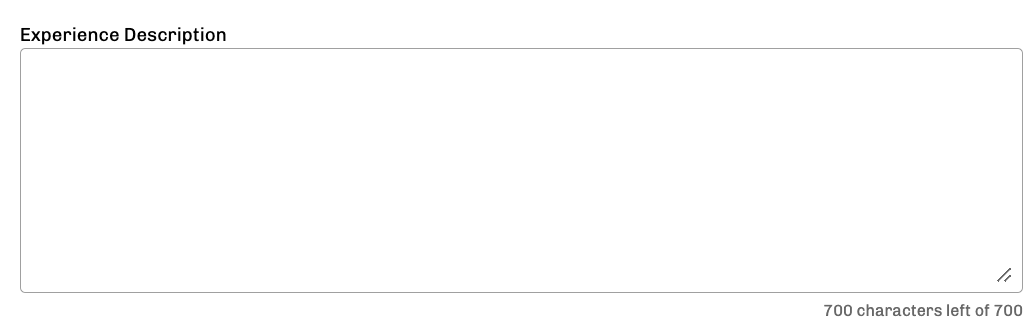
There is space for up to 15 work and activity entries, but it’s ok if you don’t have 15. Each activity description has a 700-character limit.
You also have the opportunity to highlight the three “most meaningful” experiences to you. Designating an activity as “most meaningful” gives you an additional 1,325 characters to explain why it was so meaningful.
Pro Tip: If you plan to copy and paste your activity descriptions, draft your descriptions in a text-only word processor like Mac TextEdit or Microsoft Notepad. If you copy in formatted text (such as from Microsoft Word or Google Docs), it may cause formatting errors. Always proofread.
For each entry, you can only choose one category. Here are the 19 Experience Type categories for the AMCAS Work/Activities section:
- Artistic Endeavors
- Community Service/Volunteer – Medical/Clinical
- Community Service/Volunteer – Not Medical/Clinical
- Conferences Attended
- Extracurricular Activities
- Hobbies
- Honors/Awards/Recognitions
- Intercollegiate Athletics
- Leadership – Not Listed Elsewhere
- Military Service
- Other
- Paid Employment – Medical/Clinical
- Paid Employment – Not Medical/Clinical
- Physician Shadowing/Clinical Observation
- Presentations/Posters
- Publications
- Research/Lab
- Social Justice/Advocacy
- Teaching/Tutoring/Teaching Assistant
For each activity or work experience, you’ll enter the following information:
- Experience Type (i.e., Community Service/Volunteer)
- Experience Name (i.e., Nursing Home Volunteer)
- Start Date
- End Date
- Completed Hours
- Anticipated Hours
- Whether it was repeated
- Organization name, location, and contact information
- Experience description
- Whether it was one of your most meaningful experiences (Yes/No)
The Experience Description box is crucial. Admissions committees are not simply looking for what you did. They want to know the depth of your responsibilities, what you accomplished, and how it developed you as a holistic individual and as a future physician.
Pro Tip: One of the keys to the Work & Activities section is to show that you’re well-rounded. Admissions committees want to hear about your hobbies and interests outside of your science background, as well. Don’t be afraid to list the non-science hobbies that you’re passionate about.
“The ‘Social Justice/Advocacy’ category allows you to show admissions committees how you’ve worked to improve the rights, privileges, and opportunities of a cause, group, or person.
“One of the main functions of physicians is to educate. If you can demonstrate you're well-rounded, it shows you’ll be able to find common ground with your patients beyond healthcare, such as sports, literature, or music.”Dr. Harvey Katzen, MedSchoolCoach Associate Director of Advising
Section 6: Letters of Evaluation
For schools using the AMCAS Letter Service program, your letters of recommendation (LORs) are another item submitted directly to AMCAS and the medical schools you are applying to.
Since AMCAS doesn’t require a student’s LORs to verify their application, students may submit their application even if their letters haven’t arrived at AMCAS yet. The medical schools will receive the application and letters after the application has been fully verified.
Pro Tip: Also called letters of evaluation, your LORs are a great way to set your application apart. Generic LORs won’t add value to your application. Get letters from professors, supervisors, and mentors that you had genuine relationships with — people who can speak to your character and accomplishments. Start asking letter writers for LORs 3-4 months beforehand. Check out this article on etiquette for approaching letter writers.
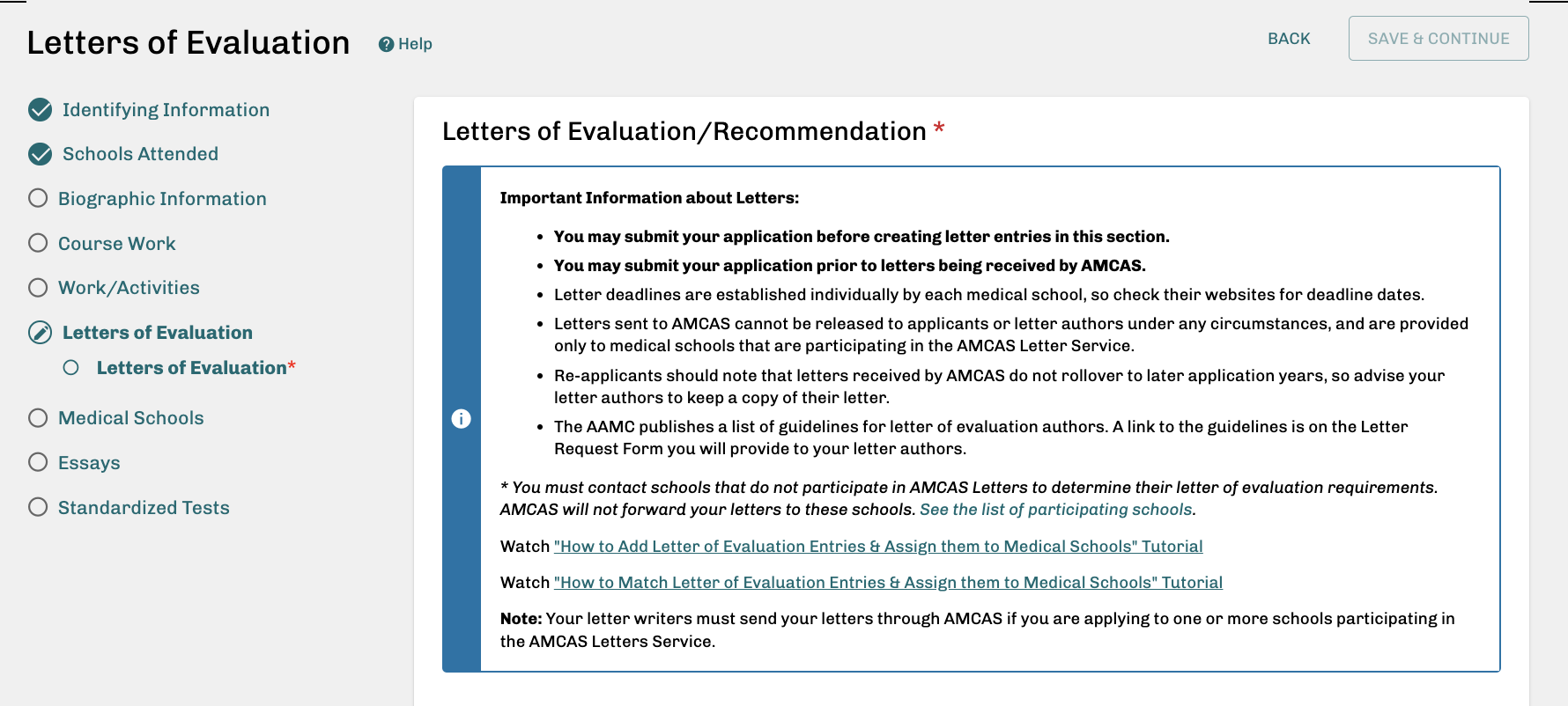
For each entry, you must choose one of three types. Each letter type is considered one letter entry, regardless of the actual number of letters it contains.
Here are the definitions of the three letter types:
- Committee Letter: A letter authored by a prehealth committee or prehealth advisor intended to represent your institution’s evaluation of you. A Committee Letter may or may not include additional letters written in support of your application. The Committee Letter is sometimes called a Composite Letter.
- Letter Packet: A set of letters assembled and distributed by your institution, often by the institution’s career center. A Letter Packet may include a cover sheet from your prehealth committee or advisor; however, in contrast to a Committee Letter, a Letter Packet does not include an evaluative letter from your prehealth committee or advisor.
- Individual Letter: A letter written by, and representing, a single letter author. If you have already included an Individual Letter within either a Committee Letter or Letter Packet, you do not need to add a separate entry for that letter.
Each medical school has a different requirement for letters of recommendation. For example, schools may require a committee letter or letter packet — or two letters from science professors, one non-science professor, and one to two others, including physicians. Check each medical school’s website for their specific requirements.
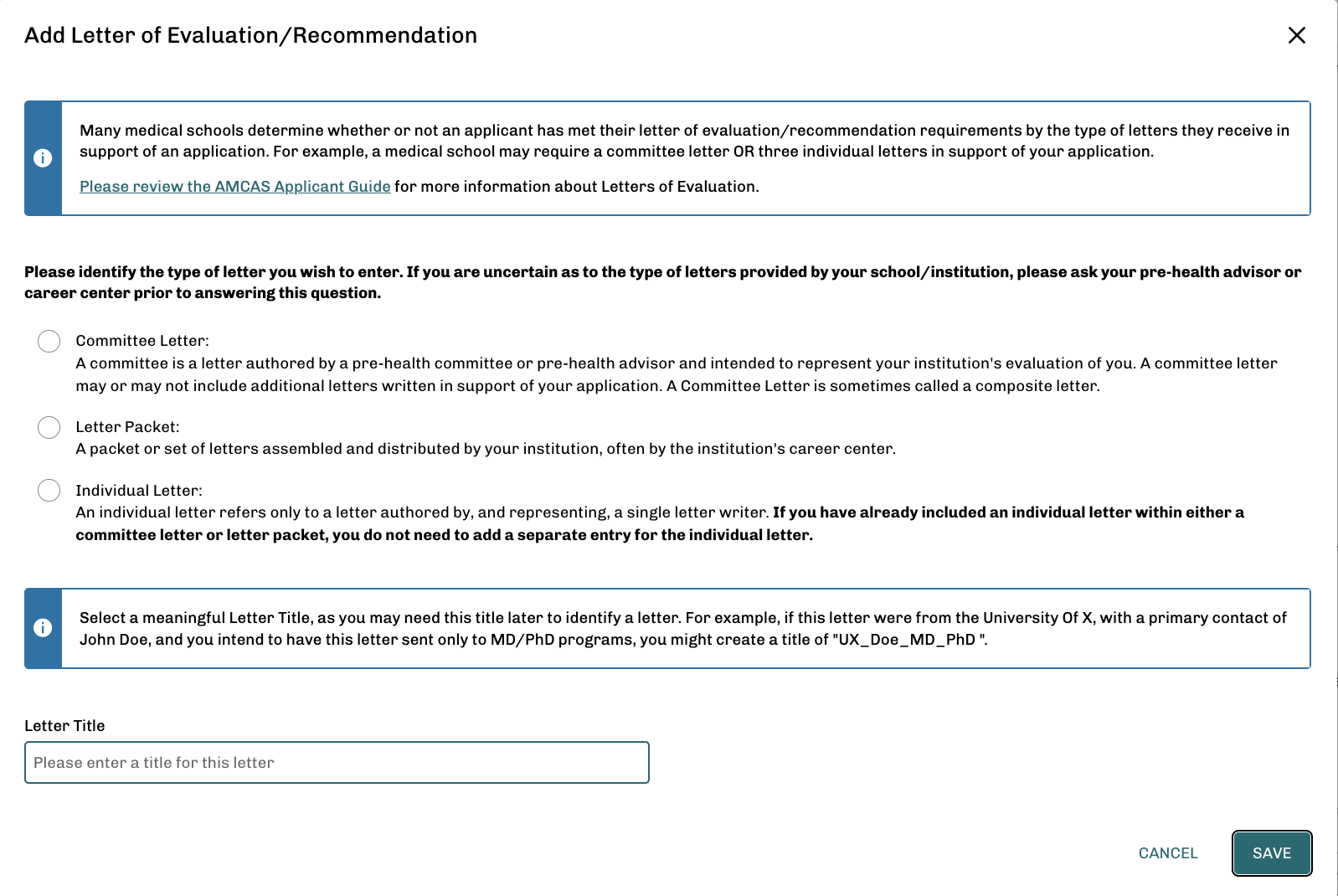
Before completing this section, you will need confirmation from your letter writers. You will add an entry for each letter you’re expecting with the author’s contact information and letter title. AMCAS will then assign an ID number for each letter that the letter writer must include.
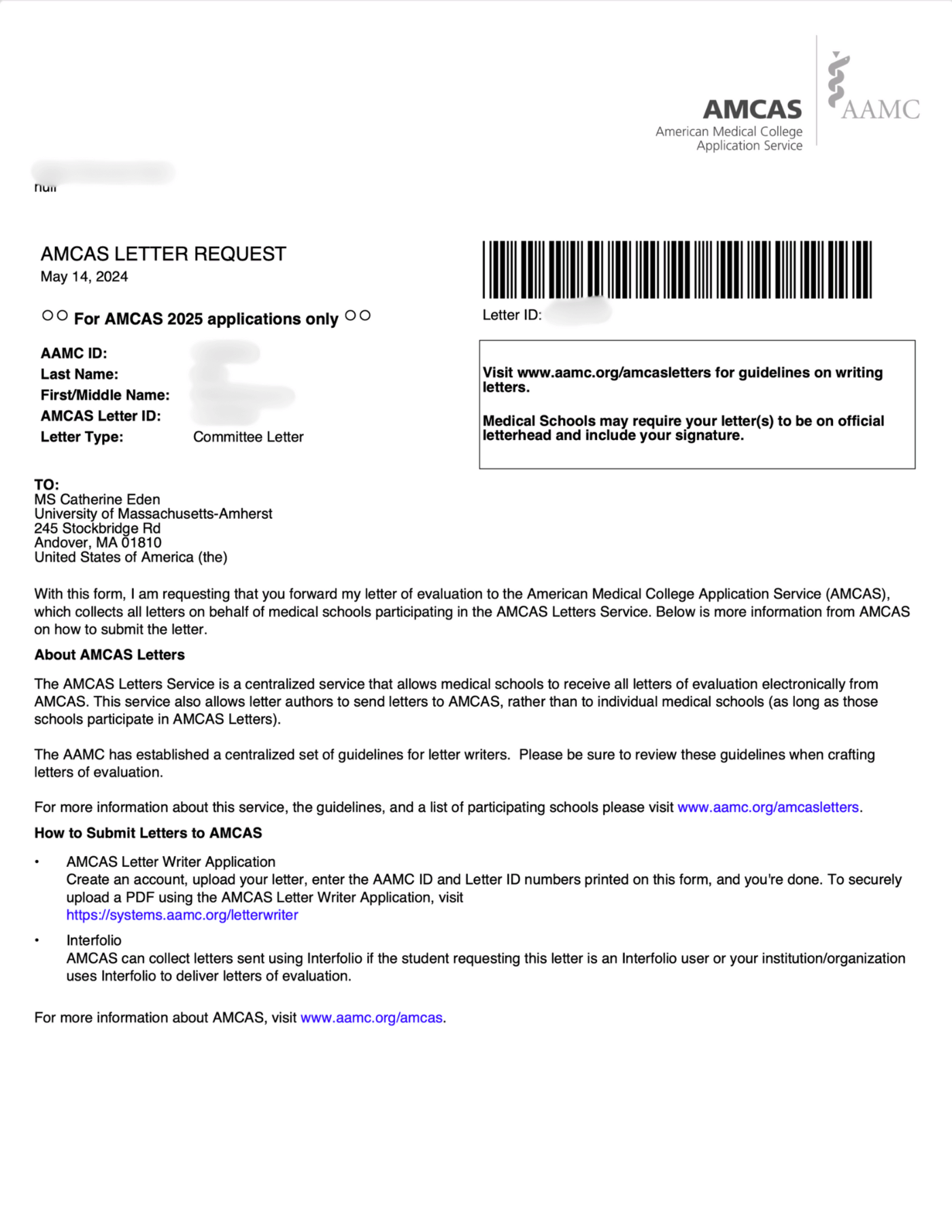
After you add each entry, you will be prompted to create a PDF AMCAS Letter Request Form that you will provide to the author.
2026 Update: There is a new email feature in this section for contacting letter writers.
Dossier services like Interfolio can be a great way to store and release confidential letters like these. Just be sure to submit only evaluations for the current application cycle.
“Great letters are an absolute must. I was really surprised to find out how seriously committee members take these letters. The fact is, there are so many worthy applicants with great credentials, academics, and activities. They're looking for distinguishing factors, and the quality of your letter is important for a really competitive application.”
Dr. Ed Lipsit, MedSchoolCoach Associate Director of Advising
Section 7: Medical Schools
In the Medical Schools section, you’ll select all the medical schools you’re applying to.
We recommend you apply to 25-40 schools, including both in-state and out-of-state schools that you feel are a good match. You can apply to as many schools as you want — but be aware that each additional school costs an additional fee to apply to.
You don’t need a full school list at this point; you only need to apply to one school to “submit” your application, which gets most of the heavy lifting out of the way. You can come back and add more schools later, after you start the verification process.
For each school you add, select a program and declare whether you’ve previously applied to that school. You will be able to see whether or not the school participates in the AMCAS Letter Service and the AMCAS-facilitated Criminal Background Check.
If you have entered letters of recommendation, you will also have the opportunity to assign a letter to each school at this point.
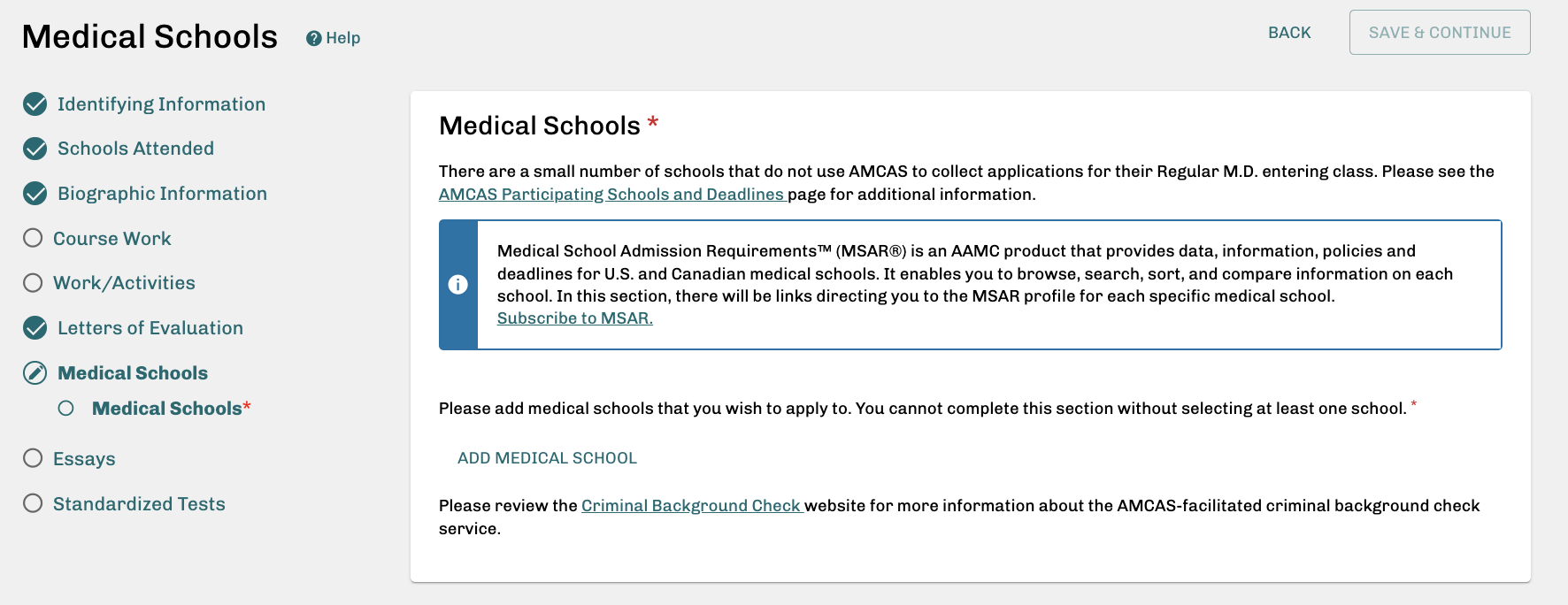
As you add schools, you will have a helpful dashboard where you can see each med school, the program you’re applying to, and the transcript and application deadlines. You’ll also see your application fees start to add up.
The fee is $175 to send your application to the first school and $47 for each additional school.

While it’s wise to apply to multiple schools, a lot of thought should go into cultivating your school list. In-state tuition is almost always going to be cheaper than out-of-state. Still, you also need to consider factors like the mission of the school (e.g., is it focused on primary care or research?), proximity to family, and preference for culture and climate.
Schools should also be academically aligned and best suited to your professional experience.
"Definitely cast a wide net. However, also try to be smart about the list you create. There are a lot of factors that go into creating a solid school list – how competitive an applicant you are, what aspects of medicine you’re interested in, and the financial impact of applying to many schools. I would encourage you to work one-on-one with an advisor to create a smart, practical school list that maximizes your chance of success.”
Dr. Ed Lipsit, MedSchoolCoach Associate Director of Advising
Section 8: Essays
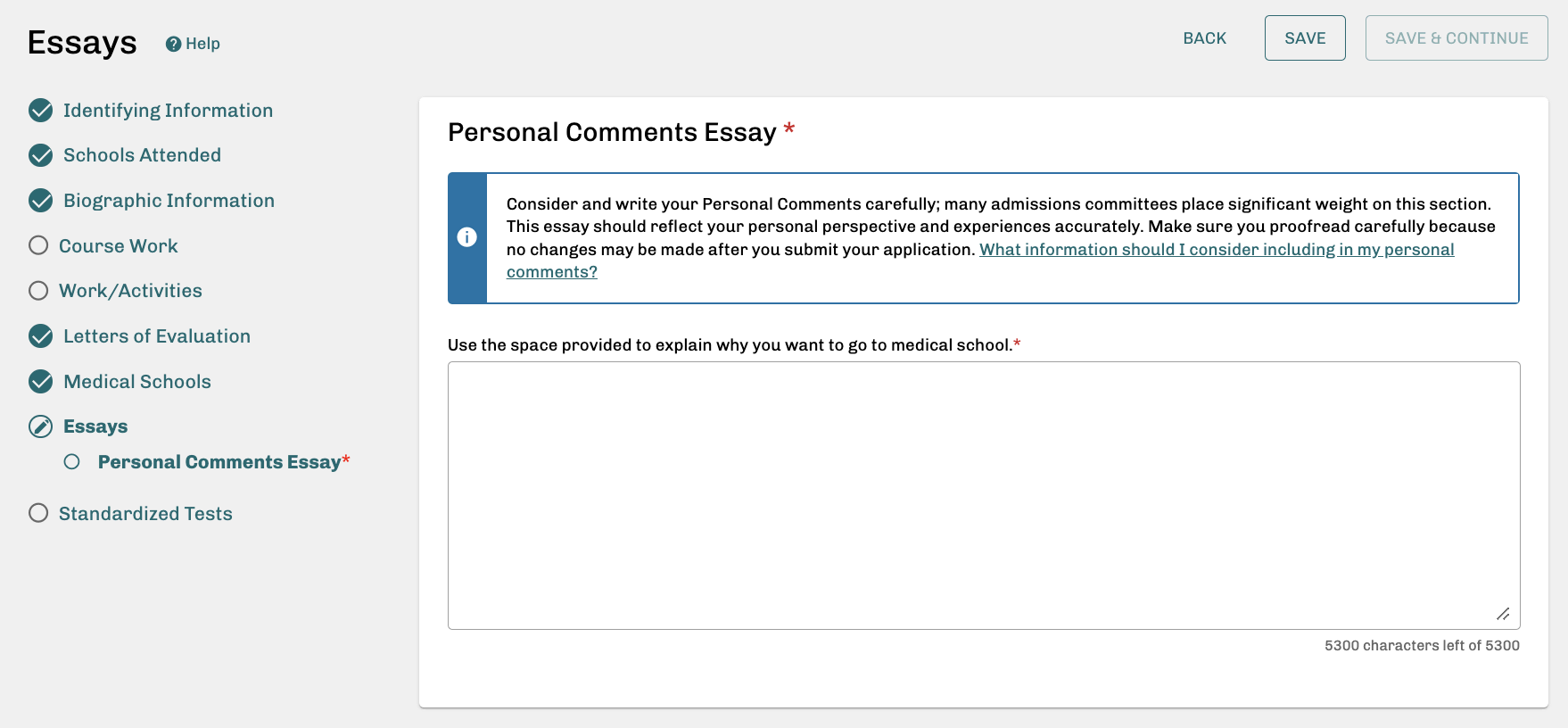
Also called a Personal Comments Essay, your personal statement (within the Essays section) is arguably the most important part of the application.
A strong medical school personal statement speaks volumes about your potential to succeed in medical school. It can demonstrate to admissions committees your potential as a future physician and how you’ll contribute to their school. A great personal essay distinguishes you from other applicants with similar GPAs and MCAT scores.
However, an unimpressive personal statement can lower your chances of getting an interview and hurt your chances of being accepted. A poorly-written personal statement with typos that lacks content is pretty much a deal breaker when admissions committees have hundreds of applications to review.
The challenge with this section is how deceptively simple it looks on the AMCAS application: “Use the space provided to explain why you want to go to medical school.” And you have 5,300 characters — or around 500 words — to do it. This may feel overwhelming, but we’ve got some expert tips below to relieve that worry.
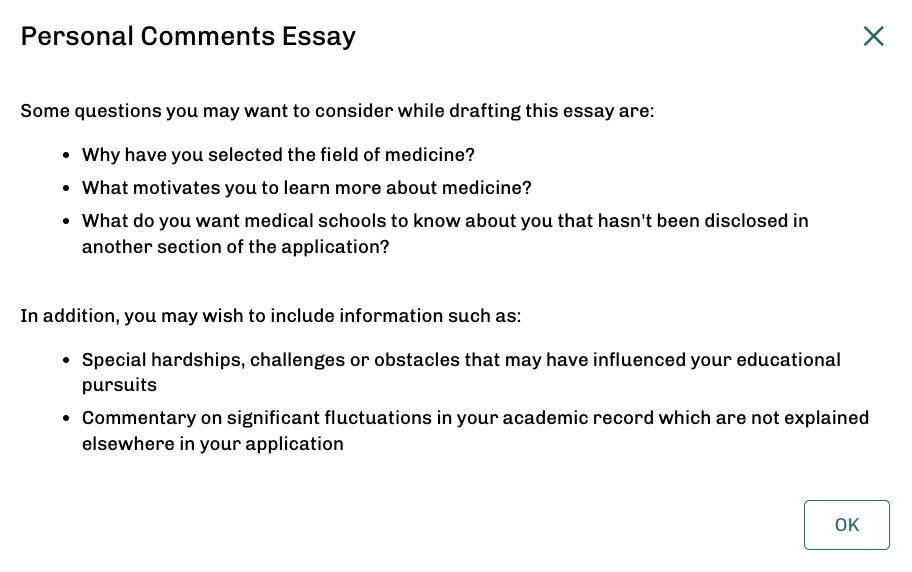
Here’s some advice on writing a standout personal statement:
- Start writing the first draft 3-6 months early.
- Be authentic.
- Demonstrate your passion for medicine.
- Stick to a central theme.
- Include personal stories — show, don’t tell.
- Share your vision for the future.
- Give it some personality.
- Carefully navigate emotional topics.
- Check out outstanding personal statement examples for inspiration.
- Get opinions from professors, work colleagues, or other medical students.
- Begin drafting your personal essay as early as December if you plan to apply by June.
- Don’t rely on ChatGPT to write for you.
AAMC’s stance on generative AI usage in essay drafting: “This essay should reflect your personal perspectives and experiences accurately and must be your own work and not the work of another author or the product of artificial intelligence.”
Below are things you should not include in your personal statement:
- Your MCAT & GPA — they are included in another section of your application
- Typos, grammar, punctuation, or spelling mistakes
- Name-dropping
- Made-up stories
- A duplicate of your CV
- Old awards
- Clichés
- Third-person writing
- Irrelevant stories
- Explanations for one bad grade
It may help you write your personal statement if you break it into smaller, manageable chunks. In general, think about your essay containing 4-5 components:
- Introduction (1 paragraph): Introduce your narrative/theme by tying it to a personal story or anecdote.
- Body (2-3 paragraphs): Highlight pivotal experiences and how they drove you to pursue medicine.
- Conclusion (1 paragraph): Tie everything together and share how you envision yourself impacting the field of medicine in the future.
Some personal essay ideas to think about:
- Significant/formative life experiences: Include events that have greatly influenced your life, how you conduct yourself, your outlook on the world, or your impactful decisions.
- Significant people: People who impacted you (positively or negatively) and how that affected your journey to medical school.
- Characteristics and skills: Use stories to demonstrate the positive traits you have that will help you succeed as a physician.
Craft your personal statement with 1-on-1 help from a Physician Advisor and a professional writer. No limits on messaging, hours, or edits.
Section 9: Standardized Tests
Standardized Tests is the final section. Congratulations on making it this far!
If you have already taken the MCAT, your scores are automatically released to AMCAS and will be visible here. All non-voided MCAT scores are released; you can’t choose which ones they see.
If you haven’t taken the MCAT yet, or if you plan to retake it and have a test date scheduled, you can indicate that here and your latest test score will be updated when released.

After MCAT details, you’ll see previous or upcoming AAMC PREview exam dates, as well as your scores if you’ve already taken this situational judgment test.
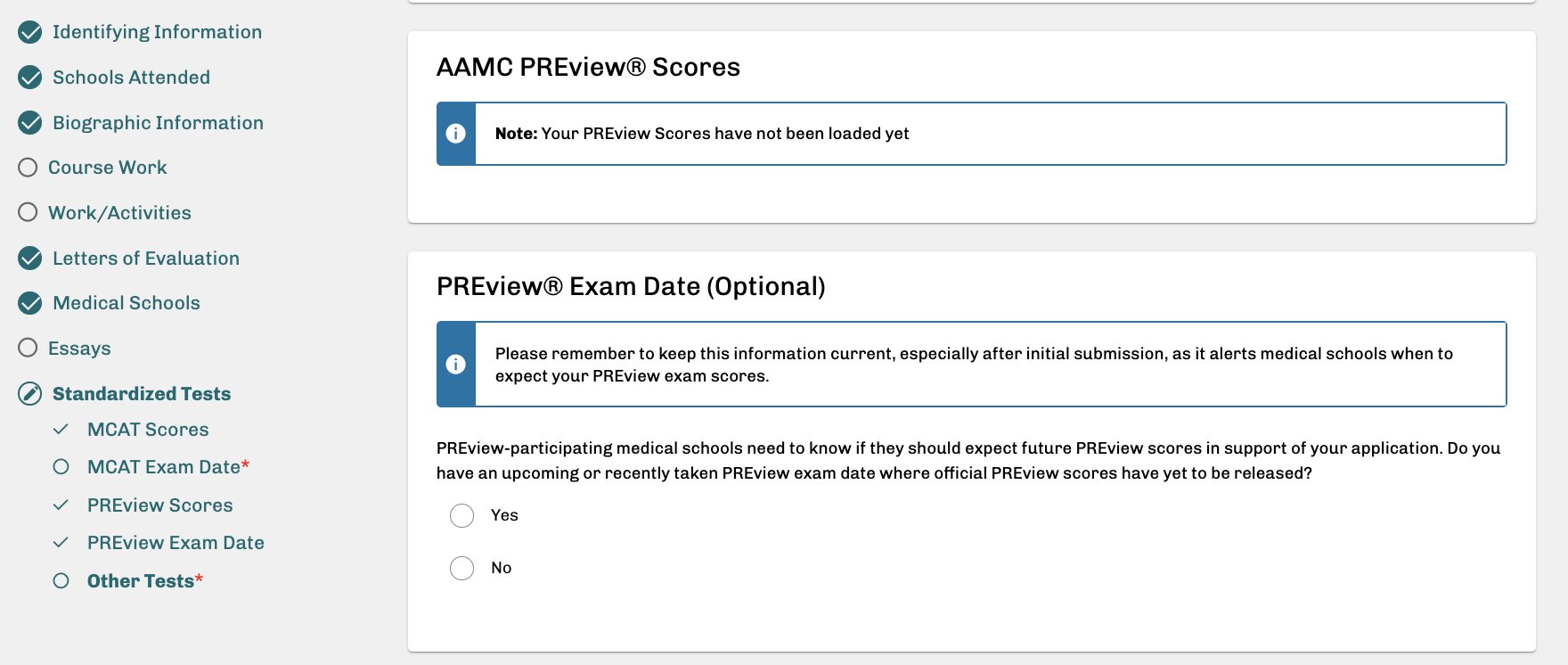
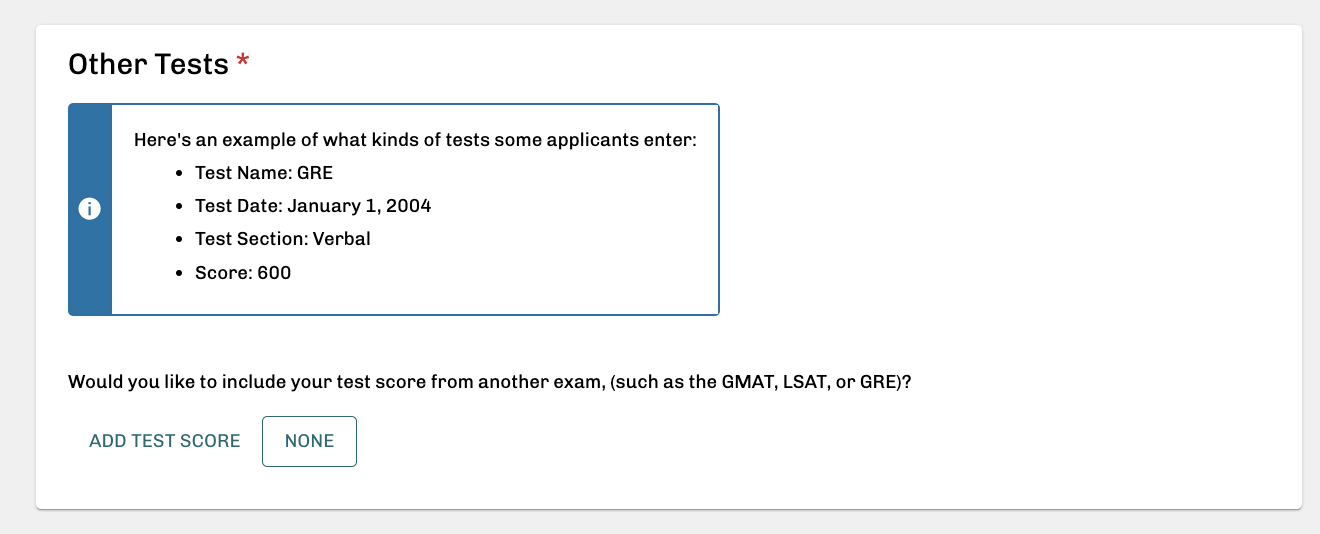
Below the AAMC PREview details, you can add details from other situational judgment tests (like Casper). This is also where you have the opportunity to enter any additional standardized test scores, such as GRE, LSAT, or GMAT.
Final Submission, Payment & Verification
From your main application menu, you have the opportunity to go back into every section and make changes. Check and double-check everything before you submit your application materials.
If you have completed the AMCAS sections in order, and each section on the left has a check mark circle next to it, then as soon as you save your standardized test sections, you will be asked if you want to submit your application.
WE HIGHLY RECOMMEND YOU SAY NO. It’s always a good idea to go back and carefully review each section to ensure accuracy, completeness, and error-free content.
When you’re ready, click “Submit Application.”
Then the AMCAS will walk you through pre-submission checks and certification. AAMC does a great job of outlining what you still need to do during the pre-submission checks, such as assigning letters of recommendation to medical schools. Remember, letters can be added and assigned at a later date as you get confirmations from letter writers.
You must complete the following to officially submit your application:
- Certification
- Password
- Criminal Background Check
- Payment
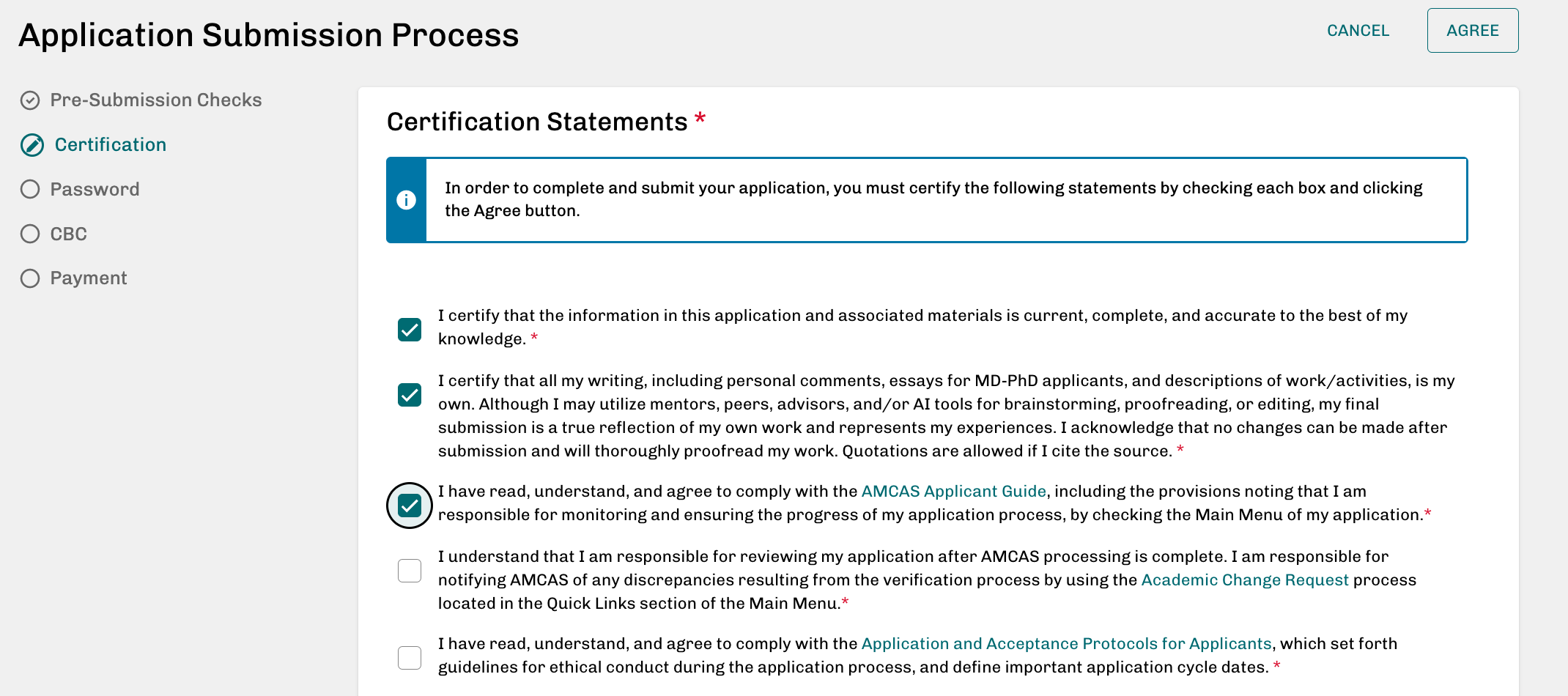
Certification: This acts as your legal signature to certify that everything on your application is accurate. There are 13 statements to read, check, and agree to on this page.
Password: Under this section, you’ll have the opportunity to print your application. Even if you don’t physically print it, the file will open as a PDF, and you can read through it.
The PDF format is exactly what medical school admissions officers will receive. We highly recommend you save or print this PDF form. If you find any errors, you can still go back and edit your application before continuing the submission process.
When you’re satisfied with your application, enter your AMCAS password to certify that you understand that you may not change, correct, or update selected parts of the application as outlined in the AMCAS Applicant Guide once it has been submitted to AMCAS.

CBC (Criminal Background Check): This page informs you that AMCAS partners with Certiphi Screening, Inc. to perform criminal background checks. Upon your initial, conditional acceptance by a participating medical school, Certiphi Screening, Inc. will send an email with additional information to your preferred email address to start your background check.

Payment: The final section is where you’ll pay your application fees. The 2026 application fees are $175 for the first school you apply to, plus $47 for each additional school.
For students who need financial aid for fees, the AAMC Fee Assistance Program can help. If your family’s income is under 400% of the 2025 national poverty line, you’re likely eligible for waived or reduced application fees, as well as reduced MCAT and PREview registration fees.
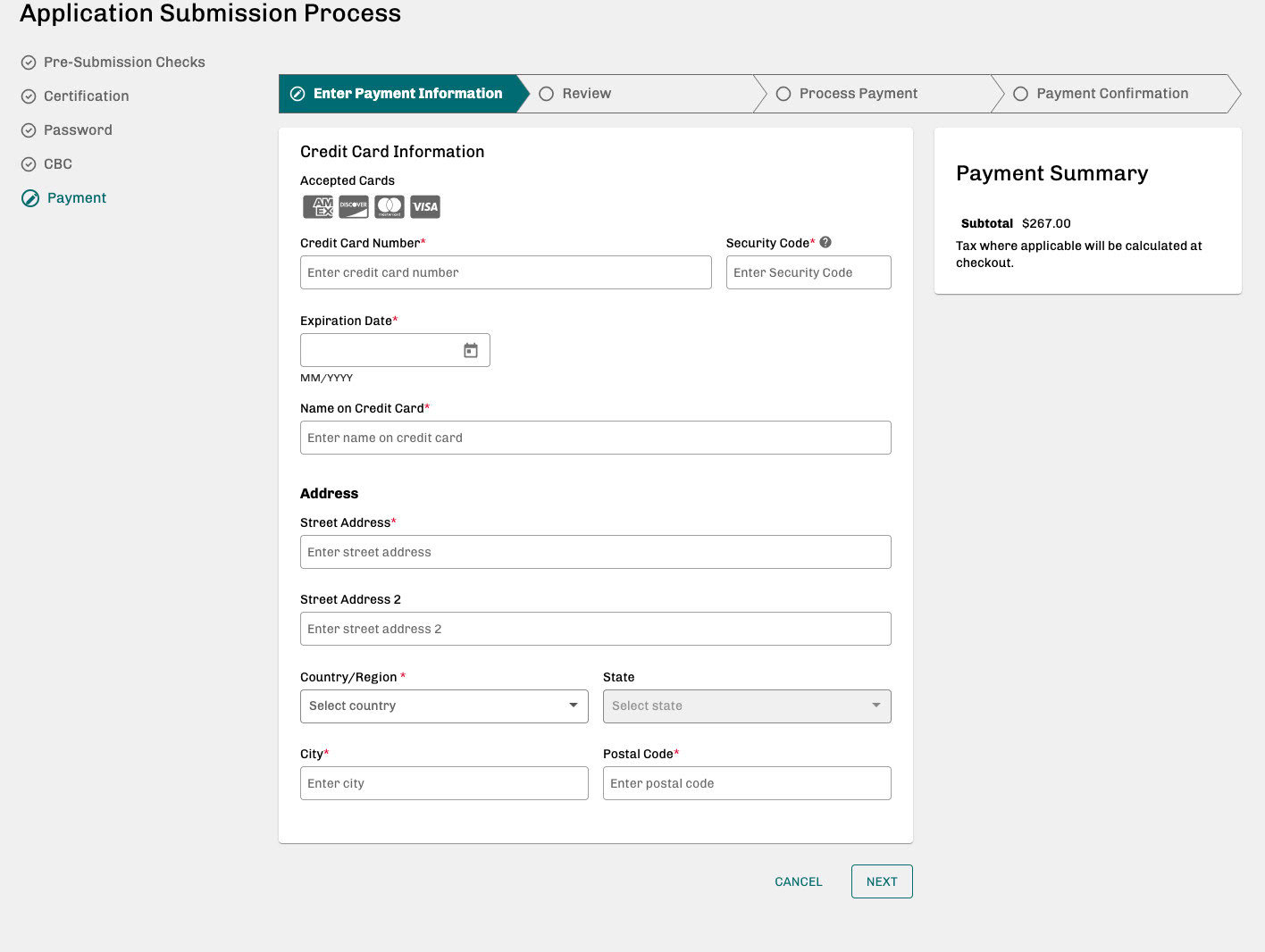
Once your payment is confirmed, your application is officially submitted.
To submit an Academic Change Request, select one of the following reasons and include an explanation:
- Recompute the following GPA/hours
- Re-verify the following courses
- Add the following courses
- Delete courses that were added by the AMCAS Verifications team (based on errors or omissions compared to the applicant’s official college transcripts)
- Update the following school information
Verification Process
The verification process can range from a few days to a few weeks. This process can be delayed if there are errors on your application, such as misclassified coursework.
In order for your application to be placed in the queue for verification, the following are required:
- Biographic Information
- Work/Activities section
- Personal Statement section
- Official transcripts and grades received by AMCAS
These items are not required for verification, and their absence will not delay the verification of your application:
- MCAT score
- Letters of recommendation
- Medical schools (except the first one required to submit)
Once you submit your application, you should closely monitor its verification status. In the top right corner of your main menu, you will see a blue status. You can also click “View Application Status History” at any time to see a record of updates.
It’s important to understand the meaning of each status so that you can track your application and know if you need to take some action:
- Not Submitted to AMCAS: AMCAS has not received your application.
- Submitted to AMCAS: Waiting for Transcripts: AMCAS has received your application. Required transcripts have not been received for review.
- Submitted to AMCAS: Ready for Review: AMCAS has received a copy of all required transcripts and has placed the application in line to be reviewed by an AMCAS verifier.
- Submitted to AMCAS: Under Review: A verifier is reviewing your application. You will be notified if there are any additional transcripts needed for processing.
- Submitted to AMCAS: Financial Hold: You have certified and submitted your AMCAS application. However, AMCAS cannot process your application until you resolve the financial hold associated with your application.
- Submitted to AMCAS: Incorrect Coursework: You have certified and submitted your AMCAS application. However, your application is on hold due to incorrect coursework in your application.
- Submitted to AMCAS: Incorrect Documents: You have certified and submitted your AMCAS application. However, your application is on hold due to incorrect documents associated with your application.
- Returned to Applicant: The application has been returned to you for missing coursework or failing to enter an original grade for a repeated course.
- AMCAS Processing is Complete: The application has been made available to your designated medical schools.
- Withdrawn from AMCAS: You have withdrawn your AMCAS application. This step is final, so you are no longer eligible to apply for the current application year.
What Can I Change After Submitting My AMCAS Application?
You can add or edit the following types of information after submitting your AMCAS:
- Letters of recommendation
- Your next MCAT and PREview exam date
- ID numbers
- Name, alternate names, and contact information
- Your date of birth
- Your gender
- The release of application details to your pre-health advisor
- Additional medical schools
If there are changes to your coursework during the verification process, you can submit an Academic Change Request to alter the Coursework section of your AMCAS.
FAQs
The AACOMAS (American Association of Colleges of Osteopathic Medicine Application Service) is the application for osteopathic medical schools outside of Texas. You’ll fill this out if you’re pursuing DO schools as part of your medical school application process.
The AMCAS (American Medical College Application Service) is the application for allopathic medical schools outside of Texas. All prospective students interested in MD schools will use this application.
The TMDSAS (Texas Medical and Dental Schools Application Service) is used for 14 medical programs in Texas. The Texas legislature has a strict 10% cap on non-resident medical students, which means 90% or more of the matriculants to Texas medical programs are in-state residents.
Avoid these common mistakes on the AMCAS application:
- Spelling and grammatical errors
- Incorrectly labeled coursework
- Miscategorized for work/activities
- Underwhelming personal statement
- Meaningless filler content
- Lies or unethical claims
- Late submission
The good news is that most of the information on your AMCAS application will remain the same when you reapply. Re-applicants' data will actually rollover for the Military Discharge, Misdemeanors, Felonies, and Institutional Actions sections.
Here are the sections reapplicants should consider updating:
- Work/Activities: If you have relevant experiences during the year that you originally applied, or if you took a gap year or earned a post-baccalaureate certificate, update this section of your application.
- Letters of Evaluation: While you can reuse letters of recommendation, you must resubmit them as AMCAS does not retain letters from previous application cycles. However, you may want to request new letters if you worked with a new mentor in the past year.
- School List: You can absolutely reapply to the same medical schools again. But reevaluate your school list with a critical eye, and be honest with yourself about how competitive you are. If students miscalculate which schools are a good fit for them, they risk no acceptance offers. Try our Medical School Chance Predictor to see which programs are right for you!
- Personal Statement: Schools expect reapplicants to write a new essay. While you can certainly still use the same theme, personal attributes, and reasons for wanting to become a physician, the stories and anecdotes should change. Consider using this section to demonstrate how you have grown since your last application.
If you struggled with your AMCAS application the first time, expert admissions advisors can help you prepare for your reapplication, increasing your chances of acceptance. Consider a Special Master’s Program with linkage to a med school.
Advisors with prior admissions committee experience can provide honest feedback on your qualifications and help you update your application to improve your chances of getting into the medical school of your choice.
Applicants who matriculate to allopathic medical school via AMCAS have an average GPA of 3.77 and an average MCAT score of 512. If your metrics are below 512, don’t worry — there’s definitely still hope. A high GPA can offset a low MCAT score, and vice versa.
According to AAMC data, a 506 on the MCAT still means a 50+% chance of acceptance, provided your GPA is high enough. Likewise, those with a 3.20 GPA can raise their odds above 50% by scoring well on the MCAT.
Check out the AAMC’s acceptance rate table to find your odds of enrollment at your current GPA and MCAT score.
Secondary applications (also called supplemental applications) are school-specific forms sent to applicants after the primary application is submitted.
Med schools’ secondary applications gather additional information about students to evaluate whether they’re a good fit for that institution.
Craft a Standout AMCAS Application With MedSchoolCoach
Looking to craft a stand-out application and ultimately achieve your dream of becoming a physician? MedSchoolCoach can help. Our admissions experts work with hundreds of students each year, providing step-by-step guidance throughout the admissions process.
Build your application alongside a doctor with admissions experience, and join the 95% of clients who get into medical school.

Sahil Mehta MD
Dr. Mehta is the founder of MedSchoolCoach and has guided thousands of successful medical school applicants. He is also a practicing physician in Boston where he specializes in vascular and interventional radiology.
See How We Can Help
Search for:
RECENT POSTS
Applying to Med School as a Non-Traditional Applicant
medschoolcoach
Sample Research Interest Letter for Pre-Meds
medschoolcoach
A Detailed Guide to Residency Program Signaling
medschoolcoach
Medical Schools in Kansas
medschoolcoach
Average Residency Applications Per Specialty (2025/26)